Wage and payroll statistics for December 2024

Overall Wage and Payroll Statistics
 
     According to the figures released today (March 28) by the Census and Statistics Department (C&SD), the average wage rate for all the selected industry sections surveyed, as measured by the wage index, increased by 3.5% in nominal terms in December 2024 over a year earlier.
 
     About 63% of the companies reported increase in average wage rates in December 2024 compared with a year ago. A total of 33% of the companies recorded decrease in average wage rates over the same period. The remaining 4% reported virtually no change in average wage rates.
 
     After discounting the changes in consumer prices as measured by the Consumer Price Index (A), the overall average wage rate for all the selected industry sections surveyed increased by 1.8% in real terms in December 2024 over a year earlier. 
 
     As for payroll, the index of payroll per person engaged for all the industry sections surveyed increased by 3.4% in nominal terms in the fourth quarter of 2024 over a year earlier. 
 
     After discounting the changes in consumer prices as measured by the Composite Consumer Price Index, the average payroll per person engaged increased by 2.0% in real terms in the fourth quarter of 2024 compared with a year earlier.
 
     The wage rate includes basic wages and other regular and guaranteed allowances and bonuses. Payroll includes elements covered by wage rate as well as other irregular payments to workers such as discretionary bonuses and overtime allowances.  The payroll statistics therefore tend to show relatively larger quarter-to-quarter changes, affected by the number of hours actually worked and the timing of payment of bonuses and back-pay.
 
Sectoral Changes
 
     For the nominal wage indices, year-on-year increases were recorded in all selected industry sections in December 2024, ranging from 3.0% to 4.1%.
 
     For the real wage indices, year-on-year increases were also recorded in all selected industry sections in December 2024, ranging from 1.3% to 2.3%.
 
     The year-on-year changes in the nominal and real wage indices for the selected industry sections from December 2023 to December 2024 are shown in Table 1.
 
     As for the nominal indices of payroll per person engaged, year-on-year increases were recorded in all selected industry sections in the fourth quarter of 2024, ranging from 1.7% to 4.3%.

     For the real payroll indices, year-on-year increases were also recorded in all selected industry sections in the fourth quarter of 2024, ranging from 0.3% to 2.8%.
 
     The year-on-year changes in the nominal and real indices of payroll per person engaged for selected industry sections from the fourth quarter of 2023 to the fourth quarter of 2024 are shown in Table 2. The quarterly changes in the seasonally adjusted nominal and real indices of payroll per person engaged in the same period are shown in Table 3.
 
Commentary
 
     A Government spokesman said that wages and labour earnings saw increases in all surveyed industries in the fourth quarter of 2024 over a year earlier, alongside the tight labour market.
 
     The average wage rate for all selected industries rose by 3.5% in nominal terms in December 2024, at a similar pace of increase in September 2024. After discounting for inflation, the average wage rate increased by an accelerated 1.8% in real terms.
 
     Payroll per person engaged, which includes basic wage, discretionary bonuses and other irregular payments, recorded a steady increase of 3.4% in nominal terms and faster growth of 2.0% in real terms in the fourth quarter of 2024. All selected industries saw increases in payroll per person engaged in both nominal and real terms.
 
     Looking ahead, continued economic expansion should render support to the labour market, as well as wages and labour earnings in the near term, though some industries may be affected by the United States’ trade protection measures and other external uncertainties.
 
Other Information
 
     Both wage indices and payroll indices are compiled quarterly based on the results of the Labour Earnings Survey (LES) conducted by C&SD. Wage index only covers employees up to the supervisory level (i.e. not including managerial and professional employees), whereas payroll index covers employees at all levels and proprietors actively engaged in the work of the establishment.
 
     Apart from the differences in employee coverage, wage statistics are conceptually different from the payroll statistics.  Firstly, wage rate for an employee refers to the sum earned for his normal hours of work. It covers basic wages and other regular and guaranteed allowances and bonuses, but excludes earnings from overtime work and discretionary bonuses, which are however included in payroll per person engaged. Secondly, the payroll index of an industry is an indicator of the simple average payroll received per person engaged in the industry. Its movement is therefore affected by changes in wage rates, number of hours of work and occupational composition in the industry. In contrast, the wage index of an industry is devised to reflect the pure changes in wage rate, with the occupational composition between two successive statistical periods being kept unchanged. In other words, the wage index reflects the change in the price of labour. Because of these conceptual and enumeration differences between payroll and wage statistics, the movements in payroll indices and in wage indices do not necessarily match closely with each other.
 
     It should also be noted that different consumer price indices are used for compiling the real indices of wage and payroll to take into account the differences in their respective occupation coverage. Specifically, the Composite Consumer Price Index, being an indicator of overall consumer prices, is taken as the price deflator for payroll of workers at all levels of the occupational hierarchy.  The Consumer Price Index (A), being an indicator of consumer prices for the relatively low expenditure group, is taken as the price deflator for wages in respect of employees engaged in occupations up to the supervisory level.
 
     Detailed breakdowns of the payroll and wage statistics are published in the "Quarterly Report of Wage and Payroll Statistics, December 2024". Users can browse and download the publication at the website of C&SD (www.censtatd.gov.hk/en/EIndexbySubject.html?pcode=B1050009&scode=210).
 
     For enquiries on wage and payroll statistics, please contact the Wages and Labour Costs Statistics Section (1) of C&SD (Tel:  2887 5550 or email: wage@censtatd.gov.hk).


HKMA Quarterly Bulletin and Half-Yearly Monetary and Financial Stability Report (March 2025 Issue)

The following is issued on behalf of the Hong Kong Monetary Authority:
 
     The Hong Kong Monetary Authority (HKMA) today (March 28) published the March 2025 issue of its Quarterly Bulletin and Half-Yearly Monetary and Financial Stability Report.
      
     The Quarterly Bulletin carries a feature article entitled "The Hong Kong Bond Market in 2024". The Half-Yearly Report provides detailed analyses of the global and local economy, as well as the monetary and financial conditions in Hong Kong. It also examines the recent performance and risks of the local banking sector.
      
     The Quarterly Bulletin and the Half-Yearly Report can be viewed on and downloaded from the HKMA website.


Hong Kong Customs detects suspected gold bullion smuggling case by air worth about $110 million (with photo)

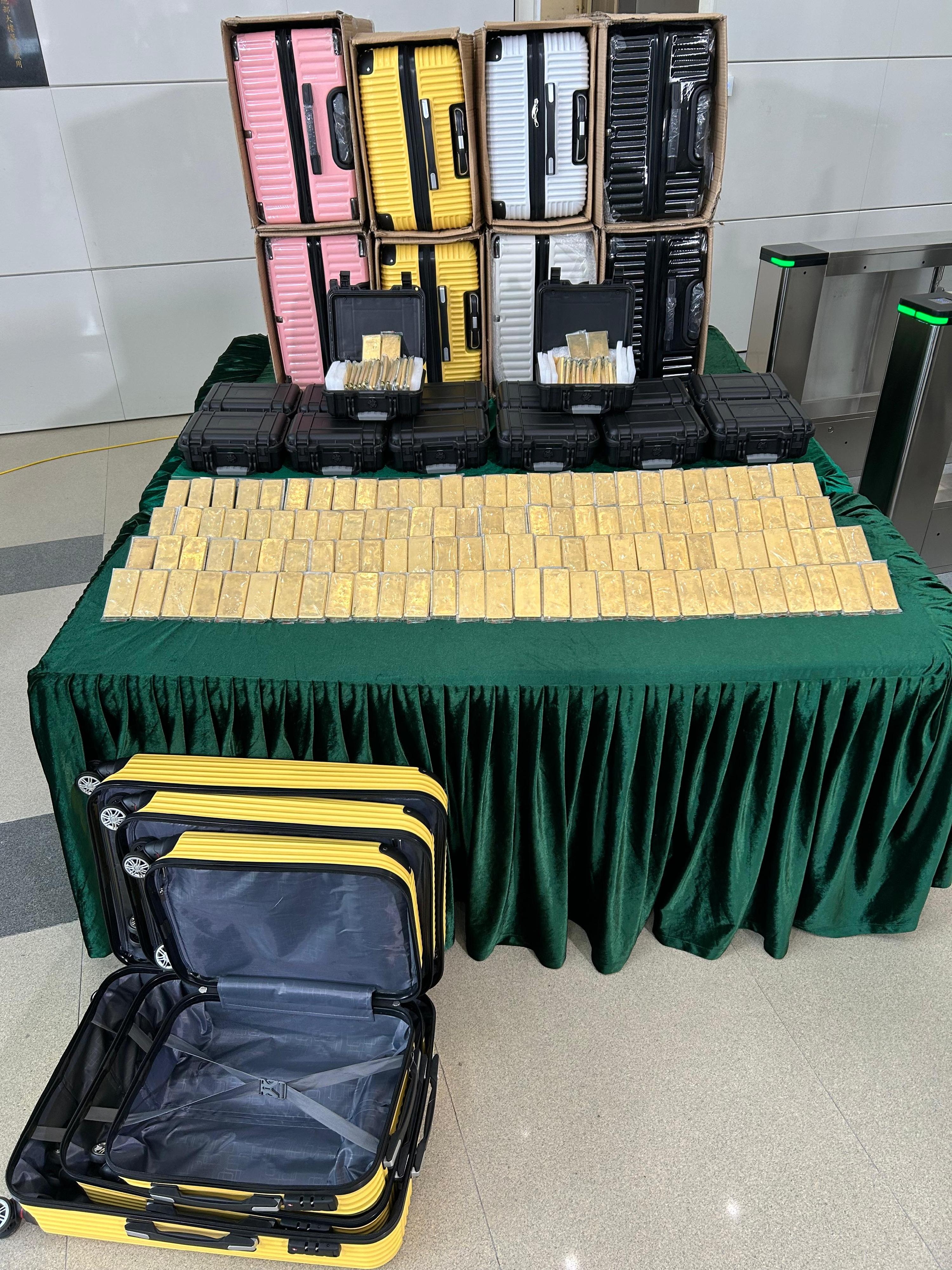
     Hong Kong Customs on March 25 detected a suspected air freight gold bullion smuggling case, and seized about 145 kilograms of suspected gold bullion with an estimated market value of about $110 million, at Hong Kong International Airport (HKIA). This is the largest gold bullion smuggling case detected by Customs on record in terms of the seizure volume and market value.

     Based on risk assessment, Customs on that day examined an outbound air cargo consignment, declared as carrying plastic luggage departing for Japan, at the Customs Cargo Examination Compound at HKIA. Upon inspection, Customs officers found a batch of luggage in 14 carton boxes, and a total of about 145kg of suspected smuggled gold bullion concealed therein.

     An investigation is ongoing. The likelihood of arrests is not ruled out.

     Customs will continue to take stringent enforcement actions against all kinds of smuggling activities through risk assessment and intelligence analysis.

     Smuggling is a serious offence. Under the Import and Export Ordinance, any person found guilty of importing or exporting unmanifested cargo is liable to a maximum fine of $2 million and imprisonment for seven years.
     â€‹
     Members of the public may report any suspected smuggling activities to Customs' 24-hour hotline 182 8080 or its dedicated crime-reporting email account (crimereport@customs.gov.hk) or online form (eform.cefs.gov.hk/form/ced002/).

Photo  


Draft Nam Sang Wai Outline Zoning Plan approved

     The Chief Executive in Council has approved the draft Nam Sang Wai Outline Zoning Plan (OZP). 
      
     "The approved OZP provides a statutory land use planning framework to guide the development and redevelopment within the Nam Sang Wai area", a spokesman for the Town Planning Board said today (March 28). 
      
     The planning scheme area, covering about 600 hectares, is bounded by San Tin Highway and Castle Peak Road – Tam Mi in the east, Mai Po and Fairview Park area in the north, Shan Pui River and Yuen Long New Town in the west and Shan Pui Chung Hau Tsuen and Castle Peak Road – Yuen Long in the south.

     The approved OZP has incorporated amendments shown on the draft Nam Sang Wai OZP No. S/YL-NSW/9, which mainly involve (i) rezoning an area to the north of Ho Chau Road from "Residential (Group D)" ("R(D)") to "Residential (Group A)1", "Residential (Group A)2" and "Other Specified Uses" ("OU") annotated "Pumping Station" to facilitate public housing and private residential developments under a Land Sharing Pilot Scheme application; (ii) rezoning a strip of land to the north of Ho Chau Road from "R(D)" to "Village Type Development" ("V") as an extension of the adjacent "V" zone, with the remaining knoll from "R(D)" to "Green Belt" to reflect the existing condition; and (iii) rezoning a site at Wing Kei Tsuen from "OU" annotated "Comprehensive Development to include Wetland Restoration Area" to "OU" annotated "Comprehensive Development to include Wetland Restoration Area 1" for a private comprehensive residential development.
      
     The Notes and Explanatory Statement of the OZP have been amended to reflect the above amendments. Opportunity is also taken to update the general information of various land use zonings and the planning circumstances, where appropriate. 
      
     The approved Nam Sang Wai OZP No. S/YL-NSW/10 is available for public inspection during office hours at (i) the Secretariat of the Town Planning Board, (ii) the Planning Enquiry Counters, (iii) the Fanling, Sheung Shui and Yuen Long East District Planning Office, (iv) the Yuen Long District Office, (v) the San Tin Rural Committee, and (vi) the Shap Pat Heung Rural Committee.
 
     Copies of the approved OZP are available for sale at the Map Publications Centre in North Point. The electronic version of the OZP can be viewed on the Town Planning Board's website (www.tpb.gov.hk).


Qualified person prohibited by disciplinary board from certifying prescribed inspections and repairs of windows for six months

     The Registered Contractors' Disciplinary Board (the Board) has completed a disciplinary inquiry under the Buildings Ordinance (BO) and decided that a registered minor works contractor (RMWC) appointed as a qualified person (QP) under the Mandatory Window Inspection Scheme (MWIS) should be disciplined for failing to discharge the duties or abide by the requirements imposed on a QP under the BO. 

     The Board ordered the RMWC to be prohibited from certifying any prescribed inspection, or certifying or supervising any prescribed repair of windows, for six months with effect from the date of the Gazette, and to pay a total of $43,400, being the costs of the Board and the Buildings Department (BD) for conducting the inquiry. 

     The Board's written decision and order issued on March 14 was published in the Gazette today (March 28). Details are available at the following link: www.gld.gov.hk/egazette/pdf/20252913/egn202529131789.pdf.

     The RMWC submitted a certificate to the BD in April 2021, certifying that a prescribed inspection had been carried out to the windows of a residential unit in Tuen Mun, and that those windows were safe and no prescribed repair was required. Subsequently, the BD conducted an investigation in response to a report and found that the rivets of some windows showed greyish white power or rust. 

     The RMWC was later prosecuted, convicted and fined $9,000 at the Tuen Mun Magistrates' Courts in May 2022, pursuant to sections 40(2B)(b) of the BO, for having carried out a prescribed inspection in a manner likely to cause a risk of personal injury or property damage. 

     In view of the convictions and investigation results, the BD notified the Board for its consideration of disciplinary action against the RMWC under the provisions of section 13(1) of the BO. 

     A spokesperson for the BD reiterated that in order to ensure building safety, the BD attaches great importance to the quality of the prescribed inspection and repair of windows by a QP under the MWIS. Any QP who contravenes the relevant provisions of the BO in carrying out a prescribed inspection and repair of windows under the MWIS is not only liable to criminal prosecution but also disciplinary action under the BO.