Pesticide residue exceeds legal limit in sample of Chinese parsley

     The Centre for Food Safety (CFS) of the Food and Environmental Hygiene Department today (June 19) announced that a sample of Chinese parsley was found to have pesticide residue at a level exceeding the legal limit. The CFS is following up on the case.

     A CFS spokesman said, "The CFS collected the sample of Chinese parsley at a market stall in Ap Lei Chau Market for testing under its routine Food Surveillance Programme. The test result showed that the sample contained bifenthrin at a level of 0.34 parts per million (ppm), exceeding the maximum residue limit (MRL) of 0.05 ppm.

     "Based on the level of pesticide residue detected in the sample, adverse health effects would not be caused under usual consumption."

     Generally speaking, to reduce pesticide residues in vegetables, members of the public can rinse vegetables thoroughly under clean running water, and scrub produce with hard surfaces with a clean brush to remove dirt and substances including pesticides and contaminants from the surface and the crevices, when appropriate.

     Any person who imports, manufactures or sells any food not in compliance with the requirements of the Pesticide Residues in Food Regulation (Cap 132CM) concerning pesticide residues commits an offence and is liable to a maximum fine of $50,000 and to imprisonment for six months upon conviction.

     Since the regulation came into effect on August 1, 2014, the CFS has taken over 146 100 samples at import, wholesale and retail levels for testing for pesticide residues. Together with the unsatisfactory sample announced today, a total of 223 food samples (including 215 vegetable and fruit samples) have been detected as having excessive pesticide residues. The overall unsatisfactory rate is less than 0.2 per cent.

     The spokesman added that excessive pesticide residues in food may arise from the trade not observing Good Agricultural Practice, e.g. using excessive pesticides and/or not allowing sufficient time for pesticides to decompose before harvesting. The MRLs of pesticide residues in food set in the Regulation are not safety indicators. They are the maximum concentrations of pesticide residues to be permitted in a food commodity under Good Agricultural Practice when applying pesticides. In this connection, consumption of food with pesticide residues higher than the MRLs will not necessarily lead to any adverse health effects.

     The CFS will follow up on the unsatisfactory result, including tracing the source of the food in question and taking samples for testing. Investigation is ongoing.   


Hong Kong Customs combats unfair trade practices by renovation trader

     Hong Kong Customs today (June 19) arrested a male renovation consultant suspected of engaging in unfair trade practices involving misleading omission in the sale of home renovation service, in contravention of the Trade Descriptions Ordinance (TDO).

     Customs earlier received information alleging that a renovation consultant misled and lured a customer to believe that the home renovation service which he procured was provided by a designated renovation company, causing the customer to make a transactional decision to procure the service.
 
     After investigation, Customs officers today arrested a 33-year-old man.
 
     Investigation is ongoing and the arrested man has been released on bail pending further investigation.
 
     Customs reminds traders to comply with the requirements of the TDO and consumers to procure services at reputable shops.
 
     Under the TDO, any trader who engages in a commercial practice that omits or hides material information and as a result causes, or is likely to cause, an average consumer to make a transactional decision commits an offence. The maximum penalty upon conviction is a fine of $500,000 and imprisonment for five years.
 
     Members of the public may report any suspected violations of the TDO to the Customs 24-hour hotline 2545 6182 or its dedicated crime-reporting email account (crimereport@customs.gov.hk).


Postal services to Sri Lanka temporarily suspended

     Hongkong Post announced today (June 19) that, as advised by the postal administration of Sri Lanka, mail operations in Sri Lanka have been affected by trade union action of the postal workers. Mail acceptance is ceased. Hongkong Post has suspended postal services (including Speedpost, parcels and letter post items) to Sri Lanka with immediate effect until further notice.


CHP investigates hand, foot and mouth disease outbreak in primary school in Southern District

     The Centre for Health Protection (CHP) of the Department of Health is today (June 19) investigating an outbreak of hand, foot and mouth disease (HFMD) in a primary school in Southern District, and again urged the public, schools and institutions to maintain strict hand, personal and environmental hygiene.

     The outbreak affected 21 students, 15 boys and six girls aged 7 to 10, who have developed fever, oral ulcers, rash and vesicles over hands or feet since May 22. Among them, 20 sought medical attention and none required hospitalisation. All of them are in stable condition.

     Officers of the CHP have conducted a site visit to the school and advised the management on necessary infection control and preventive measures. The school has been put under medical surveillance. Investigations are ongoing.

     "HFMD is common in children while adult cases may also appear. It is usually caused by enteroviruses (EVs) such as Coxsackie virus and EV71. It is clinically characterised by maculopapular rashes or vesicular lesions occurring on the palms, soles and other parts of the body such as the buttocks and thighs. Vesicular lesions and ulcers may also be found in the oral cavity. Sometimes patients present mainly with painful ulcers at the back of the mouth, namely herpangina, without rash on the hands or feet," a spokesman for the CHP said.
 
     "HFMD occurs throughout the year. A summer peak usually occurs in May to July. As young children are more susceptible, parents should stay alert to their health. Institutional outbreaks may occur where HFMD can easily spread among young children with close contact," the spokesman added.

     To prevent HFMD, members of the public, and especially the management of institutions, should take heed of the following preventive measures:
 

  • Maintain good air circulation;
  • Wash hands before meals and after going to the toilet or handling diapers or other stool-soiled materials;
  • Keep hands clean and wash hands properly, especially when they are dirtied by respiratory secretions, such as after sneezing;
  • Cover the nose and mouth while sneezing or coughing and dispose of nasal and oral discharges properly;
  • Regularly clean and disinfect frequently touched surfaces such as furniture, toys and commonly shared items with 1:99 diluted household bleach (mixing one part of bleach containing 5.25 per cent sodium hypochlorite with 99 parts of water), leave for 15 to 30 minutes, and then rinse with water and keep dry. For metallic surfaces, disinfect with 70 per cent alcohol;
  • Use absorbent disposable towels to wipe away obvious contaminants such as respiratory secretions, vomitus or excreta, and then disinfect the surface and neighbouring areas with 1:49 diluted household bleach (mixing one part of bleach containing 5.25 per cent sodium hypochlorite with 49 parts of water), leave for 15 to 30 minutes and then rinse with water and keep dry. For metallic surfaces, disinfect with 70 per cent alcohol;
  • Children who are ill should be kept out of school until their fever and rash have subsided and all the vesicles have dried and crusted;
  • Avoid going to overcrowded places; and
  • Parents should maintain close communication with schools to let them know the latest situation of the sick children.

     The public may visit the CHP's page on HFMD and EV71 infection and Public Health Advice for Play Facilities for more information.


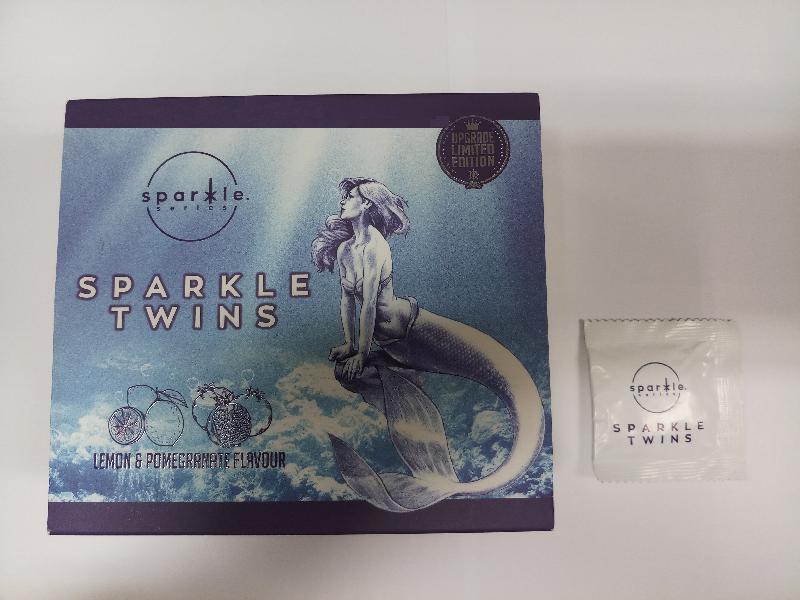
Public urged not to buy or consume slimming product from unknown sources or of doubtful composition (with photo)

     The Department of Health (DH) today (June 19) appealed to the public not to buy or consume a slimming product named SPARKLE TWINS as it was found to contain an undeclared and banned drug ingredient that might be dangerous to health.
 
     The DH commenced investigation upon receipt of a notification from the Hospital Authority (HA) regarding a 29-year-old female patient admitted to hospital for emotional disturbance with a history of consuming the above slimming product.
 
     According to testing results by the HA, which were later confirmed by the Government Laboratory, the sample of the product provided by the patient was found to contain the banned substance sibutramine.
 
     Preliminary investigation revealed that the patient purchased the product through a social media network platform. The DH's investigation is continuing.
 
     Sibutramine was once used as an appetite suppressant. Since November 2010, products containing sibutramine have been banned in Hong Kong because of increased cardiovascular risk.
 
     The DH spokesman strongly urged members of the public not to buy products of unknown or doubtful composition, or to consume products from unknown sources. Members of the public who have purchased the above product should stop consuming it immediately. They should consult healthcare professionals for advice if feeling unwell after consumption.
 
     Weight control should be achieved through a balanced diet and appropriate exercise. The public should consult healthcare professionals before using any medication for weight control.
 
     The public may visit the website of the Drug Office of the DH for health messages on overweight problem and slimming products and information on slimming products with undeclared Western drug ingredients.
 
     People who have purchased the product may submit it to the Drug Office of the DH at Room 1856, Wu Chung House, 213 Queen's Road East, Wan Chai, during office hours for disposal.

Photo