EAC responds to media enquiries on 2018 Legislative Council Kowloon West Geographical Constituency By-election

The following is issued on behalf of the Electoral Affairs Commission (EAC):

     In response to media enquiries on the 2018 Legislative Council Kowloon West Geographical Constituency By-election, a spokesman for the EAC made the following statement today (October 13):

     The EAC, an independent statutory body, supervises the conduct of the Legislative Council elections in accordance with the Electoral Affairs Commission Ordinance (Cap. 541). The EAC does not have any statutory power with regard to the decisions made by the Returning Officer in the nomination procedure.

     For Legislative Council elections, details on the eligibility to be nominated as a candidate, disqualification from being nominated as a candidate and from being elected as a Member, and the requirements to be complied with by persons nominated as candidates are set out in sections 37, 39 and 40 of the Legislative Council Ordinance (Cap. 542) respectively.

     The spokesman reiterates that whether a candidate’s nomination is valid or not is determined by the Returning Officer according to the requirements under the law. All along, the EAC is not empowered nor involved in providing any opinion with regard to the decisions made by the Returning Officer. The EAC will, after receiving the list of validly nominated candidates, make practical arrangements for the elections.

     In accordance with section 19 of the Electoral Affairs Commission (Electoral Procedure) (Legislative Council) Regulation (Cap. 541D), if the Returning Officer decides that a nomination is invalid, the Returning Officer must endorse on the nomination form his/ her decision and the reason(s) for it, which will be made available for public inspection in accordance with section 14 of the Regulation.

     Anyone may make an election petition to question the result of an election if he/she is disqualified from being a candidate at an election in accordance with section 61 of the Legislative Council Ordinance. The EAC will, as in the past, ensure that the Legislative Council by-election is conducted in an open, honest and fair manner.


SED on school in Greater Bay Area

     Following is the transcript of remarks by the Secretary for Education, Mr Kevin Yeung, after attending the launch ceremony of a drone competition in Guangdong-Hong Kong-Macao Greater Bay Area organised by Rotary District 3450 today (October 13):

Reporter: Mr Yeung, can you tell us more about the schools that are going to be set up in Greater Bay Area? Is there any worry that there will be enough demand? Will these schools only be targeting at Hong Kong students?

Secretary for Education: Hong Kong will be participating in the Greater Bay Area development. We are expecting that there are more Hong Kong people going to the Greater Bay Area to work and for future development. So we think there may be a need for the children of these people to study Hong Kong curriculum. We are exploring with the Guangdong Provincial Government and other cities' governments the possibility or feasibility of setting up schools with Hong Kong curriculum. It's still at a very early stage but we've already had good support, at least from the Education Department of Guangdong Province.

(Please also refer to the Chinese portion of the transcript.)


Hong Kong Customs mounts joint operation with Department of Health to combat unfair trade practices and unregistered medicines at medicine shop

     Hong Kong Customs mounted a joint-operation with the Department of Health (DH) yesterday (October 12) to combat unfair trade practices and unregistered medicines at a medicine shop.
      
     Customs officers conducted a test-buy operation at a medicine shop in Causeway Bay during the operation and arrested a 41-year-old salesman suspected to have applied a false trade description on a brand of medicine by stating it was a particular brand of medicine, in contravention of the Trade Descriptions Ordinance (TDO) (Cap 362).
      
     The DH officers then conducted a search at the premises and seized one type of suspected unregistered proprietary Chinese medicines (pCm) and nine types of suspected unregistered pharmaceutical products for further investigation. A 52-year-old owner of the medicine shop was arrested for suspected illegal possession of unregistered pCm and unregistered pharmaceutical products, in contravention of the Chinese Medicine Ordinance (CMO) (Cap 549) and the Pharmacy and Poisons Ordinance (PPO) (Cap 138).
      
     Investigation is ongoing and the arrested persons have been released on bail pending further investigation.
      
     Under the TDO, any person who in the course of any trade or business applies a false trade description to any goods or services commits an offence. The maximum penalty upon conviction is a fine of $500,000 and imprisonment for five years.
      
     According to the CMO, no person shall sell, import or possess any pCm unless the pCm is registered. The maximum penalty involved is a fine of $100,000 and two years' imprisonment for each offence.
      
     According to the PPO, all pharmaceutical products must be registered with the Pharmacy and Poisons Board of Hong Kong before they can be legally sold in the market. Illegal sale or possession of unregistered pharmaceutical products are criminal offences. The maximum penalty for each offence is a fine of $100,000 and two years' imprisonment.
      
     Customs reminds traders to comply with the requirements of the TDO and consumers to procure products at reputable shops.
      
     Members of the public may report any suspected violations of the TDO to the Customs 24-hour hotline 2545 6182 or its dedicated crime-reporting email account (crimereport@customs.gov.hk).
      
     "The public should not buy or use products of doubtful composition or from unknown sources. All registered pCms should carry a Hong Kong registration number on the product label in the format of 'HKC-XXXXX' or 'HKP-XXXXX'. All registered pharmaceutical products should carry a Hong Kong registration number on the package in the format of 'HK-XXXXX'. Safety, quality and efficacy of unregistered pCms or pharmaceutical products are not guaranteed," a DH spokesman said.


Opening remarks by S for IT at Symposium on Innovation & Technology (English only) (with photo)

     Following is the transcript of the opening remarks by the Secretary for Innovation and Technology, Mr Nicholas W Yang, at the Symposium on Innovation & Technology today (October 13):
      
Victor (Chairman of the Hong Kong Electronics & Technologies Association, Mr Victor Choi), Franklin (Chairman of 2018 Organising Committee of the Symposium, Mr Franklin Chan), distinguished guests, ladies and gentlemen,
      
     Good morning. It is wonderful to be back again at the Hong Kong Electronics Fair, with so many people out there, queening up to get in. It is also my pleasure to join you all at the “Symposium on Innovation and Technology”. This year, the theme is “AI Empowerment – Grow without Limits”. First of all, I would like to extend my warmest welcome to our distinguished guests, industry leaders, experts and researchers from around the world.
      
     Artificial intelligence (AI) has been developing rapidly around the globe. The manufacturing industry has adopted more AI technologies than ever to optimise production lines, testing systems and inventory management, so as to enhance industrial automation and thus improve operational efficiency. Some other industries have also applied AI technologies to modify existing business models and procedures. With the use of AI technologies, employees can focus on innovative and high value-adding work to drive business growth and increase productivity.
   
     Three days ago, the Chief Executive delivered her second Policy Address.  Again, innovation and technology (I&T) continues to be high on the agenda.  An additional $28 billion will be invested on I&T development, in upstream, midstream and downstream.  Further injection in upstream R&D will unleash the R&D capabilities of our universities and research institutions.  To boost midstream and translational R&D, we double our funding support for both the Technology Transfer Offices of local universities and the Technology Start-up Support Scheme for Universities.  
      
     Downstream, we propose new measures to boost “re-industrialisation” and encourage high-end manufacturing. Subsidies will be offered to manufacturers on a matching basis to set up smart production lines in Hong Kong under a $2 billion “Re-industrialisation Funding Scheme”. Another $2 billion will be allocated to HKSTPC (Hong Kong Science and Technology Parks Corporation) to identify suitable land in the Industrial Estates for building advanced manufacturing facilities.  What we encourage is high-technology content, high value-added, smart production which requires less land.  I am glad that all our chambers of commerce are very positive towards these new re-industrialisation initiatives.  I am confident that the new measures will add momentum to I&T development of Hong Kong.
      
     On promoting AI development, the Government has set AI as one of our key focused technology areas.  We are establishing two world-class research clusters in Hong Kong Science Park, one of which is “AIR@InnoHK” focusing on AI and robotics technologies.  We are actively negotiating with a number of leading universities and R&D institutions both from overseas and the Mainland to join these clusters.  So far their responses have been very encouraging.  For example, the Institut Pasteur of France, the RWTH Aachen University of Germany, as well as the Guangzhou Institute of Biomedicine and Health and the Institute of Automation in Beijing under the Chinese Academy of Sciences, have already expressed keen interest.
      
     In addition, we are actively strengthening co-operation with the Mainland and overseas.  We have a couple of good news last month. The Ministry of Science and Technology (MOST) has shown its solid support again for I&T development in Hong Kong. The “Arrangement on Enhancing Innovation and Technology Cooperation between the Mainland and Hong Kong” and the “Agreement on Commencing Jointly Funded Projects between the Ministry of Science and Technology and the Innovation and Technology Bureau of the Hong Kong Special Administrative Region Government” were signed last month. The two sides will enhance co-operation in six key areas, including scientific research, development of platforms, nurturing of talents, transfer of results and incubation of the I&T industry, integration into national development strategies, and cultivation of an I&T ambience.
      
     The second Agreement sets out the funding model and modus operandi of the Mainland-Hong Kong Joint Funding Scheme.  We hope the Scheme can encourage further collaboration between Hong Kong and provinces of the Mainland in the area of scientific research.
      
     Furthermore, MOST has entrusted the home-grown SenseTime Group Limited to establish the "National Open Innovation Platform for Next Generation Artificial Intelligence on Intelligent Vision". The company, founded by a number of local scholars in 2014, has emerged as China’s biggest AI unicorn in recent years.  Its leading position in AI has now been further recognised along with its coming participation in the national development and planning for the next generation of AI, which is definitely a vote of confidence in Hong Kong’s strengths in I&T.
      
     The Government will devote more resources to enhance Hong Kong’s R&D and application capabilities in the AI field, train relevant talents and support technology enterprises.
      
     We will also adopt more AI technologies in our public services and city management, spanning cyber security, customs inspection and transport.  For example, we will introduce AI and chatbot functions to the GovHK portal in 2019 to facilitate searching and access of e-Government services by the general public; and pilot the use of chatbot to handle 1823 public enquiries.  A new big data analytics platform will be built by 2020 to enable real-time data sharing among government departments, encouraging further development of AI applications and big data analytics.  
      
     In closing, I would like to express my sincere gratitude to Hong Kong Electronics and Technologies Association and the Trade Development Council for organising this Symposium, and gathering professionals in the field to discuss on the future of AI development.  I wish the Symposium every success.  Thank you and wish you all enjoy the sharing and discussion at the Symposium as well as the Electronics Fair right outside.
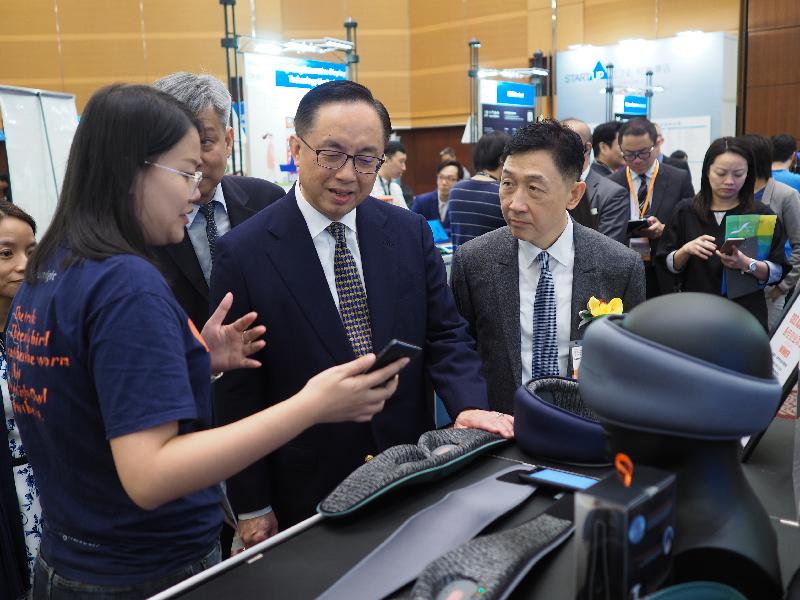
Photo  


Seminar on healthy ageing marks 20th anniversary of DH’s Elderly Health Service (with photos)

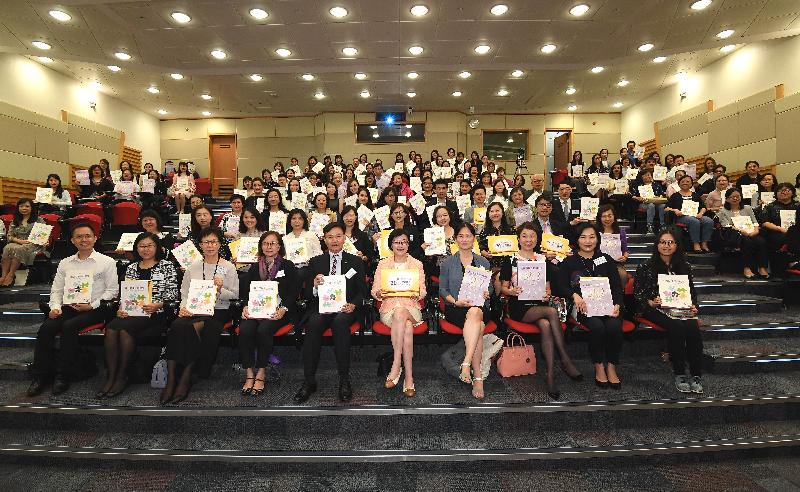
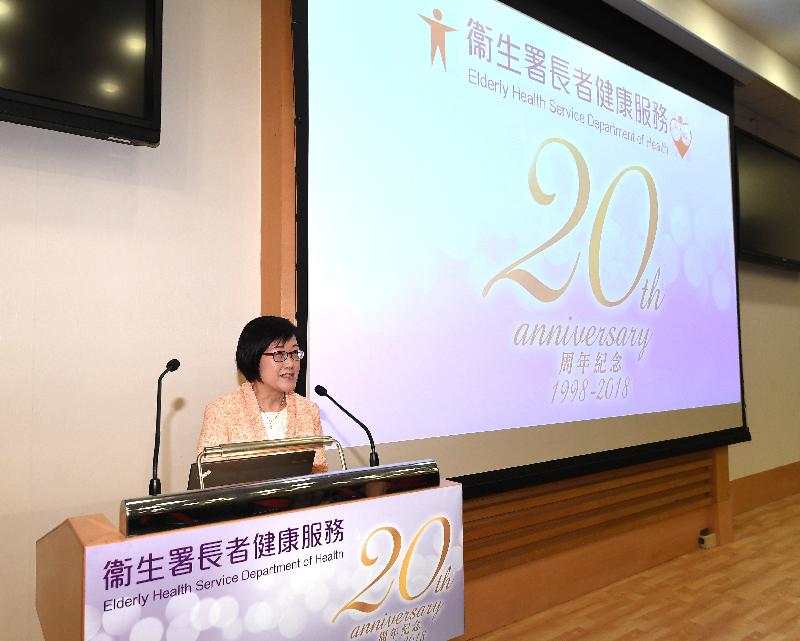
     The Department of Health (DH) held the 20th Anniversary Ceremony of the Elderly Health Service (EHS) cum Seminar on Promoting Healthy Ageing today (October 13), providing a networking platform for various stakeholders to exchange experiences and views on EHS work and explore initiatives to further promote healthy ageing.
 
     Speaking at the Ceremony, the Director of Health, Dr Constance Chan, said that since the establishment of the EHS in 1998, it has been providing integrated primary health care, including preventive, promotive and curative services, to the elderly to address their health needs by using a multi-disciplinary team approach. The EHS safeguards the health of elderly people through collaborating with different sectors of the community.
 
     Dr Chan added that similar to many regions around the globe, Hong Kong faces an increasing problem of non-communicable diseases (NCDs), which is compounded by an ageing population. To combat the threat of NCDs, the Government this year announced "Towards 2025: Strategy and Action Plan to Prevent and Control Non-communicable Diseases in Hong Kong", setting out nine local targets to be achieved by 2025, which include containing the prevalence of raised blood pressure, reducing the prevalence of insufficient physical activity, reducing the mean population intake of salt/sodium and halting the rise in diabetes and obesity.
 
     Dr Chan reminded the participants that the most effective way to help prevent NCDs is to develop healthy living habits.
 
     Dr Chan also took the opportunity to express her sincere gratitude to every counterpart for their long-term support for the EHS, which helped it reach a greater number of elderly persons and facilitate the provision of more diversified and targeted services. She said she looks forward to the continuous contribution of the EHS to the well-being of the elderly in collaboration with the partners in the future.
    
     At the Seminar, a guest speaker was invited to share findings of research on healthy ageing. DH representatives and working partners from the social welfare sector also spoke on the experiences and results gained from various jointly launched projects, including the Community Carer Capacity Building Programme and the Medical Social Collaboration Pilot Project that took place at Elderly Health Centres.
   
     For more information on the EHS and elderly health, please visit the website of the EHS of the DH.

Photo  Photo