Grants approved for flood victims in Kerala, India

    The Government of the Hong Kong Special Administrative Region has accepted the advice of the Disaster Relief Fund Advisory Committee and approved from the Disaster Relief Fund three grants totalling $8.265 million to three agencies for providing relief to flood victims in Kerala, India.
 
     Announcing the grants today (October 18), a spokesman for the Government said that endured heavy rain has increased the number of flood victims in Kerala to more than 5.4 million. The three grants – one of HK$1.786 million to Save the Children Hong Kong, one of HK$2.555 million to Plan International Hong Kong and one of HK$3.924 million to Habitat for Humanity Hong Kong, will be used to provide hygiene, household and kitchen items as well as shelter kits and education kits, to benefit around 61 890 flood victims. As the targeted localities of the three relief agencies are different, there will be no overlapping of resources. The Committee hopes the grants will facilitate the provision of timely relief to the victims and help them restore their normal living. The grant, together with those approved earlier for this flooding in Kerala of India, will take the accumulative value of grants and number of beneficiaries to $23.986 million and 170 390 respectively.
 
     "To ensure that the money is used for the designated purposes, the relief agencies will be asked to submit evaluation reports and audited accounts on the use of the grants after the relief projects have been completed," the spokesman said.


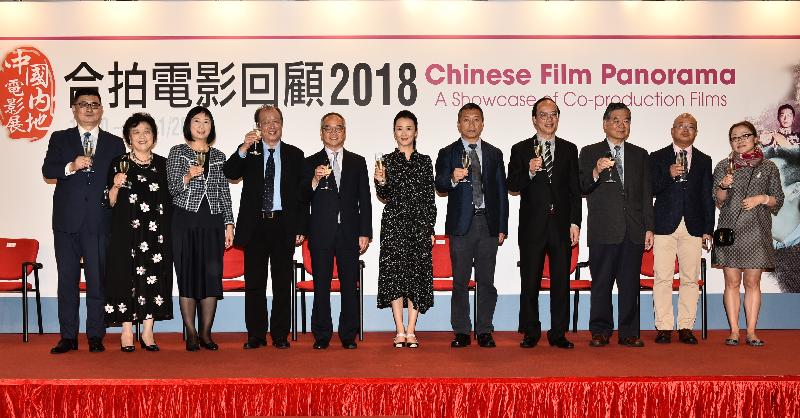
Chinese Film Panorama – A Showcase of Co-production Films 2018 opens tonight (with photos)

     An opening ceremony for the Chinese Film Panorama – A Showcase of Co-production Films 2018 was held tonight (October 18) at Hong Kong City Hall, followed by the screening of the opening film "Where Has Time Gone?" (2017), a collaboration between Chinese director Jia Zhangke and filmmakers from Brazil, Russia, India and South Africa.
 
     Showcasing 12 outstanding films co-produced by the Mainland and Hong Kong or foreign countries, the programme is jointly presented by the Leisure and Cultural Services Department and the South China Film Industry Workers Union in association with Sil-Metropole Organisation Ltd, Southern Film Co Ltd and the China Film Foundation. The films will be screened from today until November 30 at the Theatre of Hong Kong City Hall and the lecture halls of the Hong Kong Space Museum and the Hong Kong Science Museum.
 
     Speaking at the opening ceremony, the Secretary for Home Affairs, Mr Lau Kong-wah, noted that the co-production films have witnessed the continuing exchanges between China and the rest of the world and also signify the progress made by Chinese films to "go global". Through these films audiences can gain a better understanding of the cultural interactions between various places, he added.
 
     Other officiating guests at the opening ceremony included Deputy Director-General of the Publicity, Culture and Sports Department of the Liaison Office of the Central People's Government in the Hong Kong Special Administrative Region Mr Zhu Ting; leader of the Chinese film delegation Mr Li Qiankuan; the Director of Leisure and Cultural Services, Ms Michelle Li; the Chairman of the Hong Kong Film Development Council, Mr Ma Fung-kwok; the Chairman of the South China Film Industry Workers Union, Mr Yu Luen; and the Chairman of Sil-Metropole Organisation Ltd, Mr Chen Yiqi.
 
     The opening film, "Where Has Time Gone?", is the first co-production involving the BRICS countries. It consists of five short films made by the five directors using different angles to present the passage of time. The film won the "Golden Silkroad" Media Honor Special Jury Award at the 4th Silk Road International Film Festival.
 
     Other selected films include "Pali Road" (2016) directed by Jonathan Lim, "Miss Granny" (2015) directed by Leste Chen, "Wolf Totem" (2015) directed by Jean-Jacques Annaud, "The Nightingale" (2014) directed by Philippe Muyl, "A Wedding Invitation" (2013) directed by Oh Kihwan, "Aftershock" (2010) directed by Feng Xiaogang,"Hanoi, Hanoi" (2006) directed by Zhang Jing, Li Wei and Yan Junyong, "Zhou Yu's Train" (2003) directed by Sun Zhou,"Red Rose White Rose" (1994) directed by Stanley Kwan, "The Last Emperor" (1987) directed by Bernardo Bertolucci and "The Go Masters" (1982) directed by Duan Jishun and Junya Sato.
 
     "Where Has Time Gone?" is in Portuguese, Russian, Hindi, English and Putonghua; "Pali Road" and "The Last Emperor" are in English and Putonghua; "Hanoi, Hanoi" is in Vietnamese and Putonghua; "The Go Masters" is in Japanese and Putonghua while the other films are in Putonghua. All films have Chinese and English subtitles. "Red Rose White Rose" is classified as Category III, only persons aged 18 and above will be admitted.
      
     Tickets priced at $55 are now available at URBTIX (www.urbtix.hk). For credit card telephone bookings, please call 2111 5999. For programme enquiries, please call 2734 2900 or visit www.lcsd.gov.hk/fp/en_US/web/fpo/programmes/2018cfp/index.html.

Photo  Photo  


Recall of Chinese herbal medicine exceeding limits for arsenic (with photo)

     The Department of Health (DH) today (October 18) endorsed a licensed Chinese herbal medicine (Chm) wholesaler, Wong Chak Kee Limited, to voluntarily recall from the market a batch of Chm, Herba Pteridis Multifidae (batch number: 180408), as the Chm exceeded the limits for arsenic set out by the Chinese Medicines Board of the Chinese Medicine Council of Hong Kong (CMCHK). As a precautionary measure, Wong Chak Kee Limited is also voluntarily recalling other batches of Herba Pteridis Multifidae distributed by the company from the market.

     During the DH's market surveillance, a sample of the above Chm was collected for analysis. The test result from the Government Laboratory revealed that the decoction prepared from the above Chm contained, in terms of the maximum daily intake of the above Chm, about 2.6 times the maximum limit of arsenic set out by CMCHK.

     "Arsenic is a heavy metal. Long-term consumption of high levels of arsenic may cause adverse health effects. Major organs affected include the skin, the bladder and the lungs. So far, no adverse report related to the use of the above Chm has been received. Investigations are ongoing," a spokesman for the DH said.

     According to the Chinese Medicine Ordinance (Cap 549), Herba Pteridis Multifidae is any or the whole part of Pteris multifida Poir. It is a Schedule 2 Chm of the Ordinance used to clear heat and dampness, disperse swelling and detoxify, as well as cool the blood, and is haemostatic.

     Wong Chak Kee Limited has set up a hotline (2857 3332) for related enquiries. The DH will closely monitor the recall.
 
     According to section 52 of the Public Health and Municipal Services Ordinance (Cap 132), selling any drug not of the nature, substance or quality demanded by the purchaser is liable to a maximum penalty of $10,000 and three months' imprisonment. Upon completion of investigation, the DH will work with the Department of Justice on prosecution matters and will also refer the case to the CMCHK for possible disciplinary action. 

     The DH urged members of the public who have purchased the above Chm to stop using it immediately and submit it to the Chinese Medicine Division of the DH on 16/F, AIA Kowloon Tower, Landmark East, 100 How Ming Street, Kwun Tong, Kowloon, during office hours for disposal. Members of the public who have taken the above Chm and feel unwell should seek advice from healthcare professionals.

Photo  


CSD issues statement in response to media enquiries about rehabilitated person

     In response to recent media enquiries about a rehabilitated person concerning a work assignment, communication, complaints mechanism and the handling of illicit activities inside a penal institution, the Correctional Services Department (CSD) issued the following statement today (October 18) :

     According to the law, no work will be carried out by persons in custody (PICs), beyond what is strictly necessary, on Sundays and important festivals. Under the existing practice, meals provided by institutions are prepared by PICs assigned to work in the kitchen under the supervision of correctional staff and catering instructors. Kitchens of institutions have to be operated all year round in order to provide meals for PICs every day. PICs who work in the kitchen will have their weekly rest day by rotation.

     Regarding communications, PICs may send and receive letters according to the provisions stipulated in law, including to/from members of the Legislative Council, the Commissioner of the Independent Commission Against Corruption, other law enforcement agencies, etc, and proper records will be maintained to this effect. PICs may also request to have an interview with legislators or other law enforcement agencies through social visits, legal visits or visiting Justices of the Peace (JPs). There are quite a lot of examples in the past where interviews were conducted with PICs after the relevant parties were notified of the request of PICs.

     For complaints raised by PICs which are of a minor nature and related to daily operational matters of institutions, the Complaints Investigation Unit (CIU) of the CSD will refer them to the institutional management concerned for enquiry according to the existing mechanism, in order that the matter could be handled immediately. The institutional management will explain the circumstances to the PIC in detail and inform him/her of the result of the follow-up action taken. The CIU will inform the complainant regarding the relevant arrangement in writing and administer close monitoring on the progress of the case. If the case cannot be resolved by the institutional management or the complainant is not satisfied with the arrangement or the findings of the case, the CIU will carry out an investigation accordingly.

     The CIU will conduct an investigation into each complaint in a fair, impartial and thorough manner. Upon conclusion of the investigation of the complaint, the CIU will submit the findings to the Correctional Services Department Complaints Committee for examination and endorsement. If the complainant is not satisfied with the findings of the investigation, he/she can lodge an appeal to the Correctional Services Department Complaints Appeal Board (CSDCAB). At present, the CSDCAB comprises 18 JPs and religious persons who are familiar with correctional operations, so as to ensure that the appeal cases are handled in an impartial manner.

     In order to facilitate the rehabilitation of PICs in a safe and orderly custodial environment, the CSD will not tolerate any form of illicit activities such as gambling, unauthorised handling of dietary ingredients, etc. Practical measures, including large scale search operations, are taken to curb all kinds of illicit activities.

     The CSD attaches great importance to the conduct, integrity and discipline of its staff. Guidelines in relation to personal conduct, ethics and discipline are promulgated from time to time for staff observance. Any staff members found to have breached the law will be dealt with seriously by the CSD.

     The CSD suggests PICs or discharged persons who feel aggrieved by any treatment they received during imprisonment should lodge a complaint or air their grievances through various channels such as the CIU, the Ombudsman or other law enforcement agencies.


Third-term Commission on Poverty convenes second meeting

     The Chief Secretary for Administration, Mr Matthew Cheung Kin-chung, chaired the second meeting of the third-term Commission on Poverty (CoP) this afternoon (October 18).  

     At the meeting, Mr Cheung and relevant government officials briefed members on the various initiatives on improving people's livelihood announced in the 2018 Policy Address. These initiatives include further relaxing the age limit of the target beneficiaries of the Community Care Fund (CCF) Elderly Dental Assistance Programme; enhancing the means test of the Samaritan Fund and CCF assistance programmes; increasing education resources to secondary and primary schools as well as kindergartens; enhancing further labour protection for non-skilled workers engaged by government service contractors; strengthening support for the disadvantaged including ethnic minorities, children with special educational needs and persons with disability; and continuing to promote the Working Family Allowance Scheme. Members noted the Government's determination and commitment to improving people's livelihood and provided views on the new initiatives. 

     Mr Cheung stressed that the current-term Government attaches great importance to tackling social poverty and will continue to step up its efforts in alleviating poverty and helping the disadvantaged with a view to building a caring, harmonious and inclusive society.

     The CoP also noted the implementation progress of various assistance programmes and the financial position of the CCF. In addition, the CoP agreed to extend the Special Care Subsidy for the Severely Disabled Programme for a maximum of 24 months to provide eligible persons with severe disabilities a subsidy to purchase care goods and services or for other purposes related to nursing care. The revised total provision for the Programme is $452.79 million and more than 2 700 persons are expected to benefit from the Programme.  

     During the meeting, the Social Welfare Department briefed members on the progress of implementing after-school learning and support programmes for grass-roots children under the Partnership Fund for the Disadvantaged (the Fund) as well as the review on the service impacts of dedicated portions under the Fund. Members recognised that the Fund could effectively promote tripartite partnership among the welfare sector, the business community and the Government to help the disadvantaged. Members also expressed views on the assistance programmes and way forward of the Fund.  

     In addition, as a follow-up to the discussion of the last meeting, the Office of the Government Economist and the Census and Statistics Department briefed members on the enhancement proposals of the poverty line analytical framework. Members gave views on the proposals.