Transcript of remarks by STH

     Following is the transcript of remarks by the Secretary for Transport and Housing, Mr Frank Chan Fan, at a media session after touring the Hong Kong Port of the Hong Kong-Zhuhai-Macao Bridge on its first day of operation this morning (October 24):

Secretary for Transport and Housing: Today we have the official opening of the Hong Kong-Zhuhai-Macao Bridge which is serving Hong Kong citizens and tourists from overseas. As we can see, they are all very excited and trying to be the first ones to board the bus, buy the ticket and exit the Departure Hall. So I would expect this would provide Hong Kong citizens and tourists a very pleasant travel experience.

Reporter: Given what you are seeing on the first day of the Bridge opening, do you think that the existing quota and also the capacity of the Hong Kong Port area will suffice to provide for the number of visitors and people who are going through the Port area, in the medium to long term?

Secretary for Transport and Housing: I would say that the capacity of handling is going to increase in the years to come. As we can see, there are roughly about 100 cross-boundary coaches from Hong Kong to the Mainland. Also, I was given to understand that some 30 000 tourists will be coming over from the Mainland to Hong Kong. We will keep a close watch of the situation and try to mobilise more resources in enabling our handling capacity so as to give all Hong Kong residents and passengers a pleasant travelling experience.

(Please also refer to the Chinese portion of the transcript.)


Hong Kong Customs seizes suspected duty-not-paid water pipe tobacco (with photo)

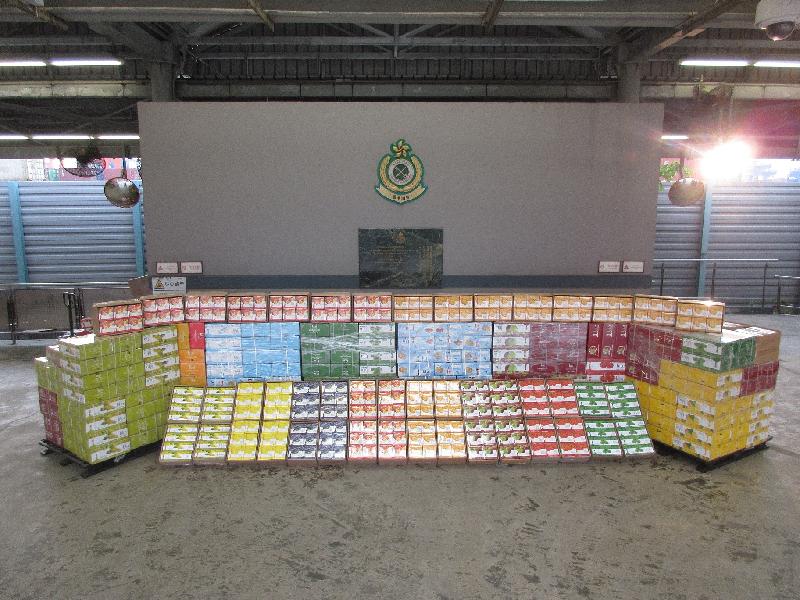
     Hong Kong Customs seized about 6 600 kilograms of suspected duty-not-paid water pipe tobacco with an estimated market value of about $2.6 million and a duty potential of about $15 million at the Kwai Chung Customhouse Cargo Examination Compound on October 22.

     Through risk assessment, Customs officers inspected a container arriving in Hong Kong from Jordan. Upon inspection, Customs officers found the batch of suspected duty-not-paid water pipe tobacco in the container.

     Investigation is ongoing.

     Under the Dutiable Commodities Ordinance, anyone involved in dealing with, possession of, selling or buying duty-not-paid tobacco commits an offence. The maximum penalty upon conviction is a fine of $1 million and imprisonment for two years.

     Members of the public may report any suspected illicit tobacco activities to Customs' 24-hour hotline 2545 6182 or its dedicated crime-reporting email account (crimereport@customs.gov.hk).

Photo  


LC Urgent Q1: Disruptions of railway services

     Following is an urgent question by the Hon Gary Fan under Rule 24(4) of the Rules of Procedure and a reply by the Secretary for Transport and Housing, Mr Frank Chan Fan, in the Legislative Council today (October 24):

Question:

     On the early morning of the 16th of this month, staff members of the MTR Corporation Limited (MTRCL) completed the tests on a new signalling system for the MTR Tsuen Wan Line and reverted to the existing system. However, they found that the signalling systems of the Tsuen Wan Line, the Island Line and the Kwun Tong Line had all broken down simultaneously and could not be fixed before the first trains commenced service. The signalling system of the Tseung Kwan O Line also broke down later. As a result, all these four railway lines could only provide limited services during the morning rush hours. This also caused severe knock-on effect and chaos on the road traffic, affecting hundreds of thousands of members of the public. In this connection, will the Government inform this Council, given that MTRCL is gradually replacing the signalling systems of various railway lines, whether the Government and MTRCL will take immediate measures to prevent the relevant works from causing disruptions of railway services, and whether they will expeditiously formulate contingency plans (including alternative public transport services) to deal with large-scale disruptions of railway services?

Reply:

President,

     During the morning peak hours on October 16, train services of the MTR Island, Tsuen Wan, Kwun Tong and Tseung Kwan O lines suffered from service disruption. Although train service was not suspended, the carrying capacity of the four railway lines were reduced with limited train service with intervals of about 12 to 15 minutes. The incident covered a wide area affecting numerous passengers. The Government and the MTR Corporation Limited (MTRCL) are sparing no efforts to look into the cause of the incident in order to avoid recurrence. Regarding the question raised by the Hon Gary Fan, I will reply from the following aspects. 

     In the early morning on October 16, MTRCL conducted testing of the new signalling system along the Tsuen Wan line, during which both the new and existing systems functioned normally. Before 5am, MTRCL switched back the signalling system to the existing one to prepare for train services. At 5.28am, the Operations Control Centre found that trains on the Island, Tsuen Wan and Kwun Tong lines were unable to receive target speed instruction. Out of safety concern, trains on these three lines were switched to manual mode at reduced speed from the start of train service at around 6am. During the period, the over-speed protection function of the trains continued to function in ensuring railway safety. 

     Engineering personnel of the MTRCL immediately carried out emergency repair works. Having failed to recover the system, engineering personnel then attempted to reboot the signalling system of the respective lines one by one. At 5.52am before the first train commenced service, MTRCL informed the Emergency Transport Co-ordination Centre (ETCC) of the Transport Department (TD) and issued amber and red alarms consecutively according to the established contingency plan, requesting other public transport operators to enhance services. During the emergency repair works, the Tseung Kwan O lines also suffered from signalling fault and trains were switched to manual mode at reduced speed. Upon rebooting the computers at the stations along the four railway lines, emergency repair works were completed one after another by 11.45am and train service gradually resumed to normal frequencies. 

     Upon receiving MTRCL's notification, taking into account the severity of the incident, the ETCC of TD upgraded its operation level to Level 2, led by directorate staff of TD, and deployed additional staff to co-ordinate other public transports and to provide emergency support. The Centre urged MTRCL to disseminate information to passengers and closely monitor and manage passenger flow in stations. It also contacted and requested franchised bus and tram operators to enhance service and sent additional staff to assist passengers in queuing. With TD's co-ordination, 11 routes of franchised bus, 24 additional trams and the Star Ferry enhanced its service during the incident to assist in picking up affected passengers. During the period, TD disseminated information to the public through media, website and mobile applications, and also deployed personnel to key affected stations. The Electrical and Mechanical Services Department (EMSD) also deployed personnel to MTRCL's Operating Control Centre and Kowloon Bay Central Equipment Room to observe train operations and monitor the repair works.  

     During the incident, the MTRCL deployed an additional 400 staff to assist passengers, including conducting crowd control at stations. MTRCL also updated the public on the relevant information through media briefings, its mobile applications, and broadcasts at stations and inside train compartments. During the incident, ticket gates of each affected station were switched to a specific mode, of which passenger fare was not deducted.

     According to the initial investigation by MTRCL, the incident was likely caused by unsmooth operation and data processing of the existing signalling system software. After resetting, all systems along the lines have returned to stable operation. Based on the abovementioned initial investigation findings, EMSD has requested the MTRCL to continue in-depth investigation, while conducting an overhaul on the related equipment of the signalling system and submit a detailed report in two months. MTRCL has set up an investigation panel. It shall arrange overseas and local experts to assist in the investigation, and conduct a comprehensive review on the system with the signalling system supplier. Directions of the detailed investigation include data processing synchronisation arrangements of the signalling systems undertaken by two suppliers, whether there are any potential software compatibility problems, and whether the interconnection and communication of the railway lines are smooth. EMSD will continue to monitor the investigation work.

     TD will also review the existing contingency plan, including the arrangements of free shuttle buses by MTRCL during the incident, and whether there is room for other public transport operators to enhance services during the incident, in order to improve the handling of similar incidents in future. However, it should be noted that shuttle bus service is an emergency supplementary measure with limited carrying capacity, and would be subject to factors such as road conditions, which can hardly replace normal train service.

     As regards to Member's question on whether the incident is related to the signalling system upgrading project, according to the signalling system alarm log of the MTRCL, the incident indeed occurred after MTRCL switched back the signalling system to the existing one and operated it for some time. There was no evidence showing correlation between the incident and the signalling system upgrading project. That said, the MTRCL has further strengthened its monitoring and maintenance of the existing systems when testing the new signalling system, and has deployed additional personnel to stand by at stations' signalling equipment room to expedite the repair works. Separately, EMSD has discussed with MTRCL to temporarily segregate the inter-connection of railway lines to avoid them to be affected by one another under similar incidents. As mentioned above, EMSD and MTRCL including the expert panel set up by MTRCL will also review whether the incident was indeed not related to the signalling system upgrading project when conducting the in-depth investigation.


Government releases Interim Report of Expert Adviser Team on Shatin to Central Link Project

     The Expert Adviser Team on the Shatin to Central Link (SCL) Project has submitted Interim Report No. 1 to the Transport and Housing Bureau (THB). It was uploaded to the THB website today (October 24) (www.thb.gov.hk/eng/psp/publications/transport/studies/index.htm).
 
     Comprising three senior retired government officers, the Expert Adviser Team carried out site visits, reviewed relevant documents and met with MTR Corporation Limited (MTRCL) and the relevant government departments to look into matters concerning the management and construction of the SCL Project. Interim Report No. 1 includes observations and views of the Expert Adviser Team regarding the steel bar connection works in the East West Line platform slab and diaphragm walls at the Hung Hom Station Extension site, as well as the settlement-related issues at the Exhibition Centre Station and To Kwa Wan Station sites.
 
     The THB agreed with the 16 preliminary recommendations made by the Expert Adviser Team. Nine of the preliminary recommendations are related to the Hung Hom Station Extension works, four are on settlement issues, and the remaining three are about project management in general.
 
     On the recommendations with respect to the Hung Hom Station Extension, subsequent to discussions with the Government and the Expert Adviser Team, the MTRCL has agreed to formulate a holistic strategy for assessing the acceptability of the built structures. The strategy should encompass a combination of diagnoses, including verifying objective evidence, physical inspections through opening up the structures and conducting non-destructive tests, instead of relying solely on the load test as previously proposed. Furthermore, apart from the East West Line platform slab, the North South Line platform slab and the diaphragm walls should also be assessed.
 
     The MTRCL submitted a proposal for verification of part of the East West Line platform slab to the Highways Department on October 15, 2018. As the proposal obviously failed to meet the requirements of the holistic assessment strategy described above, the Government has requested the MTRCL to submit a strategy conforming to the recommendations of the Expert Adviser Team by the end of this month, so as to investigate and address matters relating to the Hung Hom Station Extension works expeditiously. 
 
     Regarding the settlement-related issues, the Expert Adviser Team's recommendations were incorporated into the monitoring and announcement mechanism for the impact of SCL works on nearby structures and public facilities promulgated on September 28, 2018. The Expert Adviser Team will audit selected cases of the SCL Project to assess the effectiveness of the monitoring and control system.
 
     The Expert Adviser Team will continue to review the project management system of the MTRCL, and recommend additional management and monitoring measures to be undertaken by the MTRCL and the relevant government departments as appropriate in taking forward the SCL Project. The Expert Adviser Team will also provide expert advice on matters (including settlement issues) relating to the works of the SCL Project.


LCQ21: Real estate investments under Long-term Growth Portfolio of Exchange Fund

     Following is a question by the Hon Au Nok-hin and a written reply by the Financial Secretary, Mr Paul Chan, in the Legislative Council today (October 24):

Question:
 
     Since 2009, the Hong Kong Monetary Authority has drawn on some of the Exchange Fund's assets to make investments under the Long-term Growth Portfolio (LTGP).  In this connection, will the Government inform this Council of the current (i) total number of units and (ii) total market value of the buildings involved in the assets under LTGP that fall within the asset class of "real estate", with a breakdown by the location and type of real estates (set out in the table below):
 

Location of real estates Type of real estates Total
Residential unit/
service apartment
Office/
commercial building
Industrial building/
industrial land
Hotel Shop Others
(i) (ii) (i) (ii) (i) (ii) (i) (ii) (i) (ii) (i) (ii) (i) (ii)
Hong Kong                            
Mainland China                            
Other regions in Asia                            
Europe                            
Americas                            
Africa                            

Reply:

President,
 
     To better manage risks and enhance returns in the medium and long term, the Hong Kong Monetary Authority (HKMA) has been diversifying part of the investment of the Exchange Fund (EF), in a prudent and incremental manner, into a greater variety of asset classes, including real estate.  As of end December 2017, the market value of real estate investment in the Long-term Growth Portfolio (LTGP) amounted to HK$78.4 billion, covering various regions and sectors.
 
     According to the HKMA, given the EF's statutory purposes are to maintain the stability and integrity of the monetary and financial systems of Hong Kong, its investment mainly focuses on overseas financial and real assets.  Apart from addressing emergency and strategic needs (e.g. the acquisition of Hong Kong equities in the Hong Kong stock market in 1998 in response to the Asian financial crisis, and the purchase of the HKMA's office premises), the EF has no investment in Hong Kong real estate and stock market.
 
     On overseas real estate, the LTGP predominantly invests in traditional and mature markets, including North America and Western Europe, and has started diversifying into Asian markets in recent years.  Investment channels include direct acquisition of prime properties in major overseas cities and investment in real estate funds.  Assets cover office, retail and logistics sectors. 
 
     Noting the potential market sensitivities pertaining to the investment of the EF, it would be inappropriate for the HKMA to disclose specific details thereof.