LCQ16: Visual fire alarm systems for persons with hearing impairment

     Following is a question by Hon Leung Yiu-chung and a written reply by the Secretary for Transport and Housing, Mr Frank Chan Fan, in the Legislative Council today (October 31):

Question:

     It is learnt that there are currently more than 150 000 deaf/hard-of-hearing persons in Hong Kong, many of whom are residing in public housing estates. As all public housing estates in Hong Kong are currently not installed with visual fire alarm systems, there is a lack of protection for the safety of such persons. It has been reported that the Housing Department (HD) launched a trial scheme in August last year to install fire alarm flashing lights in units of public housing estates, but HD has so far not given an account of the progress. In this connection, will the Government inform this Council:

(1) of the details and progress of the trial scheme as well as the manpower involved; whether HD has consulted the deaf/hard-of-hearing persons and concern groups in respect of the implementation of the trial scheme; if so, of the details; if not, the reasons for that;

(2) whether the deaf/hard-of-hearing public housing tenants may currently apply for fire alarm flashing lights to be installed by HD in their units; if so,

(i) of the respective numbers of applications received, approved and rejected by HD since last year;

(ii) if there were rejected applications, of the reasons for the
rejection; whether the tenants concerned may lodge an appeal; if so, of the mechanism involved;

(iii) of the number of cases to-date in which the works for installation of fire alarm flashing lights have been completed;

(iv) whether HD has provided training and guidelines for the frontline staff on handling such applications, and distributed application forms to the tenants concerned; if so, of the details; if not, whether HD will do so as soon as possible; and

(3) whether it will consider making amendments to the Buildings Ordinance (Cap. 123) and the Fire Services Ordinance (Cap. 95) to require that (i) all newly constructed public and private residential buildings must be installed with a visual fire alarm system, and that (ii) existing residential buildings must be retrofitted with such a system within a specified period of time; if so, of the details and the timetable; if not, the reasons for that?

Reply:
 
President,

     Having consulted the Development Bureau and the Security Bureau, I set out the consolidated reply to various parts of the question raised by the Hon Leung Yiu-chung as follows:

     The Building (Planning) Regulations (B(P)R) prescribes design requirements on barrier-free access and facilities to ensure that suitable barrier-free access and facilities are provided in private buildings to meet the needs of persons with disabilities.  At the same time, although the related provisions do not apply to buildings built before the commencement date of the B(P)R (viz. August 1985), any alterations or additions to such buildings are required to comply with the relevant regulations.

     In order to facilitate registered building professionals to comply with the aforesaid requirements, the Buildings Department (BD) has issued the Design Manual: Barrier Free Access (the Design Manual) which has set out the mandatory statutory design requirements as well as recommendations for best practice design. Upon receipt of general building plans submitted by registered building professionals, BD shall vet the provision of barrier free facilities and access in the buildings for persons with disabilities in accordance with the details set out in the Design Manual. The Fire Services Department (FSD) will also ensure that all fire service installations and equipment comply with the requirements set out in the "Code of Practice for Minimum Fire Service Installation and Equipment" issued by FSD, having regard to the intended use of the buildings prescribed under the Buildings Ordinance.

     The Design Manual has also specified the scope of application of visual fire alarm system (VFA). Comprising of various sectors, including rehabilitation, building and academia, the Technical Committee on the Design Manual had discussion on the scope of application of VFA. There were no views expressed then to mandate each private residential unit to be installed with such alarm system. However, in the light of the recommendations made by the Technical Committee, BD revised the Design Manual in April 2017 to recommend that apart from mandating the installation of VFA at some of the areas at the various uses of buildings listed in the Design Manual, registered building professionals should adopt new best practice design during the general building plans submission by providing VFA in situations where person with hearing impairment has to work alone (except for areas designed for domestic use).

     Though the Design Manual does not mandate the installation of VFA in a residential unit, the Government welcomes the installation of such alarm system according to the actual needs of the owner.

     At the same time, the Hong Kong Housing Authority (HA) has all along been providing appropriate assistance to tenants with hearing impairment according to actual circumstances. For instance, relevant households may opt for special notification service provided by HA and authorise estate office staff to notify the designated contact person(s) in case of suspension of fresh water supply/electricity supply/lift service or in emergency (e.g. fire incident); and to transfer their relevant information to other government departments, such as the Police, FSD, etc. for communication purposes. In case of emergency, such as fire incident, estate office staff may, under safe situation, notify persons with hearing impairment to leave their public rental housing (PRH) units, before the Police or FSD personnel arrives at the scene. Relevant households may also apply to HA for free installations of flashing-light doorbells to facilitate their answering of door calls.

     HA has also been strictly complying with the regulations and requirements of the relevant legislations in installing fire protection systems in its PRH estates. Under the prevailing legislation, individual units in residential buildings (including PRH units) are not required to be equipped with VFA. Installing VFA in residential units would require proper handling of certain statutory and technical issues. For example, the system must be connected to the communal fire service installations so as to enable the simultaneous actuation of fire alarm bells in the event of a fire. In fact, as we understand, it is not common for VFA to be installed in individual units in residential buildings.

     At present, HA does not have a policy on installing VFA in PRH units. Nevertheless, with a view to further assisting households with hearing impaired persons, HA commenced a feasibility study for the installation of VFA in August 2017. FSD's consent to the relevant proposal was obtained in November 2017. Thereafter, HA submitted the preliminary design drawings and detailed fire service installation drawings to FSD in December 2017 and April 2018 respectively, in the pursuit of carrying out trial installation of VFA in a PRH unit with  hearing impaired tenant. FSD's consent to the installation works was obtained in July 2018. HA installed the VFA on August 20, 2018 and, on the same date, held a meeting with the deaf/hearing-impaired concern group assisting the household; as well as several other households with hearing impaired members residing in other PRH estates, to gauge their opinions. In addition, HA held a meeting with another deaf/hearing-impaired concern group on September 3, 2018 to gather their views and explain to them about the VFA and the progress of the trial.

     HA will closely monitor the performance of the VFA and observe if changes in environment conditions, such as temperature and humidity, will affect its operation. HA will also maintain communication with the relevant household to understand and assess the effectiveness of the installation. The review over the trial installation is expected to be completed by mid-2019.

     Up to now, HA has received enquiries from six households with hearing impaired members requesting for the installation of VFA. As the system is still under trial, its performance and effectiveness are to be monitored and reviewed. HA will determine the way forward upon the completion of the review.



Special traffic arrangements for race meeting in Sha Tin

     Police advise motorists that special traffic arrangements will be implemented in Sha Tin to facilitate the race meeting today (October 31).

     The arrangements will come into effect two hours before the start of the first race and will last until the crowds have dispersed after the race meeting.

     Appropriate traffic signs will be put up and police will be on hand to guide motorists.

     The Police also appeal to people going to Sha Tin Racecourse for the race meeting and to Happy Valley Racecourse for cross betting to make maximum use of public transport.

     Parking spaces at the two racecourses are available only to holders of appropriate permits issued by Hong Kong Jockey Club and any vehicles illegally parked will be towed away.


LCQ7: Residential units produced from projects undertaken by private sector

     Following is a question by the Hon Abraham Shek and a written reply by the Secretary for Transport and Housing, Mr Frank Chan Fan, in the Legislative Council today (October 31):

Question:

     Will the Government inform this Council, in tabulated form, of the respective numbers of residential units produced from projects undertaken by the private sector in each of the years from 2015 to 2018 on sites involving applications for (i) lease modification, (ii) land exchange and (iii) private treaty grant?

Reply:

President,

     According to the statistics of Rating and Valuation Department (Note 1), the actual or forecast number of private residential units completed from 2015 to 2018 are set out below:

Year Private residential units completed/forecast completion (No. of units)
2015 11 296
2016 14 595
2017 17 791
2018 18 130 (Note 2)

     The Government does not have statistical information on completed private residential units by category of land, such as lease modification, land exchange, private treaty grant, etc.
 
Note 1: The statistics are from the "Hong Kong Property Review 2018" published by the Rating and Valuation Department (www.rvd.gov.hk/doc/en/hkpr18/03A-1.pdf).

Note 2: This is the forecast completion figure for 2018.


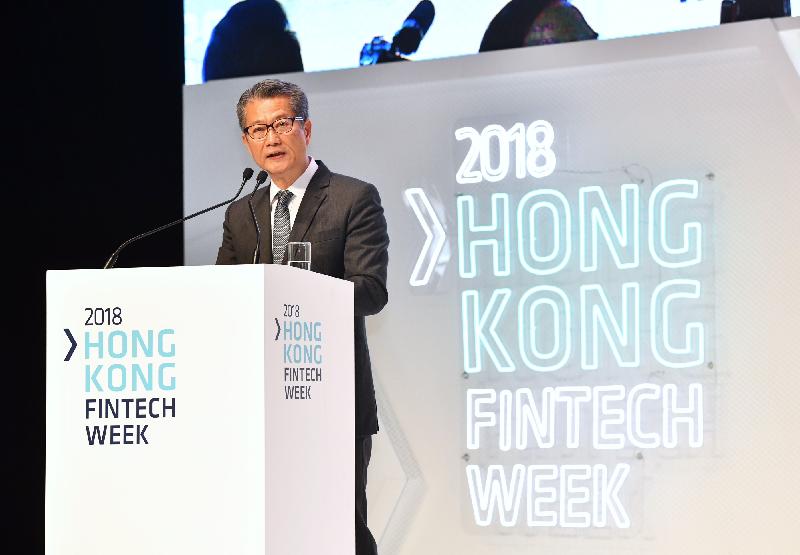
Speech by FS at opening of Hong Kong FinTech Week 2018 (English only) (with photos/video)

     Following is the speech by the Financial Secretary, Mr Paul Chan, at the opening of Hong Kong FinTech Week 2018 this morning (October 31):
 
Norman (Chief Executive of the Hong Kong Monetary Authority, Mr Norman Chan), distinguished speakers and guests, ladies and gentlemen,
 
     Good morning.
 
     I am delighted to be here today, to have this welcome opportunity to speak to you all here for Hong Kong FinTech Week, an event gathering more than 8 000 business leaders, start-up innovators, regulators, investors and more from over 50 countries and regions. Most of you, I'm sure, are flag-waving fintech fans, passionate believers in the future of financial technology. Some might be holding a wait-and-see attitude, waiting to be convinced and converted.
 
     No matter which group you belong to, I'd say you've come to the right place. Over the next four days, this third edition and the biggest ever Hong Kong FinTech Week is going to present more than 200 speakers tackling themes critical to the future of fintech.
 
     On the fifth day of FinTech Week, together we will head for Shenzhen, making this the world's first ever cross-border fintech event.
 
     No less important, the day in Shenzhen will give you the chance to see for yourself how Hong Kong can serve as your fintech base, while tapping into the vast opportunities of the Guangdong-Hong Kong-Macao Greater Bay Area, a big part of the world's largest fintech market.
 
     Some are already calling Shenzhen the Silicon Valley of China. Imagine placing Silicon Valley next door to New York City. I'm sure and confident that's pretty much what Hong Kong and Shenzhen will, soon enough, offer the world. Let me share with you a few thoughts on this.
 
     It starts, of course, with our financial sector. Hong Kong is consistently rated among the world's top three international financial centres and first in Asia. Our information and communications technology (ICT) infrastructure is equally world-class. Hong Kong's financial regulatory framework enables innovation, while protecting users and the industry in general. And our talent pool is multilingual and multitalented as I'm sure you'll discover in the course of this FinTech Week.
 
     More importantly, Hong Kong welcomes you with an inclusive spirit of entrepreneurship, and with the assurance of a level playing field for all.
 
     You may be well aware that Hong Kong is the freest economy in the world. Our government concentrates on promoting and facilitating, so that you can focus yourself on innovating and business building.
 
     Earlier this year, I dedicated HK$500 million to develop the financial services industry, and fintech is definitely on the agenda.
 
     I also allocated nearly HK$200 million to Cyberport as part of our determined effort to support fintech start-ups. The Government's HK$2 billion Innovation and Technology Venture Fund and Cyberport's Macro Fund also help finance new fintech projects.
 
     Private funding from angel investors, venture capitalists and private equity funds is also rife. Indeed, investment in Hong Kong-based fintech companies exceeded US$500 million in 2017 – more than doubling the amount in 2016.
 
     Hong Kong is undoubtedly an ideal launch pad for those seeking a future in fintech. There are well over 300 fintech start-ups at Cyberport and Hong Kong Science Park and over 150 other fintech companies are flourishing in the private co-working spaces dotted all over Hong Kong. 
 
     Our Fast Track Programme is here, right outside this hall, to support you to join the league. Specialists from InvestHK, as well as our financial regulators and fintech partners, are there to assist you, to help you launch your fintech future here in Hong Kong.
 
     What Hong Kong can offer is smartly summed up by the tagline of our new Hong Kong fintech logo, "Launch, Leap and Lead".
 
     I've touched on Hong Kong's resources for launching your fintech company or start-up. We'll help you make that leap as our city as a whole excitedly rolls into the era of fintech. Just last month, the Hong Kong Monetary Authority launched the Faster Payment System. 
 
     That means instant fund transfer round the clock in both Hong Kong dollars and Renminbi not only between banks, but also between e-wallets.
 
     A common QR code for retail payment has also been established, allowing Hong Kong merchants to accept payment from multiple channels, including e-wallets and individual banking apps.
 
     By the end of this year, the first batch of virtual bank licenses will be given to those virtual banks to open their portals. An Open API framework is also on the way. It will allow fintech companies to collaborate with banks in providing innovative offerings.
 
     As for leading, that means, among other things, expanding our markets. We're certainly working on that. Those of you who make the trip to Shenzhen this Friday will get a first-hand appreciation for that and for the possibilities, the promise, of the Greater Bay Area and Hong Kong's role, very unique role, in this national development strategy.
 
     The Greater Bay Area links nine prosperous cities in southern China together with Hong Kong and Macao. Together, they count some 70 million ready consumers of financial services, and of course fintech.
 
     My sincere thanks to my colleagues in InvestHK and all the other organisers and supporters for putting together this year's Hong Kong FinTech Week. I'm sure it will be a resounding success.
 
     I wish you all a rewarding week, and the best of fintech business in the coming year.
 
     Thank you.

Photo  Photo  Photo  


Two illegal workers jailed

     Two illegal workers comprising a Pakistani and an Indian were jailed by Shatin Magistrates' Courts yesterday (October 30).

     Immigration Department (ImmD) investigators received a referral from the Hong Kong Police Force to further investigate an illegal employment case in April. Enforcement officers arrested a male Pakistani worker, aged 43, who was conveying goods in a car park in Kwai Chung. Upon identity checking, he produced for inspection a recognisance form issued by the ImmD, which prohibits him from taking employment. Further investigation revealed that he was a non-refoulement claimant. An employer suspected of employing the illegal worker was also arrested and the investigation is ongoing.

     In addition, during a joint operation conducted by the ImmD and the Hong Kong Police Force codenamed "Powerplayer" on June 27, enforcement officers raided a restaurant in Tsim Sha Tsui. One male Indian illegal worker, aged 25, was arrested. When intercepted, he was working as a kitchen worker. Upon identity checking, he produced for inspection a recognisance form issued by the ImmD, which prohibits him from taking employment. Further investigation revealed that he was a non-refoulement claimant. An employer suspected of employing the illegal worker was also arrested and investigation is ongoing.

     The two illegal workers were charged at Shatin Magistrates' Courts yesterday with taking employment after landing in Hong Kong unlawfully and remaining in Hong Kong without the authority of the Director of Immigration or while being a person in respect of whom a removal order or deportation order was in force. After trial, they were sentenced to 16 months and 26 days' and 22 months and two weeks' imprisonment respectively.

     The ImmD spokesman warned that, as stipulated in section 38AA of the Immigration Ordinance, illegal immigrants or people who are the subject of a removal order or a deportation order are prohibited from taking any employment, whether paid or unpaid, or establishing or joining in any business. Offenders are liable upon conviction to a maximum fine of $50,000 and up to three years' imprisonment. The Court of Appeal has issued a guideline ruling that a sentence of 15 months' imprisonment should be applied in such cases.

     The spokesman reiterated that it is a serious offence to employ people who are not lawfully employable. The maximum penalty is imprisonment for three years and a fine of $350,000. The High Court has laid down sentencing guidelines that the employer of an illegal worker should be given an immediate custodial sentence. According to the court sentencing, employers must take all practicable steps to determine whether a person is lawfully employable prior to employment. Apart from inspecting a prospective employee's identity card, the employer has the explicit duty to make enquiries regarding the person and ensure that the answers would not cast any reasonable doubt concerning the lawful employability of the person. The court will not accept failure to do so as a defence in proceedings. It is also an offence if an employer fails to inspect the job seeker's valid travel document if the job seeker does not have a Hong Kong permanent identity card. The maximum penalty for failing to inspect such a document is imprisonment for one year and a fine of $150,000.
 
     Under the existing mechanism, the ImmD will, as a standard procedure, conduct initial screening on vulnerable persons, including illegal workers, illegal immigrants, sex workers and foreign domestic helpers, who are arrested during any operation, with a view to ascertaining whether they are trafficking in persons (TIP) victims. When any TIP indicator is revealed in the initial screening, the officers will conduct a full debriefing and identification by using a standardised checklist to ascertain the presence of TIP elements, such as threat and coercion in the recruitment phase and the nature of exploitation. Identified TIP victims will be provided with various forms of support and assistance, including urgent interference, medical services, counselling, shelter, temporary accommodation and other supporting services. The ImmD calls on TIP victims to report crimes to the relevant departments.