Cluster of Carbapenemase-Producing Enterobacteriaceae cases at United Christian Hospital

The following is issued on behalf of the Hospital Authority:

      The spokesperson for United Christian Hospital made the following announcement today (October 31):

      Seven male patients aged 63 to 92 in a surgical ward have been confirmed to have Carbapenemase-Producing Enterobacteriaceae (CPE) since October 23. Three of the patients concerned are being treated under isolation and are in a stable condition; one patient passed away due to his own underlying disease; and the remaining three patients have been discharged.
 
      The Hospital Infection Control Team has followed up with the departments concerned and experts of the Centre for Health Protection. The following enhanced infection control measures have already been adopted in the ward:

  1. Apply stringent contact precautions and enhance hand hygiene;
  2. Enhance attention to contamination-prone procedures; and
  3. Enhance cleansing and disinfection of the ward.

 
      The hospital will continue to closely monitor the situation on the ward. The cases have been reported to the Hospital Authority Head Office and the Centre for Health Protection for necessary follow-up. 


LCQ14: Hawker Assistance Scheme

     Following is a question by the Hon Ho Kai-ming and a written reply by the Secretary for Food and Health, Professor Sophia Chan, in the Legislative Council today (October 31):

Question:

     Under the Hawker Assistance Scheme (the Scheme) launched by the Government in June 2013, hawker licensees of about 4 300 fixed-pitch hawker stalls in 43 hawker areas might choose to apply for a relocation cum reconstruction grant or surrender of their licences to the Government for an ex-gratia payment of $120,000. The Scheme expired in June this year. In this connection, will the Government inform this Council:

(1) of the respective numbers of applications for surrender of hawker licences received and approved by the Government under the Scheme;

(2) of the number of pitches available for allocation (except those unsuitable for allocation due to safety reasons) in the 43 hawker areas upon expiry of the Scheme, with a breakdown by district and hawker area;

(3) of the respective total numbers of licensed hawkers in the 43 hawker areas (i) before the launch and (ii) upon expiry of the Scheme, with a breakdown by district and hawker area; and

(4) as the Government indicated at a committee meeting of this Council that it would consider re-issuing the surrendered hawker licences for application by interested parties, of the timetable and progress of the work concerned, and whether the trade and the public will be consulted on the relevant arrangements; if so, of the details; if not, the reasons for that?

Reply:

President,

     To reduce the fire risks posed by on-street hawking activities, the Government obtained funding approval of $230 million from the Legislative Council (LegCo) Finance Committee on March 15, 2013 for a five-year Hawker Assistance Scheme (the Scheme) for the licensed hawkers in 43 fixed-pitch hawker areas in the territory. The Scheme aims to improve the fire resisting design and capability of hawker stalls, and to relocate stalls away from staircase discharge points of buildings or emergency vehicular access.

     The Scheme covers the following scope:

(a) Hawkers who are required by the Food and Environmental Hygiene Department (FEHD) to relocate their stalls for fire safety reasons may apply for a one-off relocation cum reconstruction grant to dismantle their old stalls and build new ones at the newly assigned pitch spaces to meet the fire-resisting specifications drawn up by the FEHD in consultation with the Fire Services Department and the Buildings Department;

(b) Hawkers who are not required to relocate their stalls under (a) may apply for a one-off in-situ reconstruction grant to carry out partial or full reconstruction of their stalls in-situ to meet the prescribed fire-resisting specifications for reducing fire risks; and

(c) An ex-gratia payment (EGP) of $120,000 will be paid to hawkers (except for those whose licences are newly issued pursuant to the hawker licensing policy review in 2008-09) who opt for voluntary surrender of their hawker licences to the Government. This helps expedite the release of vacant pitches and hence facilitates the relocation of stalls which pose higher fire risks. Hawkers who have obtained a one-off grant for relocation cum reconstruction or in-situ reconstruction of their stalls under the Scheme will not be eligible for EGP, if they surrender their hawker licences subsequently.

     The Scheme commenced on June 3, 2013 and ended on June 2, 2018 (i.e. closed for applications).

     My reply to the various parts of the question is as follows –

(1) Among the 4 330 licensed fixed-pitch hawkers in the 43 hawker areas, FEHD received applications from 854 hawkers for surrender of hawker licences for EGP in the five-year Scheme period. The approval procedures for all applications had been completed and the stalls were vacated. Besides, FEHD received 422 applications for relocation cum reconstruction grant and 3 002 applications for in-situ reconstruction grant to upgrade the fire safety standards of hawker stalls. In other words, 98.8 per cent of the licensed hawkers in the 43 hawker areas had joined the Scheme since its commencement.

(2) In processing the applications for surrender of hawker licences for EGP, some of the hawker pitches vacated were deleted as they were located directly in front of staircase discharge points of adjacent buildings or emergency vehicular access. Some other hawker pitches vacated were used to accommodate hawker stalls which were originally located directly in front of staircase discharge points of adjacent buildings or emergency vehicular access or those stalls necessary to be relocated for other reasons or used for the purpose of rationalising the overall layout of the hawker areas. Due to fire safety considerations, vacated hawker pitches which were located within six-metre radius in front of the staircase discharge points of buildings were unsuitable for re-use. As a result, as at August 31, 2018, there are a total of 237 vacant hawker pitches which can be used for reallocation under the Scheme. Details are set out in Annex I. At present, FEHD is collating figures on hawker pitches within or outside the 43 hawker areas which are vacated due to other reasons. As a rough estimate, the number of vacant pitches available for allocation amounts to almost 400.

(3) The number of hawkers in the 43 hawker areas before and after the Scheme is set out in Annex II.

(4) At present, the Government has commenced consultation work in relation to the issue of new fixed-pitch hawker licences and the allocation of vacant fixed pitches. Also, meetings were held with the stakeholders (including the trade) to listen to their views. Given the limited number of vacant fixed pitches, the principles of fairness, impartiality and openness should be adopted in allocating the pitches. The Government will later report to the LegCo Panel for Food Safety and Environmental Hygiene on the latest development and recommendations.
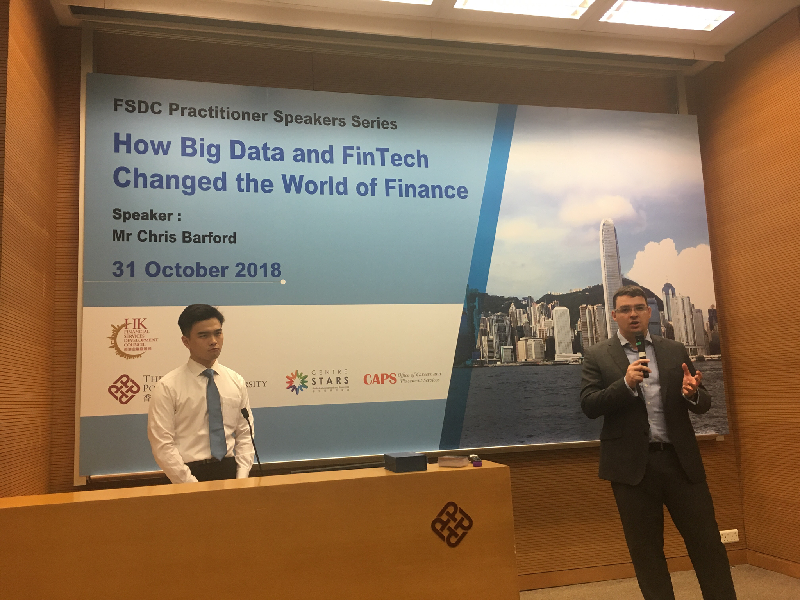


FSDC holds forum to explore how big data and Fintech changed financial industry (with photo)

The following is issued on behalf of the Financial Services Development Council:
 
     The Financial Services Development Council (FSDC) and the Hong Kong Polytechnic University today (October 31) jointly hosted a forum to explore how big data and financial technology (Fintech) have changed financial institutions.
 
     Entitled "How Big Data and FinTech Changed the World of Finance", the forum was the 29th event under the FSDC's Practitioner Speaker Series. The panel featured the Director of the Financial Services Advisory Team of EY, Mr Chris Barford, who also serves as Co-chair of the Big Data Committee of the FinTech Association of Hong Kong.
 
     As Director in EY's Data and Analytics practice leading the Financial Services team in Hong Kong, Mr Barford said, "Due to massive technological revolutions, surveys that predict that work is going to change for us all over the next 20 years may underestimate how significant the upcoming adjustments will be. However, there is so much hope and potential. In every prior technological revolution, we have created new jobs, new opportunities and different ways of being more productive."
 
     He added, "I encourage young graduates and university students to think for themselves how big data, Fintech and disruption will benefit Hong Kong's future as a competitive hub for financial services. The focus on working for a single large financial institution for life that was often your parents' dream is no longer the only route to a long career in financial services. At this point in your life, I would encourage you to consider a career path that embraces data, Fintech and disruption. 'Risk on', as investors would say.
 
     "With the introduction of virtual banking licences, due in December 2018, Hong Kong is poised on the edge of a financial services revolution, which was kicked off with the use of stored value facilities over the last few years. I hope that the difference between a mainly cashless, mobile first Mainland and Hong Kong's more traditional models that rely on money, paper forms and Octopus will converge. All of these innovations rely on big data, and I am hopeful this will occur imminently thanks to the Government's focus in this area, and the significant Fintech investment that private businesses are making."
 
     The FSDC's Practitioner Speaker Series is a project developed between the FSDC and local universities, with speakers from the financial services industry giving talks to university students about important industry facts and the skill sets required in developing a career in financial services.
 
About the FSDC
 
     The Hong Kong Special Administrative Region Government established the FSDC in 2013 as a high-level, cross-sectoral advisory body to engage the industry in formulating proposals to promote the further development of Hong Kong's financial services industry and to map out the strategic direction for development.
 
     The FSDC set up five committees, namely the Policy Research Committee, the Mainland Opportunities Committee, the New Business Committee, the Market Development Committee and the Human Capital Committee, as the five streams of its work.

Photo  


Transcript of SFH at media session

     Following is the transcript of remarks by the Secretary for Food and Health, Professor Sophia Chan, at a media session in the Legislative Council Complex after the passage of the Inland Revenue (Amendment) (No. 4) Bill 2018 today (October 31):

Reporter: (about tax reduction)

Secretary for Food and Health: A number of people have actually raised the issue of the attractiveness of tax reduction. I want to reiterate the fact that tax reduction is just one of the incentives to motivate people to buy these Voluntary Health Insurance Scheme (VHIS) products. In fact, there are other attractive points in the VHIS, such as the quality of the products increasing the confidence of the people to buy the insurance products, the regulation of the products including the transparency of the costs, and all related improvement measures of the insurance products. All these together would hopefully attract more people to buy VHIS products.

(Please also refer to the Chinese portion of the transcript.)


CHP notified of human case of avian influenza A(H5N6) in Guangxi

    The Centre for Health Protection (CHP) of the Department of Health (DH) today (October 31) received notification of an additional human case of avian influenza A(H5N6) in Guangxi from the National Health Commission, and again urged the public to maintain strict personal, food and environmental hygiene both locally and during travel.
 
     The case involved a 44-year-old man from Hechi in Guangxi. He developed symptoms on October 18, was hospitalised on October 21 and died on October 27. The patient denied that he had contact with live poultry before the onset of symptoms.
 
     From 2014 to date, 22 human cases of avian influenza A(H5N6) have been reported by the Mainland health authorities.
 
     "All novel influenza A infections, including H5N6, are notifiable infectious diseases in Hong Kong," the spokesman said.
 
     Travellers to the Mainland or other affected areas must avoid visiting wet markets, live poultry markets or farms. They should be alert to the presence of backyard poultry when visiting relatives and friends. They should also avoid purchasing live or freshly slaughtered poultry, and avoid touching poultry/birds or their droppings. They should strictly observe personal and hand hygiene when visiting any place with live poultry.
 
     Travellers returning from affected areas should consult a doctor promptly if symptoms develop, and inform the doctor of their travel history for prompt diagnosis and treatment of potential diseases. It is essential to tell the doctor if they have seen any live poultry during travel, which may imply possible exposure to contaminated environments. This will enable the doctor to assess the possibility of avian influenza and arrange necessary investigations and appropriate treatment in a timely manner.
 
     While local surveillance, prevention and control measures are in place, the CHP will remain vigilant and work closely with the World Health Organization and relevant health authorities to monitor the latest developments.
 
     The CHP's Port Health Office conducts health surveillance measures at all boundary control points. Thermal imaging systems are in place for body temperature checks on inbound travellers. Suspected cases will be immediately referred to public hospitals for follow-up.
 
     The display of posters and broadcasting of health messages in departure and arrival halls as health education for travellers is under way. The travel industry and other stakeholders are regularly updated on the latest information.
 
     The public should maintain strict personal, hand, food and environmental hygiene and take heed of the advice below if handling poultry:
 

  • Avoid touching poultry, birds, animals or their droppings;
  • When buying live chickens, do not touch them and their droppings. Do not blow at their bottoms. Wash eggs with detergent if soiled with faecal matter and cook and consume the eggs immediately. Always wash hands thoroughly with soap and water after handling chickens and eggs;
  • Eggs should be cooked well until the white and yolk become firm. Do not eat raw eggs or dip cooked food into any sauce with raw eggs. Poultry should be cooked thoroughly. If there is pinkish juice running from the cooked poultry or the middle part of its bone is still red, the poultry should be cooked again until fully done;
  • Wash hands frequently, especially before touching the mouth, nose or eyes, before handling food or eating, and after going to the toilet, touching public installations or equipment such as escalator handrails, elevator control panels or door knobs, or when hands are dirtied by respiratory secretions after coughing or sneezing; and
  • Wear a mask if fever or respiratory symptoms develop, when going to a hospital or clinic, or while taking care of patients with fever or respiratory symptoms.

 
     The public may visit the CHP's pages for more information: the avian influenza page, the weekly Avian Influenza Reportglobal statistics and affected areas of avian influenza, the Facebook Page and the YouTube Channel.