LCQ18: Metal gates of Public Rental Housing units

     Following is a question by Hon Alice Mak and a written reply by the Secretary for Transport and Housing, Mr Frank Chan Fan, in the Legislative Council today (November 17):
 
Question:
 
     I have received complaints from a number of tenants of public rental housing (PRH) alleging that quite a number of PRH units have been broken into and burgled by thieves because the metal gates of such unites had security vulnerabilities. However, the Housing Department has not actively arranged improvement works for the metal gates. In this connection, will the Government inform this Council:
 
(1) of the number of burglaries of PRH units in various PRH estates in the past three years;
 
(2) of (i) the number of complaints received by the authorities about metal gates of PRH units having security vulnerabilities, and (ii) the number of metal gates of PRH units for which improvement works were carried out by the authorities, in the past three years (with a breakdown by estates);
 
(3) of the types of metal gates installed for new PRH units by the authorities in the past three years and, among them, the respective types of metal gates (i) with complaints received about their having security vulnerabilities and (ii) the units to which they were fitted experienced a higher incidence of burglary;
 
(4) as the authorities announced in 2014 that old-type see-through collapsible gates of more than 170 000 PRH units would be replaced in the five years starting 2015-2016, of the progress of the work; whether the authorities have regularly reviewed the security level of the metal gates (including the new-type metal gates) of all PRH units in Hong Kong and carried out improvement works for the metal gates with security vulnerabilities; if so, of the time of the last review, as well as its outcome and the follow-up work; and
 
(5) whether the authorities will carry out improvement works for the metal gates with security vulnerabilities which have been provided for PRH units and for units which were sold under the Tenants Purchase Scheme, and bear the relevant repair and maintenance costs in future; if not, of the reasons for that?
 
Reply:
 
President,
 
     My consolidated reply to various parts of the question raised by the Hon Alice Mak is as follows.
 
     The Hong Kong Housing Authority (HA) has all along been attaching great importance to the security of Public Rental Housing (PRH) estates. The HA has put in place a number of security facilities, such as installing security gates with password locks at the entrances of ground floor lobbies and fire escape staircases of buildings, and providing 24-hour guard services, CCTV and telecom systems inside the lifts and at the main entrance of the buildings which are monitored by the tower guards stationed at the ground floor lobbies.
 
     The HA also places great emphasis on the training of guards. Guards are required to carry out visitors' registration at the entrances of ground floor lobbies at PRH buildings. Guard control rooms also arrange for guards and building supervisors to patrol the buildings and provide them with necessary support. Furthermore, the HA collects feedback from tenants and disseminates messages about anti-theft through the Estate Management Advisory Committees. When necessary, assistance from Police will be sought.
 
     Tenants' co-operation is crucial for achieving good security. In this regard, the HA periodically reminds tenants to close their main doors when leaving their flats, not to disclose the passwords of the entrance gates of ground floor lobbies to outsiders other than their family members, etc. Under safe condition, tenants are advised to notify the estate management office (EMO) or the guards immediately whenever suspicious or unknown persons are found loitering in the building premises.

     Upon receiving reports on burglary, staff of the EMO will provide appropriate assistance to the tenant. However, the HA has not maintained consolidated statistics on burglary cases concerning PRH units.
 
     In light of the problem that the old-type see-through collapsible gates require frequent maintenance due to ageing, the HA has launched a programme to replace such gates in about 170 000 PRH units from 2015-16 onwards. This five-year programme is expected to be completed in 2019-20. Up to October 2018, the HA has replaced the metal gates of about 70 per cent of such PRH units (about 120 000 units) under the programme.
 
     Other types of metal gates in PRH estates have been performing well in general. Hence, the HA has no plan to replace them. New PRH units completed in the past three years are installed with sliding metal gates.
 
     Tenants of PRH estates (including HA tenants in Tenants Purchase Scheme (TPS) estates) may contact the EMO in case they have any problem relating to the maintenance of the metal gates of their units. The EMO will deploy staff for on-site checking and follow-up. The HA will take up the maintenance costs of the metal gates, arising from normal wear and tear. Flat owners are responsible for the maintenance cost of the metal gates of sold flats in TPS estates.
 
     The HA has not maintained statistics on complaint cases about metal gates of PRH units.


LCQ5: Regulation of products containing cannabis

     Following is a question by the Dr Hon Helena Wong and a written reply by the Secretary for Security, Mr John Lee, in the Legislative Council today (November 7):

Question:

     Last month, the Canadian authorities relaxed control on recreational cannabis.  Packaging labels bearing "THC" (i.e. the abbreviation of tetrahydro-cannabinol, the main constituent of cannabis) or "Cannabis" indicates that the food products or drinks to which they are affixed contain cannabis, and nationals of that country may purchase such food products or drinks from licensed suppliers.  In addition, the World Health Organization has indicated that in recent years, some countries have relaxed the regulation of cannabidiol (CBD), a cannabis compound, and regarded products containing CBD as medical products.  Regarding the regulation of cannabis under the laws of Hong Kong, will the Government inform this Council:

(1) whether the import of food products or drinks containing THC falls within the ambit of the Dangerous Drugs Ordinance (Cap. 134); if so, of the details; if not, whether it will amend the relevant legislation to impose regulation in this regard;

(2) whether the possession or purchase via the Internet of food products or drinks containing THC is against the law; if so, of the details; and

(3) whether the manufacture or import of medical products, food products or drinks containing CBD is against the law; if so, of the details?

Reply:

President,

     In consultation with the Food and Health Bureau and the Department of Health, the reply to the question is as follows:

(1) and (2) Tetrahydro-cannabinol (THC) is a cannabinoid present in cannabis plants and is a dangerous drug controlled under the Dangerous Drugs Ordinance (Cap. 134).  Any products (including any food products and drinks) that contain THC are also controlled under Cap. 134.

     Under Cap. 134, trafficking in dangerous drugs, or illicitly importing to and exporting from Hong Kong, procuring, supplying, manufacturing, or dealing in or with dangerous drugs, constitutes a criminal offence.  The maximum penalty is life imprisonment and a fine of $5 million.  Illicitly possessing, or smoking, inhaling, ingesting or injecting dangerous drugs is subject to a maximum penalty of imprisonment for seven years and a fine of $1 million.

(3) Cannabidiol (CBD) is another cannabinoid present in cannabis plants but is not a dangerous drug controlled under Cap. 134.  For pharmaceutical products containing CBD but not any dangerous drugs, the products must be registered with the Pharmacy and Poisons Board (the Board) in accordance with the requirements under the Pharmacy and Poisons Ordinance (Cap. 138) before it can be sold or distributed.  Manufacturers, importers or distributors of the pharmaceutical products must also obtain relevant licences from the Board.  In addition, for importing pharmaceutical products, an import licence must be obtained under the Import and Export Ordinance (Cap. 60).  At present, no registered pharmaceutical product contains CBD.

     Regarding food products or drinks containing CBD, since it is difficult to extract pure CBD, the food products and drinks concerned may highly likely contain other cannabinoids controlled under Cap. 134 (such as THC).  The local food trade should avoid importing or manufacturing products concerned lest they would breach the law.


Ombudsman probes effectiveness of Joint Office for Investigation of Water Seepage Complaints in handling water seepage complaints

The following is issued on behalf of the Office of The Ombudsman:

     The Ombudsman, Ms Connie Lau, today (November 7) announced a direct investigation to examine the effectiveness of the Joint Office for Investigation of Water Seepage Complaints (JO) in handling water seepage complaints, with a view to making recommendations for improvement.

     High-rise buildings are ubiquitous in Hong Kong. Poorly maintained water pipes or waterproofing materials in the floor slabs of an upper floor unit would likely cause seepage to the unit below, giving rise to environmental hygiene nuisance. Upon receipt of a water seepage complaint, the JO, which is composed of staff from the Food and Environmental Hygiene Department and the Buildings Department, will conduct investigation and tests. Should an upper floor unit be confirmed as the source of water seepage, the JO will issue a Nuisance Notice requiring that necessary repairs be carried out by that unit.

     Between January 2016 and September 2018 (i.e. 33 months in total), the Office of The Ombudsman had received 360 complaints against the JO for failing to properly handle water seepage problems. Many complainants alleged that despite the JO taking a long time to conduct various tests, the source of water seepage still remained unidentified. The JO relies mainly on colour water tests to locate the source of seepage. While the Office may at times engage a consultant to use newer technologies (such as infrared or microwave detectors) in dealing with more complicated cases, that is not a general practice.

     Ms Lau said, "Prolonged water seepage can cause great nuisance to the parties affected and would lead to environmental hygiene problems. We have initiated this direct investigation with a view to exploring with the JO better ways to effectively resolve water seepage complaints."

     To make the investigation more comprehensive, The Ombudsman is now inviting the public to send in information and/or views in writing to the Office of The Ombudsman by December 8, 2018:
 
Address: 30/F, China Merchants Tower, Shun Tak Centre, 168-200 Connaught Road Central, Hong Kong
Fax: 2882 8149
Email: complaints@ombudsman.hk


Red flag hoisted at Silverstrand Beach

Attention TV/radio announcers:

Please broadcast the following as soon as possible:

Here is an item of interest to swimmers.

     The Leisure and Cultural Services Department announced today (November 7) that due to big waves, red flag has been hoisted at Silverstrand Beach in Sai Kung District. Beach-goers are advised not to swim at the beach.


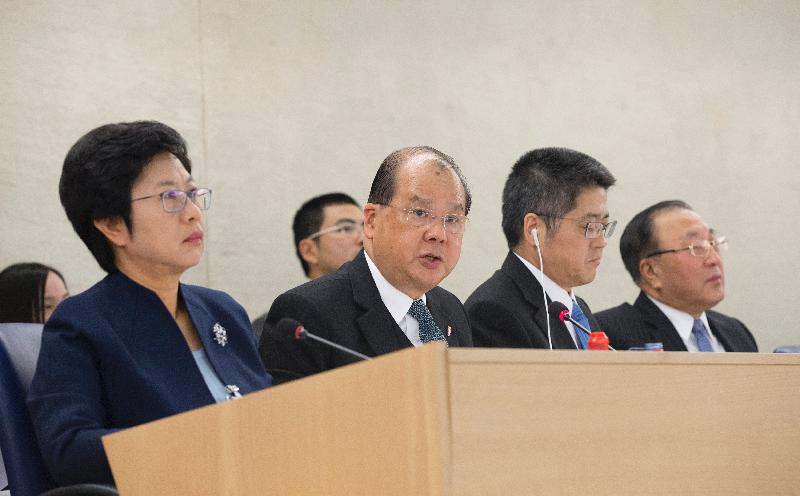
Chief Secretary clears air on Hong Kong’s human rights situation at UN Forum (with photo)

     The Universal Periodic Review (UPR) Working Group of the United Nations Human Rights Council (UNHRC) held a review meeting in Geneva, Switzerland today (November 6, Geneva time) to consider China's third report, which covers the Hong Kong Special Administrative Region (HKSAR) and Macao Special Administrative Region. 
 
     A team of HKSAR Government officials, led by the Chief Secretary for Administration, Mr Matthew Cheung Kin-chung, attended the meeting as members of the China delegation.
 
     Mr Cheung spoke at the meeting in his capacity as the Deputy Head of Delegation led by the Vice Minister of Foreign Affairs, Mr Le Yucheng. 
 
     Some 150 Member States spoke at the meeting today and eight of them gave oral comments and four submitted written comments on the report submitted by the HKSAR.
 
     In response to concerns and questions raised by Member States, Mr Cheung reiterated that Hong Kong enjoyed a high degree of autonomy under "one country, two systems" and that fundamental rights and freedoms were all guaranteed by the Basic Law. 
 
     "Recent concerns over some aspects of Hong Kong's human rights situation are unwarranted, unfounded and unsubstantiated.  They arise from misconception and a lack of understanding of our real situation," he stressed. 
 
     "We are firmly committed to protecting press freedom. We do not exercise any censorship.
 
     "On a recent work visa extension case, we will not comment on any specific decision on our immigration control.  All such decisions are made by our immigration authorities under the laws and prevailing policies, having regard to individual circumstances of each case.  
 
     "Any concerns that Hong Kong's freedom of speech and of the press is under threat are totally groundless.  On the contrary, we maintain an environment conducive to the operation of a free and active press.   Some 80 foreign media organisations operate in Hong Kong and rigorously perform their role as a watchdog," Mr Cheung emphasised.
    
     Speaking on the eligibility for running in the Legislative Council election, Mr Cheung pointed out that "Article 1 of the Basic Law stipulates that HKSAR is an inalienable part of the People's Republic of China." 
 
      "HKSAR has the duty to safeguard our country's sovereignty, security and development interests.  A person who promotes 'Hong Kong independence' or 'self-determination' or advocates independence as an option cannot uphold the Basic Law and swear allegiance to HKSAR," he emphasised. 
 
     Mr Cheung said that the Standing Committee of the National People's Congress had the ultimate authority to interpret the Basic Law under Article 158.  The Court of Final Appeal agreed that the Standing Committee's interpretation was valid and binding on our courts.  As for Article 104 relating to oath-taking when assuming specified public offices, the Standing Committee's interpretation simply explained clearly the meaning of that Article without changing its content.
 
     Whilst the HKSAR Government would not comment further on the decision to ban an organisation under the Societies Ordinance as appeal has been lodged, Mr Cheung pointed out that "Hong Kong people do enjoy freedom of association and expression but, like any other jurisdictions, such freedom is not absolute.  The International Covenant on Civil and Political Rights provides that restrictions may be imposed by law if this is necessary to protect national security or public safety, public order, or the rights and freedoms of others.  This is mirrored in the Hong Kong Bill of Rights."
     
     Mr Cheung took the opportunity to dispel the misunderstanding that some protesters were targeted for exercising their civil rights. 
 
     "I must clarify that these protesters were convicted not because of their beliefs or their exercising civil rights, but because of their disorderly or violent conduct in breach of the law.  They have crossed the line separating the lawful exercise of constitutional rights from unlawful activities subject to sanctions," Mr Cheung explained.
 
     "I must say that the number of public meetings and processions in Hong Kong last year was ten times over 1997, and the overwhelming majority of these activities were orderly and peaceful.  This demonstrates that freedom of peaceful assembly is fully respected," Mr Cheung said.
 
     On speculations of authorities of other jurisdictions taking law enforcement actions in Hong Kong, Mr Cheung said that the Hong Kong Police had investigated and found no evidence in support of such claims.  
 
     The UN Working Group meeting noted that since the establishment of the HKSAR in 1997, Hong Kong had remained the world's freest economy, a vibrant international financial and business centre, a thriving logistics and tourism hub, as well as one of the safest cities in the world. 
 
     "We are committed to building a caring and fair Hong Kong, with the Government investing heavily in education, medical services, welfare, infrastructure, poverty alleviation and helping the ethnic minorities. 
 
     "Such remarkable achievements are underpinned by our core values and unique institutional strengths which make Hong Kong tick.  Hong Kong will continue to forge ahead as Asia's world city with openness, inclusiveness and diversity under the successful, innovative and well-tried 'one country, two systems'," Mr Cheung highlighted. 
 
     The delegation will attend the meeting to be held on November 9 when the report on China will be adopted by the UNHRC Working Group.
 
     The human rights situation in Hong Kong was reported to the Working Group during the review meeting. 
 
     The meeting noted that since the establishment of the HKSAR in 1997, the HKSAR Government "has been implementing 'one country, two systems' and 'Hong Kong people administering Hong Kong' under a high degree of autonomy in strict accordance with the Basic Law of the HKSAR and with the full support of the Central People's Government." 
 
     The rule of law, executive, legislative and independent judicial power and power of final adjudication, as well as human rights and freedom are all fully guaranteed by the Basic Law.  Hong Kong has been ranked as the world's most open and freest economy for many years.  Such achievement is underpinned by HKSAR's strengths such as the fine tradition of rule of law, a free and open market, an efficient public sector and a robust institutional framework.  
 
     The Working Group also noted that, alongside with the promotion of economic development, the HKSAR Government had devoted significant resources to education, poverty alleviation, helping the disadvantaged, caring for children and support for the ethnic minorities, with a view to building a caring, equitable, inclusive and "people-oriented" society.  All these bear strong testimony to the successful implementation of "one country, two systems", the achievements of which are widely recognised.

Photo