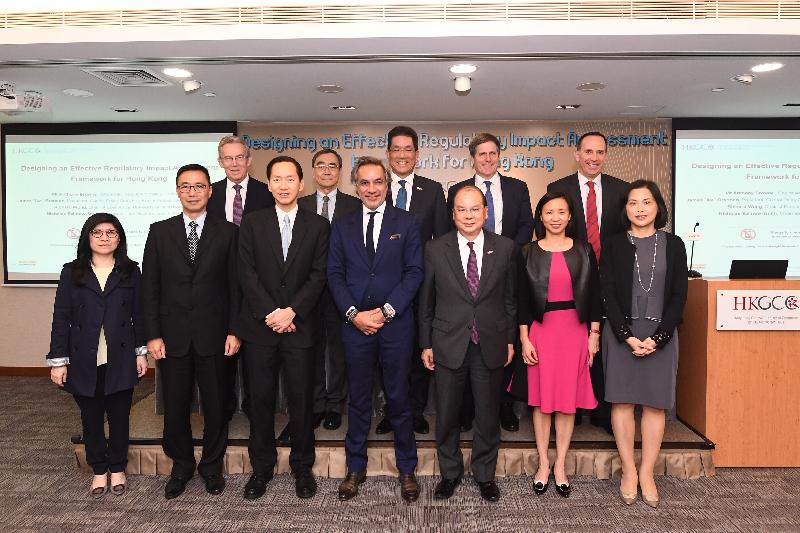
Following is the speech by the Chief Secretary for Administration, Mr Matthew Cheung Kin-chung, at a seminar on "Designing an Effective Regulatory Impact Assessment Framework for Hong Kong" hosted by the Hong Kong General Chamber of Commerce (HKGCC) this afternoon (November 15):
Aron (Chairman of HKGCC, Dr Aron Harilela), Shirley (Chief Executive Officer of HKGCC, Ms Shirley Yuen), distinguished guests, ladies and gentlemen,
Good afternoon. It is my honour to join you all here to speak on the subject of "Regulatory Impact Assessment" which sits at the core of the legislative process of the Hong Kong Special Administrative Region (HKSAR) Government.
Hong Kong is an open and free market. For 24 consecutive years, Hong Kong has topped the Heritage Foundation’s Index of Economic Freedom. In the 2018 Index, Hong Kong came first in a number of categories, including business freedom, trade freedom, financial freedom and fiscal health.
Freedom is not just a privilege enjoyed by large and established corporations. Across the city, small and medium enterprises thrive, and startups are bourgeoning. To provide a level-playing field for businesses to grow, Hong Kong establishes safeguards and regulations needed for healthy competition to take place, so that good performers stand a fair chance to win market share, while those who cannot make it can try again. For this reason, Hong Kong has long been amongst the top five markets in the World Bank’s Ease of Doing Business global ranking, which places great emphasis on market health for small and medium enterprises (SMEs).
One key building block to maintaining a level-playing field in Hong Kong is our competition regime. Competition is a key driver of growth and one of the pillars of a vibrant economy. A robust competition regime ensures that the most efficient and innovative market players, big or small, can thrive, and new players may also enter the market with no barrier. To this end, the Competition Ordinance in Hong Kong came into full effect in 2015. The Ordinance prohibits anti-competitive practices such as bid-rigging, price-fixing, market-sharing and abuse of market power. It is gradually making its mark across the economy.
Established under the Ordinance as an independent authority, the Competition Commission has achieved a number of important milestones across its various facets of work, including taking a number of anti-competitive cases to court, in less than three years. Besides enforcement, the Competition Commission has also spared no effort in public education and giving sector-specific advice on compliance. As a result, both the business sector and the general public in Hong Kong are increasingly aware of the Ordinance and how it works. There have also been concrete changes in business practices and culture. I trust that you would agree with me that rather than tying the hands of businesses, the Competition Ordinance provides better safeguards for them to develop and expand freely in Hong Kong.
The HKSAR Government never takes Hong Kong's economic freedom for granted. It is the bedrock of our success, the basis for growth, and the prerequisite for economic and social progress. In practice, this means regulations should be made and implemented to the effect that companies are not subject to unreasonable compliance risks and can realise their full potential as compliant businesses.
In deciding whether to regulate and if so, how much, Government bureaux and departments need to strike the right balance between protecting the citizen and limiting the impact on those being regulated, especially small, medium and micro businesses. Considering what form of regulation if any is needed throughout the legislative process requires careful regulatory impact assessments.
The purpose of regulatory impact assessments is to explain the objective of the regulatory proposal, the risks being addressed and the likely costs and benefits of options for delivering the objective. To this end, the HKSAR Government has a long-established mechanism to assess the implications of legislative proposals from different perspectives. The key elements include evaluating a range of options, including not regulating, and encouraging self-regulation where feasible. If regulation is needed, relevant policy bureau and departments need to consider how to ensure compliance by those affected.
While many believe that regulation can safeguard citizens, promote a prosperous economy and protect the environment, regulation can also impose costs on businesses, charities, voluntary organisations, and ultimately the citizen. And the effort involved in understanding and implementing new regulations can bear particularly heavily on small, medium and even micro businesses that are more vulnerable to changes in the business environment.
This is the reason why Government policy bureaux and departments are required to assess thoroughly the impact of every legislative proposal, including whether it is in conformity with the Basic Law as well as relevant provisions on human rights, any impact on the binding effect of the existing laws, as well as implications on the financial, economic, productivity, environmental, sustainability, family, gender and civil service. An assessment of the implications of a legislative proposal needs to be set out clearly in writing for consideration during the legislative process.
The HKSAR Government takes it upon itself to ensure that legislative proposals are put through proper and thorough consultation with the public, which includes the business community. In addition, the Legislative Council maintains its critical function of scrutinising bills and subsidiary legislation for any unintended or adverse impact on the business or other sectors. This system keeps regulatory impacts in check for business in Hong Kong.
Indeed, the current-term Government takes a pragmatic approach to "care", "listen" and "act" while being "innovative", "interactive" and "collaborative" in implementing our policy initiatives proactively. A case in point is the proposal to abolish the arrangement for "offsetting" severance payments (SPs) and long service payments (LSPs) with Mandatory Provident Fund (MPF) benefits. As you are aware, the Government has decided to further enhance the Government’s financial support for employers, particularly the micro, small and medium-sized enterprises (MSMEs).
We will extend the period of the second-tier subsidy to 25 years. Together with the 12-year first-tier subsidy, the financial commitment of the entire government subsidy scheme will be significantly increased to $29.3 billion. We believe that the arrangement of significantly extending the period and increasing the commitment will go a long way in helping MSMEs make preparation relating to possible SPs or LSPs payable by them.
Another good example is the proposal to extend the statutory maternity leave (ML) from the current 10 weeks to 14 weeks. If an employee is entitled to ML pay under the Employment Ordinance, the employer will, together with the current 10 weeks’ statutory ML pay, also provide her with ML pay for the additional four weeks’ statutory ML. The rate will be maintained at four-fifths of the employee’s average daily wages and be subject to a cap of $36,822 per employee. The cap may be adjusted from time to time. Employers may apply to the Government for reimbursement of the additional four weeks’ statutory ML pay.
I just want to close by emphasising that when we started off with this new term of Government, we made it very clear that we would step forward – apart from traditional, conventional regulatory and service provider roles, we would also take on a new role proactively as a facilitator and promoter. That is why the Government is not only here to regulate, but is also actively promoting an environment conducive to businesses operating, striving, in Hong Kong.
On this note, I thank you all for inviting me and wish you all a very fruitful and stimulating exchange today. Thank you.