Labour Department to hold talk on employment of foreign domestic helpers

     The Labour Department will hold a talk on the employment of foreign domestic helpers (FDHs) on February 22 (Friday) at 7.30pm at the Lecture Hall of the Hong Kong Space Museum, 10 Salisbury Road, Tsim Sha Tsui. Enrolment is now open.

     The employment rights and obligations of employers of FDHs will be introduced. The Founding President of the Hong Kong College of Nursing and Health Care Management, Dr Alice Tso, has been invited to speak about her experience in hiring and living with FDHs over the past 30 years and more, as well as the effective ways to communicate with them. Employers of FDHs, especially first-time employers, are welcome to attend.

     The seminar will be conducted in Cantonese and admission is free. Seats will be allocated on a first-come, first-served basis. The enrolment deadline is February 19 (Tuesday). The enrolment form can be downloaded from the department's website (www.labour.gov.hk). For enquiries, please call the Labour Department at 2852 4000.


Illegal worker jailed

     An Indian illegal worker holding a recognisance form was jailed by Shatin Magistrates' Courts yesterday (January 16).
      
     During a joint operation conducted by the Immigration Department (ImmD) and the Hong Kong Police Force codenamed "Champion" on July 18, 2018, enforcement officers raided an industrial building in Kowloon Bay. A male Indian illegal worker, aged 33, was arrested. When intercepted he was working as a renovation worker. Upon identity checking, he produced for inspection a recognisance form issued by the ImmD, which prohibits him from taking employment. Further investigation revealed that he was a non-refoulement claimant.
 
     The illegal worker was charged at Shatin Magistrates' Courts yesterday with taking employment after landing in Hong Kong unlawfully and remaining in Hong Kong without the authority of the Director of Immigration or while being a person in respect of whom a removal order or deportation order was in force. He pleaded guilty to the charge and was sentenced to 16 months and 26 days' imprisonment.
 
     The ImmD spokesman warned that, as stipulated in section 38AA of the Immigration Ordinance, illegal immigrants or people who are the subject of a removal order or a deportation order are prohibited from taking any employment, whether paid or unpaid, or establishing or joining in any business. Offenders are liable upon conviction to a maximum fine of $50,000 and up to three years' imprisonment. The Court of Appeal has issued a guideline ruling that a sentence of 15 months' imprisonment should be applied in such cases.
     
     The spokesman reiterated that it is a serious offence to employ people who are not lawfully employable. The maximum penalty is imprisonment for three years and a fine of $350,000. The High Court has laid down sentencing guidelines that the employer of an illegal worker should be given an immediate custodial sentence. According to the court sentencing, employers must take all practicable steps to determine whether a person is lawfully employable prior to employment. Apart from inspecting a prospective employee's identity card, the employer has the explicit duty to make enquiries regarding the person and ensure that the answers would not cast any reasonable doubt concerning the lawful employability of the person. The court will not accept failure to do so as a defence in proceedings. It is also an offence if an employer fails to inspect the job seeker's valid travel document if the job seeker does not have a Hong Kong permanent identity card. The maximum penalty for failing to inspect such a document is imprisonment for one year and a fine of $150,000.
 
     Under the existing mechanism, the ImmD will, as a standard procedure, conduct initial screening on vulnerable persons, including illegal workers, illegal immigrants, sex workers and foreign domestic helpers, who are arrested during any operation, with a view to ascertaining whether they are trafficking in persons (TIP) victims. When any TIP indicator is revealed in the initial screening, the officers will conduct a full debriefing and identification by using a standardised checklist to ascertain the presence of TIP elements, such as threat and coercion in the recruitment phase and the nature of exploitation. Identified TIP victims will be provided with various forms of support and assistance, including urgent interference, medical services, counselling, shelter, temporary accommodation and other supporting services. The ImmD calls on TIP victims to report crimes to the relevant departments.


Red flag hoisted at Clear Water Bay Second Beach

Attention TV/radio announcers:

Please broadcast the following as soon as possible:

Here is an item of interest to swimmers.

     The Leisure and Cultural Services Department announced today (January 17) that due to big waves, the red flag has been hoisted at Clear Water Bay Second Beach in Sai Kung District. Beach-goers are advised not to swim at the beach.


Appointments to Board of Financial Services Development Council

     The Government announced today (January 17) appointments to the Board of Directors of the incorporated Financial Services Development Council (FSDC) for a term of two years from January 17, 2019 to January 16, 2021.
 
     Further to the appointment of Mr Laurence Li Lu-jen as Chairman of the Board of Directors upon the incorporation of the FSDC as a company limited by guarantee, the Chief Executive has appointed 14 members to the Board of the incorporated FSDC, including 12 serving members of the FSDC. The Board will oversee the operation of the incorporated FSDC with effect from January 17, 2019. 
 
     Announcing the appointments, the Secretary for Financial Services and the Treasury, Mr James Lau, said, "The appointees are all seasoned practitioners and broadly representative of major sectors of the financial services industry. I am confident that the Board will direct the incorporated FSDC to further step up its efforts in conducting research, promoting market development, and nurturing talent with increased resources and operational flexibility."
 
     Mr Lau also expressed his heartfelt gratitude to all outgoing members of the FSDC for their contributions to the work of the FSDC over the past years.
 
     The FSDC was established in 2013 by the Hong Kong Special Administrative Region Government as a high-level, cross-sectoral advisory body to engage the industry in formulating proposals to promote the further development of Hong Kong's financial services industry and to map out the strategic direction for development. The FSDC has been incorporated as a company limited by guarantee with effect from September 2018 to allow it to better discharge its functions with more flexibility. 
 
     Following is the membership list of the Board of the incorporated FSDC with effect from January 17, 2019:
 
Chairman
———-
Mr Laurence Li Lu-jen   (appointed with effect from September 21, 2018)
 
Members (14)
—————
Dr Au King-lun
Ms Diana Cesar*
Ms Bonnie Y Chan
Ms Lena Chan*
Mr Mark Dickens
Ms Ding Chen
Mr Henry Fan Hung-ling
Mr Glenn Fok
Dr Hu Zhanghong
Mr Brian Li Man-bun
Mr Joe Ngai
Mr Andrew Walter Bougourd Ross Weir
Mr Stephen Wong Yuen-shan
Ms Winnie Wong Chi-shun
 
Ex-officio member
——————–
Mr James Lau (in the capacity as Secretary for Financial Services and the Treasury)
 
* new appointee


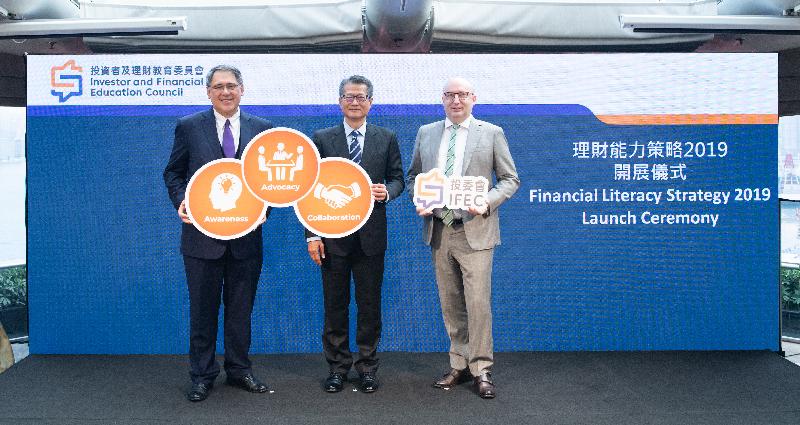
Speech by FS at Financial Literacy Strategy 2019 Launch Ceremony (English only) (with photos/video)

     Following is the speech by the Financial Secretary, Mr Paul Chan, at the Financial Literacy Strategy 2019 Launch Ceremony today (January 17):
 
Lester (Chairman of the Investor and Financial Education Council, Mr Lester Huang), David (General Manager of the Investor and Financial Education Council, Mr David Kneebone), Tim (Chairman of the Securities and Futures Commission, Mr Tim Lui), distinguished guests, ladies and gentlemen,
 
     Good morning.
 
     I'm pleased to be here today for the launch of the latest version of the Financial Literacy Strategy, with a continuing and vitally important mission to advance the financial literacy of the people of Hong Kong.
 
     That mission was set in motion with the establishment of the Investor Education Centre – now the Investor and Financial Education Council – in late 2012. It took flight three years later, with the release of the Hong Kong Financial Literacy Strategy in 2015, as mentioned by Lester. The new Strategy unveiled today builds on the inaugural version, applying what has been learned in the past three years about financial literacy and focusing on those who need it the most.
 
     This is why this 2019 version puts more emphasis on financial literacy and socio-economic issues, from our ageing population and youth development to financial inclusion.
 
     It's also why this new version emphasises specific target audiences, including youths, working adults, the elderly, low-income families and those who struggle with low income and less community integration.
 
     Today's financial market is endlessly changing and complex, with technology increasingly driving financial innovation. At the same time, such societal changes as increased longevity have brought about new considerations and needs in financial planning, at both the individual and the community levels.
 
     In short, people today must be equipped with the relevant knowledge to make informed financial choices under rapidly changing socio-economic circumstances. That is certainly no easy task, Lester.
 
     Hong Kong, of course, is one of the world's leading international financial centres. We take pride in offering a wide range of financial services and products. The people of Hong Kong have long participated in the financial market through, for example, the trading of stocks.
 
     That said, there are clearly some concerns regarding Hong Kong's overall financial knowledge, according to a recent survey. For example, while about 80 per cent of the people of Hong Kong have financial goals, less than half have taken the necessary action to achieve those goals.
 
     Although four out of five people lived within their means, some 40 per cent of respondents lacked the emergency funds to respond to unexpected financial needs.
 
     And for those who borrowed money, about 20 per cent admitted to failing to make their debt repayments on time.
 
     In short, there is room to improve financial literacy and awareness in Hong Kong. That makes the new Strategy all the more timely.
 
     To be sure, financial education – like education in general – is a long-term process, if not a life-long pursuit. In its six years of existence, however, the Investor and Financial Education Council has laid a solid foundation in enhancing the financial literacy of our people, including the elderly, working adults, youths and school children.
 
     The Chin Family, and its lively cartoon characters, is now a household name. And in March, the third edition of Money Month will be held, bringing together the financial planning prowess of Government, finance, education, the media and more.
 
     I'm pleased to note the Council is hardly alone on the financial education front. The Hong Kong Monetary Authority, for example, has launched a Consumer Education Programme. It offers tips on banking and related products and services. That includes the recently launched Faster Payment System, as well as stored-value facilities, Internet banking services, ATMs and credit cards.
 
     And HKMC Annuity, a subsidiary of the Hong Kong Mortgage Corporation, runs a campaign to boost public awareness of the suitability, and, of course, the associated risks, of using your life annuity as a retirement-planning solution.
 
     The Securities and Futures Commission issued guidelines relating to the distribution and trading of virtual assets in last November. The Commission, of course, oversees the new Investor and Financial Education Council.
 
     I am confident that under the able leadership by Lester, the new Council will build on the good work done by its predecessor in advancing financial literacy in Hong Kong.
 
     Certainly, the Investor and Financial Education Council has the full support of the Government. A financially informed public can make a difference for all of us.
 
     My thanks again to all those involved in creating the new Financial Literacy Strategy, from the Council's predecessor, the Investor Education Centre, to the Education Bureau, our four financial regulators, representatives of the Hong Kong financial industry and many stakeholders.
 
     Ladies and gentlemen, I wish you all a new year blessed with health, happiness and financial well-being.
 
     Thank you.
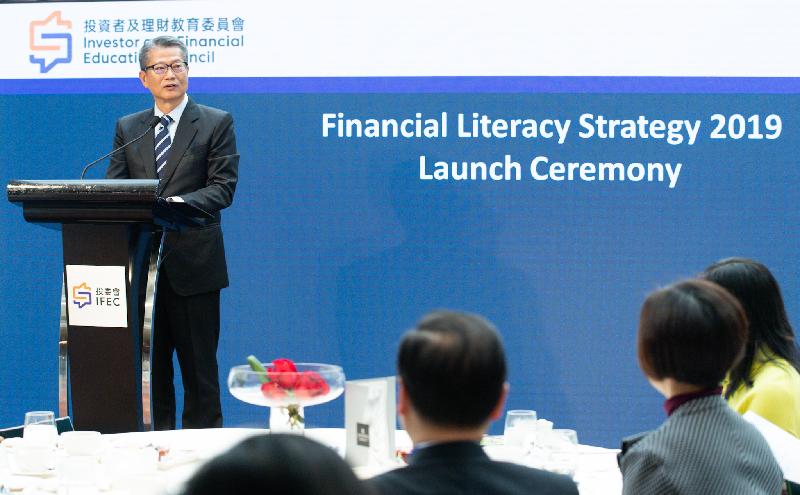
Photo  Photo