Speech by FS at Greater Bay Entrepreneurship Day in Davos (English only)

     Following is the speech by the Financial Secretary, Mr Paul Chan, at the Greater Bay Entrepreneurship Day today (January 22, Davos time) in Davos, Switzerland:

Calvin (the Chairman and President of AMTD Group, Mr Calvin Choi), Mayor Chen (the Executive Vice Mayor of Guangzhou Municipality, Mr Chen Zhiying), Mr Leung (the Chairman of the Chamber of Hong Kong Listed Companies, Mr Francis Leung), Ms Chao (the Executive Chairman of Wah Kwong Maritime Transport Holdings, Ms Sabrina Chao), Distinguished Guests, Ladies and Gentlemen,

     Good evening! A very warm welcome to you all to this Greater Bay Entrepreneurship Day.

     First of all, I congratulate AMTD Group on organising this event, which shines a light on the exciting potential of the Guangdong-Hong Kong-Macao Greater Bay Area (Greater Bay Area).

     We are fortunate to have a number of leading entrepreneurs – people who know what it takes to succeed in Hong Kong, in the Mainland of China and internationally – to share their insights and experiences with us today.

     The Greater Bay Area is a huge and wide-ranging initiative with great potential for our region and for local and international entrepreneurs alike.

     So let me begin by putting the scale of the Greater Bay Area into perspective:

     Covering more than 56 000 square kilometres, it is larger than the Tokyo and San Francisco Bay Areas combined.

     The Greater Bay Area has a total population of nearly 70 million, similar to that of the United Kingdom, and generates GDP of about US$1.5 trillion, which is similar to that of Korea and roughly double that of Switzerland (US$679 billion in 2017).

     What's more, Greater Bay Area GDP is forecast to reach US$4.6 trillion by 2030, which is close to that of Japan in 2017 (Japan GDP in 2017 – US$4.87 trillion).

     In other words, this is a globally significant economic cluster. It covers nine major cities in Guangdong Province plus the Special Administrative Regions of Hong Kong and Macao. Each of these cities has their own strengths, in manufacturing, technology, tourism, finance and so on.

     The challenge is to harness the collective economic power of the region, and what's most exciting for entrepreneurs is that we are just getting started! Opportunities for new ideas and inventions are limitless.

     Here's how Hong Kong can help you connect and excel in the Greater Bay Area.

     As a Special Administrative Region of China guided by the principle of "one country, two systems", our city offers several unique and deeply ingrained advantages. These include free flows of capital, people and information and a level playing field for all businesses. Our tried and trusted common law system, underpinned by an independent judiciary, gives entrepreneurs peace of mind whether in getting started, raising capital, mergers and acquisitions or resolving disputes.

     Capitalising on these strengths, Hong Kong is a global financial centre, ranked alongside New York and London. Last year, we led the world again in terms of IPO funds raised (approximately US$37 billion). We serve as a fund management, insurance and offshore Renminbi business hub for the region and the world. So if you choose to raise capital or settle trade using the Chinese currency, you can do that easily and efficiently in Hong Kong.

     Perhaps the most valuable asset for entrepreneurs taking the plunge in any new market is know-how. Hong Kong has been doing business with the Mainland for decades, and especially since China implemented its opening up and reform policies 40 years ago.

     We know the language, the culture, the people and the way of doing business in the Mainland, and the next generation of entrepreneurs can use this knowledge to their advantage when they explore Greater Bay Area opportunities.

     Our cross-boundary connectivity – close links with both the Mainland and the rest of the world – has helped to attract more than 8 700 Mainland and overseas companies to operate in Hong Kong. Nearly half of them have their regional headquarters or regional offices in our city, according to the latest report by Invest Hong Kong.

     In the past few years, the local start-up scene has also shifted into high gear. Currently, there are over 2 600 start-ups in Hong Kong, representing an increase of 18 per cent compared to 2017. A closer look reveals that 35 per cent of the founders are from outside Hong Kong with the leading countries of origin being the UK, the US, Mainland China and Australia.

     That also means that just over 60 per cent of start-up founders are from Hong Kong, reflecting our entrepreneurial spirit that is part of our city's DNA.

     The Government is supportive of youth innovation and entrepreneurship. We have set up a $300 million Youth Development Fund to support business ventures by young people. To further enhance support for youth business start-ups, we will inject another $300 million into the Fund.

     Elsewhere, InvestHK launched the StartmeupHK programme in 2013 to attract innovative and scalable entrepreneurs to Hong Kong. The programme serves as a one-stop service platform to support entrepreneurs and enhance our start-up ecosystem.

     And the Hong Kong Trade Development Council provides start-ups and SMEs with a competitive edge in such areas as market insights, effective networking and trade promotion opportunities, to name just a few.

     We encourage collaborative efforts between the Government and various community resources to help young entrepreneurs grasp opportunities in the Greater Bay Area.

     Echoing this spirit of collaboration, we applaud the establishment of the Greater Bay Young Entrepreneurs Association.

     Working together, I believe that we can spur the Greater Bay Area to achieve its full potential, and, in doing so, create new and exciting opportunities for start-up entrepreneurs.

     I wish you all a fruitful Greater Bay Entrepreneurship Day and the best of business in 2019. Thank you.


LegCo Members visit Tai O

The following is issued on behalf of the Legislative Council Secretariat:
  
     Legislative Council (LegCo) Members conducted a site visit to Tai O today (January 22) to follow up on a complaint put forth by a deputation about the location and design of the new bus terminus as well as the new public open space (previously known as the entrance plaza) in Tai O.
 
     In order to enhance the traffic and pedestrian circulation, the Administration has reconstructed the bus terminus under the Tai O Improvement Works Project.  Yet, the deputation considers such reconstruction undesirable and hence lodges a complaint with the Members. Accompanied by representatives of the Development Bureau, the Civil Engineering and Development Department as well as the Transport Department, Members visited the new bus terminus and the new public open space. During the visit, Members took the opportunity to exchange views with residents to learn more about their concerns.
 
     After the site visit, Members held a case conference with the Administration and the New Lantao Bus Company (1973) Limited at the LegCo Complex for follow-up.
 
     Members who participated in the visit included Mr Chan Chi-chuen (Convenor), Mr Leung Yiu-chung, Mr Leung Che-cheung and Mr Chu Hoi-dick.


Transcript of remarks by STH

     Following is the transcript of remarks by the Secretary for Transport and Housing, Mr Frank Chan Fan, at a media session at the lobby of the West Wing in Central Government Offices today (January 22):
 
Reporter: Secretary, could you first explain why there is a sudden change? Because just hours earlier you were saying that you still had the slightest hope that the proposal will win enough votes in the Legislative Council. My second question is that you mentioned that there could be room for some minor changes, some concessions, small concessions. What sort of concessions are you talking about? Because you said the big framework, the tolls, shouldn't be changed. So are you thinking about subsidies or allowances for drivers, the transitional period? What do you have in mind? And thirdly, you mentioned that you are trying to persuade lawmakers, to spend the next two months to try to persuade the lawmakers. If you don’t win enough support after two months, what's next?

Secretary for Transport and Housing: As you would be aware that throughout the process when we started promoting and campaigning for the acceptance of the motion by our friends in the legislature, we have been taking a very positive and very proactive approach to explain and earn their trust and acceptance of the proposal. But so far as you would appreciate, every one of them is speaking not because of something fundamental of difference, but rather focusing on the toll of the Cross Harbour Tunnel and the Eastern Harbour Crossing. That is why if these are the only differences or the major concerns they have, I would think that there are rooms for further discussion and agreement, and that is the belief we have in mind. Of course, when you ask whether or not there are rooms for changes, be it minor or major, we are rather open in that aspect because so far when we talked with our friends in the legislature, not many of them have come up with a concrete proposal per se. Instead, they would suggest us to lower the toll of the Cross Harbour Tunnel and the Eastern Harbour Crossing. Since these are things that we can't change unilaterally, I have explained to them that if they are agreeable to keeping these agreements in principal intact, perhaps we can focus on things that we can talk about, which are of value and benefit to the community at large. Therefore, we do have a hope and belief that we would be able to make it. Of course, whether or not we could make it depends on the reception and responses of friends in the legislature.

Reporter: What are things…

Secretary for Transport and Housing: We haven't come to that yet, I must say. Because since the time we introduced the motion, we haven't had that much of time to talk about whether or not and how we are going to make compromises. As you have reported during the past few months, the focus is mainly on toll. So there had not been any concrete suggestion or proposal put forward, and we are looking into that with an open mind.

 (Please also refer to the Chinese portion of the transcript.)


CHP investigates case of severe paediatric influenza A infection

     The Centre for Health Protection (CHP) of the Department of Health is today (January 22) investigating a case of severe paediatric influenza A infection.

     The case involves a 35-month-old boy with good past health, who has presented with fever and cough since January 19. He developed convulsions on January 21 and attended Hong Kong Adventist Hospital – Tsuen Wan. He was transferred to the Accident and Emergency Department of Yan Chai Hospital and was subsequently admitted to the paediatric intensive care unit of Princess Margaret hospital for further management on the same day.
 
     His nasopharyngeal aspirate tested positive for influenza A virus upon laboratory testing. The clinical diagnosis was influenza A infection complicated with encephalitis. He is now in a stable condition.

     Initial enquiries revealed that the patient had not received seasonal influenza vaccination for the current season and had no travel history during the incubation period. His elder brother also had influenza A, but did not require hospitalisation and has been in a stable condition. His other home contacts have remained asymptomatic so far.
 
     The CHP's investigations are ongoing.
 
      "The latest surveillance data indicated that the local seasonal influenza activity may continue to rise in the period ahead. We urge the community to continue heightening its vigilance against seasonal influenza. As young children are particularly affected in this influenza season, we appeal to parents who have not yet arranged vaccination for their children in this season to do so as soon as possible to strengthen their personal protection," a spokesman for the CHP said.

     "Apart from children, people aged 50 to 64 years, the elderly and those with underlying illnesses who have not yet received influenza vaccination this season are also urged to get vaccinated as early as possible to prevent seasonal influenza as it takes about two weeks for antibodies to develop in the body after vaccination. Medical advice should be sought promptly if influenza-like symptoms develop so that appropriate treatment can be initiated as early as possible to prevent potential complications. Parents and carers are reminded to render assistance in prevention, care and control for vulnerable people," the spokesman added.

     Besides receiving seasonal influenza vaccination as early as possible for personal protection, the public should maintain good personal and environmental hygiene for protection against influenza and other respiratory illnesses. For more information, please visit the CHP's influenza page and weekly Flu Express.


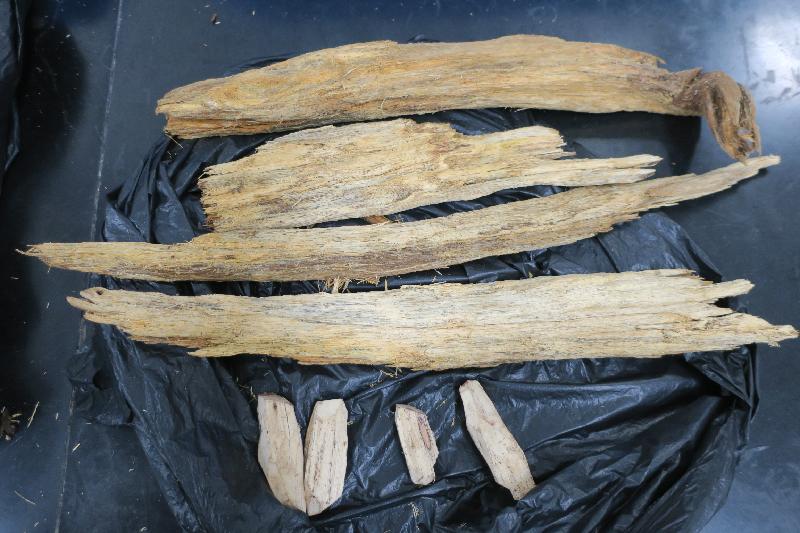
Traveller sentenced to imprisonment for smuggling incense tree wood chips (with photos)

     A traveller who illegally exported incense tree wood chips has been convicted and sentenced to imprisonment for 24 months at the District Court today (January 22).
 
     A spokesman of the Agriculture, Fisheries and Conservation Department (AFCD) said that Customs officers intercepted an outbound male passenger, aged 30, at Shenzhen Bay Control Point and seized about 2.6 kilograms of incense tree (Aquilaria sinensis) wood chips from his backpack on July 4, 2018. The estimated market value of the wood chips was about $207,000.
 
     Upon investigation by the AFCD, the man was charged with illegal export of endangered species. He was convicted at the court today. The court handed down 36-month imprisonment as the starting point for sentencing. The defendant was sentenced to 24 months behind bars after one-third reduction as he pleaded guilty. 

     All Aquilaria species, including the native incense tree, are listed in Appendix II to the Convention on International Trade in Endangered Species of Wild Fauna and Flora. They are regulated under the Protection of Endangered Species of Animals and Plants Ordinance.
 
     The penalties under the Ordinance have been drastically increased since May 1 last year. Any person importing, exporting or possessing specimens of endangered species not in accordance with the Ordinance will be liable to a maximum fine of $10 million and imprisonment for 10 years. The specimens will also be forfeited upon conviction.
 
     The spokesman also pointed out that according to the Forests and Countryside Ordinance, felling of trees on government land without permission is an offence. The maximum penalty is a fine of $25,000 and imprisonment for one year.
 
     The spokesman appealed to the public not to defy the law by smuggling agarwood or illegally felling incense trees. To enquire about the importation or exportation of endangered species and to report illegal cases, the public can call the AFCD at 1823 or visit the website www.cites.hk.

Photo  Photo