Twenty immigration offenders arrested (with photo)

     The Immigration Department (ImmD) mounted a territory-wide anti-illegal worker operation codenamed "Twilight" from February 11 to 14. A total of 16 illegal workers and four suspected employers were arrested.
      
     During the operation, ImmD Task Force officers raided 23 target locations including a company, construction sites, a farm, a garbage collection point, a park, a residential building, restaurants, shops and warehouses. Sixteen illegal workers and four employers were arrested. The illegal workers comprised seven men and nine women, aged 24 to 59. Among them, one woman was a holder of recognisance form, which prohibits her from taking any employment. Meanwhile, three men and one woman, aged 23 to 41, were suspected of employing the illegal workers.
      
     "Any person who contravenes a condition of stay in force in respect of him shall be guilty of an offence. Also, visitors are not allowed to take employment in Hong Kong, whether paid or unpaid, without the permission of the Director of Immigration. Offenders are liable to prosecution and upon conviction face a maximum fine of $50,000 and up to two years' imprisonment. Aiders and abettors are also liable to prosecution and penalties," an ImmD spokesman said.
 
     The spokesman warned that, as stipulated in section 38AA of the Immigration Ordinance, illegal immigrants or people who are the subject of a removal order or a deportation order are prohibited from taking any employment, whether paid or unpaid, or establishing or joining in any business. Offenders are liable upon conviction to a maximum fine of $50,000 and up to three years' imprisonment. The Court of Appeal has issued a guideline ruling that a sentence of 15 months' imprisonment should be applied in such cases. It is an offence to use or possess a forged Hong Kong identity card or a Hong Kong identity card related to another person. Offenders are liable to prosecution and a maximum penalty of a $100,000 fine and up to 10 years' imprisonment.
      
     The spokesman reiterated that it is a serious offence to employ people who are not lawfully employable. The maximum penalty is imprisonment for three years and a fine of $350,000. The High Court has laid down sentencing guidelines that the employer of an illegal worker should be given an immediate custodial sentence. According to court sentencing, employers must take all practicable steps to determine whether a person is lawfully employable prior to employment. Apart from inspecting a prospective employee's identity card, the employer has the explicit duty to make enquiries regarding the person and ensure that the answers would not cast any reasonable doubt concerning the lawful employability of the person. The court will not accept failure to do so as a defence in proceedings. It is also an offence if an employer fails to inspect the job seeker's valid travel document if the job seeker does not have a Hong Kong permanent identity card. The maximum penalty for failing to inspect such a document is imprisonment for one year and a fine of $150,000.
      
     Under the existing mechanism, the ImmD will, as a standard procedure, conduct initial screening of vulnerable persons, including illegal workers, illegal immigrants, sex workers and foreign domestic helpers, who are arrested during any operation with a view to ascertaining whether they are trafficking in persons (TIP) victims. When any TIP indicator is revealed in the initial screening, the officers will conduct a full debriefing and identification by using a standardised checklist to ascertain the presence of TIP elements, such as threat and coercion in the recruitment phase and the nature of exploitation. Identified TIP victims will be provided with various forms of support and assistance, including urgent interference, medical services, counselling, shelter, temporary accommodation and other supporting services. The ImmD calls on TIP victims to report crimes to the relevant departments.
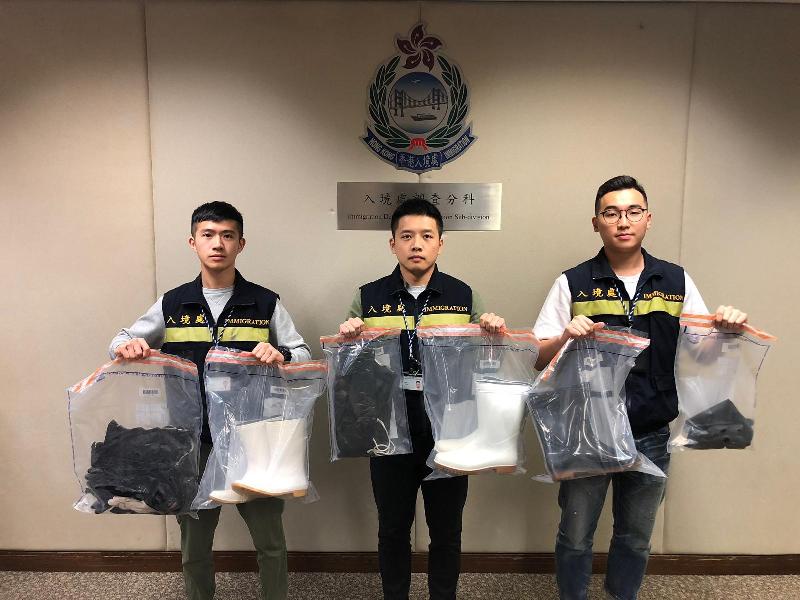
Photo  


New Enriched ICT Training Programme promotes digital inclusion among elderly

     The Office of the Government Chief Information Officer (OGCIO) announced today (February 15) the launch of the new Enriched Information and Communications Technology (ICT) Training Programme for the Elderly, on top of a new round of the ICT Outreach Programme for the Elderly, to promote digital inclusion among the elderly at different levels and serve more elderly persons.
      
     The new Enriched ICT Training Programme is a two-year programme for elderly persons on basic ICT knowledge. Eleven Elder Academies (EAs) have been commissioned to run relevant training courses. Elderly people can take advanced training courses at these EAs to learn about the adoption of digital technology in their daily lives, such as how to use e-Government services, mobile applications and social media. Students in the district can also take part in the voluntary work of the EAs, such as by serving as teaching assistants, to exchange experience in digital living with the elderly, which will in turn foster harmony between elderly people and the young.
      
     Apart from enhancing their own ICT knowledge, participants who have completed the training courses will be able to serve as trainers to help more elderly people acquire technology knowledge. The measure will further assist the elderly in coping with the development of the digital society, thus achieving greater digital inclusion. 
      
     The EAs are currently formulating detailed arrangements for the training courses. Enrolment is expected to commence in the second quarter of this year. The 11 EAs are located across the territory:
 

Region Elder Academy joining the Enriched ICT Training Programme
Hong Kong Island HKSKH Eastern District Elder Academy
Hong Kong Island Elder Academies Cluster
 
Kowloon Institute of Active Ageing, the Hong Kong Polytechnic University
Kowloon West Elder Academies Cluster
LST YKH & Buddhist HWCP Innovation Elder Academy
New Territories Elder Academy of the Open University of Hong Kong
Kiangsu-Chekiang (Shatin) Elder Academy
New Territories West Elder Academies Cluster
Pak Kau Caritas Elder Academy
Pui Shing Elder Academy
TM Hope Elder Academy


     "A web-based learning portal organised by the OGCIO will also be launched in the second half of this year. Online learning resources targeting the elderly and those in need will be collated and developed through non-profit-making organisations and EAs. These resources will subsequently be made available on this dedicated online platform to facilitate learning with an interesting approach and inspire them to embrace smart living," a spokesman for the OGCIO added.
      
     Separately, the OGCIO regularised the ICT Outreach Programme from 2018-19 onwards and extended it to a two-year programme, allowing greater flexibility for non-profit-making organisations in planning activities. The new round of the Outreach Programme commenced at the end of 2018, with the Caritas Hong Kong-Services for the Elderly, the Hong Kong Chinese Women's Club, the Hong Kong Lutheran Social Service, the Neighbourhood Advice-Action Council, the Po Leung Kuk and the Yan Chai Hospital Social Services Department as participating organisations. Since its launch in 2014, the response to the Outreach Programme has been overwhelming, benefitting over 5 700 institutionalised and "hidden" elderly people, as well as those receiving day care centre and home care services and elderly people with dementia.
      
     The spokesman for the OGCIO said, "The Government has been striving to implement various digital inclusion initiatives. Over $20 million in funding support will be allocated in the coming two years for the two Programmes. We look forward to creating an ambience of ICT adoption among the elderly. By encouraging elderly persons to pass on knowledge they acquired to their peers, we hope that the Programmes not only help them embrace the benefits of ICT adoption, but also strengthen their connection with the community and their self-confidence, thus bringing them a joyful and flourishing life in their golden years."
      
     Details of the two Programmes can be viewed via www.ogcio.gov.hk/en/our_work/community/ict_programmes_for_elderly.


Smoking (Public Health) (Amendment) Bill 2019 gazetted

     The Government published in the Gazette today (February 15) the Smoking (Public Health) (Amendment) Bill 2019 (Amendment Bill), which aims to ban the import, manufacture, sale, distribution and advertisement of alternative smoking products, including electronic cigarettes, heat-not-burn products and herbal cigarettes.
 
     A spokesman for the Food and Health Bureau said, "Protecting public health is the Government's prime consideration. We must prevent the harm of these new products from taking root and ensure that our achievements in tobacco control over the years would not be undermined.
 
     "Often packaged as less harmful substitutes with promotion tactics targeted at youngsters and non-smokers, these emerging alternative smoking products open a gateway to the eventual consumption of conventional cigarettes. 
 
     "The fact is all these new smoking products are harmful to health and produce second-hand smoke. There are more and more studies concluding that these new products are harmful to health. There is also a lack of evidence that these products can help in quitting smoking. The public may underestimate the harmful effects of these products and even endorse the smoking image and relevant behaviours once again."
 
     The proposed ban covers the import, manufacture, distribution, sale and advertisement of alternative smoking products, including items that are designed for use as a component or accessory. The ban on import covers parcels and cargoes and articles brought in by incoming travellers. Articles in transit, air transhipment cargoes and persons in transit shall be exempted from the proposed ban. We also propose to ban possession for the purpose of manufacture, sale or distribution of alternative smoking products. The activation and use of alternative smoking products in no smoking areas are also banned. Exports of alternative smoking products are not banned and sellers can export the products at any time to clear out their stocks.
 
     Any person who contravenes the ban will be liable to penalty as listed below:
 

Activity Penalty
Use in no smoking areas Fixed penalty of $1,500 or summary conviction to a fine of $5,000 #
Advertisement Summary conviction to a fine at level 5 and in the case of a continuing offence, to a further penalty of $1,500 for each day during which the offence continues #
Import, manufacture, sale, distribution for certain purposes, possession for certain purposes, or promoting in certain ways Summary conviction to a fine at level 5 and to imprisonment for six months

# The penalty is in line with that for conventional smoking products
 
     "The ban will come into force six months after gazettal of the Ordinance upon passage of the Amendment Bill. The Government is prepared to adopt a lenient approach during the initial period after the Ordinance comes into operation, in cases where incoming visitors voluntarily surrender the alternative smoking products that they have brought to Hong Kong.
 
     "The emphasis of the proposed ban is to make it difficult for potential consumers to get access to such products before they become widely popular, similar to what we had achieved with the ban of smokeless tobacco under the Smokeless Tobacco Products (Prohibition) Regulations (Cap. 132BW) enacted in 1987. At the same time, the Government will continue with its work to control conventional smoking products, with a view to achieving a smoking prevalence of 7.8 per cent by 2025 as promulgated under 'Towards 2025: Strategy and Action Plan to Prevent and Control Non-communicable Diseases in Hong Kong'," he said.
 
     The Amendment Bill will be introduced into the Legislative Council for first reading and second reading on February 20.


Applications invited for Exchanges with Taiwan Funding Scheme

The following is issued on behalf of the Secretariat to the Hong Kong-Taiwan Economic and Cultural Cooperation and Promotion Council:
 
     The Hong Kong-Taiwan Economic and Cultural Cooperation and Promotion Council (ECCPC) is inviting applications for the Exchanges with Taiwan Funding Scheme.

     The Scheme aims to enhance exchanges and understanding between Hong Kong and Taiwan at the community level through providing funding support to local non-government organisations to organise relevant activities.

     Application forms can be downloaded from the ECCPC website at www.eccpc.org.hk/eng/scheme.htm. The deadline for application is March 31, 2019.

     For enquiries, please contact the ECCPC Secretariat at 2810 2011.


Gazettal of Financial Reporting Council (Amendment) Ordinance 2019

     The Government published in the Gazette today (February 15) the Financial Reporting Council (Amendment) Ordinance 2019 in an effort to enhance the regulatory regime for auditors of listed entities. 
 
     The Amendment Ordinance enables the Financial Reporting Council (FRC) to become a comprehensive and independent oversight body regulating auditors of listed entities, and to be responsible for the inspection, investigation and disciplinary functions with regard to these auditors. Under the new regime, the Hong Kong Institute of Certified Public Accountants will continue to perform the statutory functions of registration, setting requirements for continuing professional development, and also setting standards on professional ethics, auditing and assurance in respect of relevant auditors, subject to oversight by the FRC.    
    
     The Amendment Ordinance ensures that Hong Kong's regulatory regime for auditors of listed entities is benchmarked against international standards and practice, and will also enable Hong Kong to be eligible for joining the International Forum of Independent Audit Regulators, which is an important forum for international co-operation on the regulation of auditors.
 
     A government spokesperson said, "The Amendment Ordinance enhances the existing regulatory regime for auditors of listed entities, allowing it to be independent from the audit profession, thereby providing better protection to investors. This is crucial to strengthening Hong Kong's status as an international financial centre and capital market. We are working closely with relevant parties on the preparations for implementing the new regulatory regime as soon as practicable."
 
     The Amendment Ordinance was enacted by the Legislative Council on January 30, 2019, and will commence operation on a day to be appointed by the Secretary for Financial Services and the Treasury by notice published in the Gazette.