LCQ13: Enforcement actions in relation to Import and Export Ordinance

     Following is a question by the Hon Dennis Kwok and a written reply by the Secretary for Security, Mr John Lee, in the Legislative Council today (February 20):
 
Question:

     Will the Government inform this Council of the respective numbers of times for which law enforcement actions were taken in the past five years by law enforcement agencies for the purpose of enforcing the requirements under Part III (Prohibited Articles, etc.) and Part IV (Unmanifested cargo and smuggling) of the Import and Export Ordinance (Cap 60); the respective numbers of prosecutions and convictions resulting from such actions, and the classes and quantities of the articles/cargoes involved?

Reply:
 
President,
 
     The Import and Export Ordinance (Chapter 60) (IEO) provides for the regulation and control of the import of articles into Hong Kong, the export of articles from Hong Kong, the handling and carriage of articles within Hong Kong which have been imported into Hong Kong or which may be exported from Hong Kong, and any matter incidental to or connected with the foregoing. Having consulted relevant policy bureaux and department, the consolidated reply is as follows:
 
     Based on risk-profiling and intelligence-driven strategy, the Customs and Excise Department (C&ED) vigorously conducts checks and monitors on passengers, cargoes, postal packets and conveyances at various control points and sea boundary for combating smuggling activities effectively, including the smuggling of prohibited articles and unmanifested cargo. C&ED maintains close liaison with law enforcement agencies in Hong Kong and other places so as to enhance exchange of intelligence and conduct joint operations, as and when necessary, for anti-smuggling purposes.
 
     In the past five years (2014 to 2018), C&ED has detected 20,666 and 622 cases in relation to Part III (Prohibited Articles, etc.) and Part IV (Unmanifested Cargo and Smuggling) of the IEO (Cap 60) respectively.
 
     Under the IEO, any import or export of prohibited articles must be accompanied by a valid licence or permit issued in advance by the relevant authorities. It is an offence if the prohibited articles are brought into/out of Hong Kong without a valid licence or permit. The prohibited articles will also be seized and confiscated. The prohibited articles under Part III (Prohibited Articles, etc.) of the IEO and the relevant authorities are as follows:
 

  • Trade and Industry Department: Strategic Commodities and Powdered Formula, etc.
  • Food and Environmental Hygiene Department: Frozen or Chilled Meat and Poultry, etc.
  • Environmental Protection Department: Hazardous Chemicals, etc.
  • Department of Health: Pharmaceutical Products and Medicines, Chinese Herbal Medicines and Proprietary Chinese Medicines, etc.
  • Agriculture, Fisheries and Conservation Department: Pesticides, etc.

 
     For cases in relation to Part III (Prohibited Articles, etc.), a total of 21,363 persons and 400 companies were prosecuted in the past five years, of which 20,864 persons and 387 companies were convicted. The estimated value of the seizures was about $224 million. Major seizures included powdered formula, chemicals, pharmaceutical products and medicines, etc. A detailed breakdown of the above statistics is at Annex I.
 
     Under the IEO, all cargo which is imported or exported shall be recorded in a manifest. Any person who imports or exports any unmanifested cargo shall be guilty of an offence. As for cases in relation to Part IV (Unmanifested Cargo and Smuggling), a total of 868 persons and 23 companies were prosecuted in the past five years, of which 731 persons and 20 companies were convicted. The estimated value of the seizures was about $1.21 billion. Major seizures included mobile phones and accessories, computers and accessories, precious metal and dutiable cigarettes, etc. A detailed breakdown of the above statistics is at Annex II.
 
     C&ED will continue to strengthen its enforcement, co-operation as well as intelligence exchanges with other law enforcement agencies for maintaining the vigorous enforcement and interdiction of smuggling attempts at all fronts.


Update on cluster of Influenza A cases in Siu Lam Hospital

The following is issued on behalf of the Hospital Authority:

     Regarding an earlier announcement on a cluster of patients infected with Influenza A in a female ward for severe intellectual disability, the spokesperson for Siu Lam Hospital gave the following update today (February 20):

     One more 69-year-old patient in the ward presented with respiratory symptoms. Appropriate viral tests were arranged for the patient and the test results were positive for Influenza A. The patient concerned is being treated under isolation with stable condition.

     Admission to the ward has been suspended and restricted visiting has been imposed. Infection control measures have already been stepped up according to established guidelines. All other patients in the ward are under close surveillance.

     The case has been reported to the Hospital Authority Head Office and the Centre for Health Protection for necessary follow-up.


EDB announces arrangements for implementing “one executive officer for each school” policy in public sector schools and Direct Subsidy Scheme schools

     The Education Bureau (EDB) issued a circular memorandum today (February 20) to all public sector schools and Direct Subsidy Scheme (DSS) schools to announce the implementation details of the "one executive officer for each school" policy.
 
     An EDB spokesman said, "Starting from the 2019/20 school year, the EDB will provide all public sector schools and DSS schools with resources for hiring additional administrative manpower, enabling schools to review administrative arrangements and requirements, streamline procedures, strengthen administrative support and at the same time reduce the administrative work of teachers and principals, thereby creating room for them to focus more on core education tasks and to take care of student development. The new measure will incur an annual additional expenditure of around $500 million."
      
     Starting from September 1, 2019, each aided school (including special schools) will be provided with a school executive officer. Schools may, in accordance with their school-based circumstances and needs, opt to create a regular School Executive Officer post in the approved non-teaching staff establishment of aided schools, or to receive the School Executive Officer Grant (SEOG) for the appointment of a full-time school executive officer with a local bachelor's degree (or equivalent). Schools receiving the SEOG may hire from service providers' school administrative support service, which should include the provision of at least one full-time school executive officer with a local bachelor's degree (or equivalent) stationed at school. Government schools, caput schools and DSS schools will also be provided with resources for appointment of additional administrative staff to suitably strengthen their administrative effectiveness.
      
     The main duty of the school executive officer is to supervise and co-ordinate the administrative affairs of the school. The EDB will organise an induction programme for the newly appointed school executive officers of public sector schools. The programme will cover various aspects of school administration, such as school finances, procurement, appointment of staff, assessment of staff salary, handling school complaints, crisis management, and maintenance and safety of school premises. Briefing sessions will also be held to introduce the implementation details of the "one executive officer for each school" policy to schools.
      
     The Education Commission set up the Task Force on School-based Management Policy (Task Force) in November 2017 to study the implementation of the school-based management (SBM) policy in aided schools and, based on the results of the study, recommend support measures for the optimisation of SBM. Among the recommendations, the proposed provision of additional resources for schools to handle administrative work received widespread support from the stakeholders. In view of this, the Government took the Task Force's advice that this proposal be implemented as soon as possible. The Chief Executive announced the initiative of "one executive officer for each school" in her Policy Address last year.


Transcript of remarks by SFH at media session

     Following is the transcript of remarks by the Secretary for Food and Health, Professor Sophia Chan, at a media session at the Legislative Council Complex today (February 20):

Reporter: So far have you got enough votes to pass the ban on e-cigarettes? Secondly, can you clarify, under the Greater Bay Area framework, about the patient transfer plan of non-emergency patients? Are you talking about Hong Kong people or Mainland residents?

Secretary for Food and Health: The objective of our ban on e-cigarettes (and other alternative smoking products) is to protect the health of our next generation, our young people. I think these new or alternative smoking products are often packaged as less harmful and also attractive to young people. So in order to continue our hard work on tobacco control and reducing our smoking prevalence, especially protecting our young people's health from not being jeopardised, in the last Policy Address, the Chief Executive has announced the banning of e-cigarettes and alternative smoking products altogether including import, manufacture, distribution, promotion and sale. Of course, we have tried our best to explain our policy to all legislators and political parties. We try our best to explain and answer questions. On one hand, we have staunch supporters. On the other hand, there are legislators who hold different opinions. We will continue to try our best to let the legislators and different political parties understand. This is really the wish of not only the Government, but also the general public, the medical and health profession, the education sector, parents as well as young people.

     Regarding your question about the Greater Bay Area, the focus is on Hong Kong people who live in the Greater Bay Area. The suggested transfer measure is for Hong Kong people. Throughout the year, those Hong Kong people who live in the Greater Bay Area have expressed a need for having better and facilitated transportation (of non-emergency Hong Kong patients). It is just to explore how this could be taken forward.

(Please also refer to the Chinese portion of the transcript.)


International meeting on Hong Kong Chinese Materia Medica Standards held in Hong Kong (with photo)

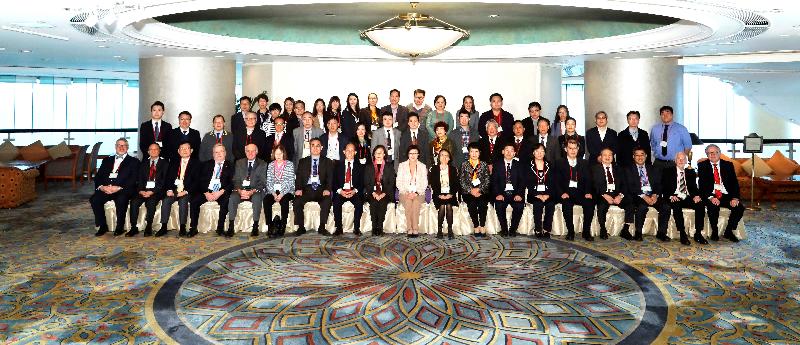
     The 11th meeting of the International Advisory Board (IAB) on Hong Kong Chinese Materia Medica Standards (HKCMMS) was held in Hong Kong from February 18 to February 20 and was attended by over 70 overseas, Mainland and local experts. At the meeting, the IAB reviewed the research work of the current phase for 31 Chinese Materia Medica (CMM) and concluded a pilot study on eight Chinese medicine decoction pieces. The future research direction of the HKCMMS project was also discussed.
 
     Addressing the meeting, the Director of Health, Dr Constance Chan, said, "With the publication of the ninth volume of the HKCMMS, we have already published a total of 299 CMM reference standards, which are well recognised in the field of Chinese medicine testing and certification. While we continue to further our work on the standard setting for CMM, we will introduce advance testing methods to improve the quality control of CMM and strive to be on par with international standards."
 
     The IAB was established in early 2002 to give advice on the principles, methodologies and analytical methods for the development of the HKCMMS. It comprises renowned experts from the Mainland, Australia, Austria, Canada, Germany, Japan, Thailand, the United Kingdom and the United States, in addition to local experts.
 
     Dr Chan said the project of setting standards for CMM relies heavily on the participation of the scientific community, and the Government is most grateful to the eight research partners, namely the City University of Hong Kong, Hong Kong Baptist University, the Chinese University of Hong Kong, the Hong Kong Polytechnic University, the Hong Kong University of Science and Technology, the University of Hong Kong, the National Institutes for Food and Drug Control of the People's Republic of China and Taiwan's China Medical University, for rallying behind the project and making efforts to meet various challenges in setting standards. In addition, the Government Laboratory is continuing to conduct inter-laboratory verification studies, which adds to the project's scientific rigour and robustness.
 
     "We are also indebted to the National Medical Products Administration, the National Administration of Traditional Chinese Medicine, and the Chinese Pharmacopoeia Commission for their invaluable advice and continuous support for the development of the HKCMMS," Dr Chan added.
 
     Previous publications of the HKCMMS can be accessed at www.cmd.gov.hk/html/eng/GCMTI/hkcmms/volumes.html.

Photo