March 2019 issue of “Hong Kong Monthly Digest of Statistics” now available

     The Census and Statistics Department (C&SD) published today (March 15) the March 2019 issue of the "Hong Kong Monthly Digest of Statistics" (HKMDS).

     Apart from providing up-to-date statistics, this issue also contains two feature articles entitled "Analysis of Hong Kong's External Merchandise Trade by Mode of Transport" and "Consumer Price Index and Its Movements during 2009 to 2018".

"Analysis of Hong Kong's External Merchandise Trade by Mode of Transport"

     External merchandise trade is one of the important economic activities in Hong Kong. Goods are brought into or out of Hong Kong by various means of transport. In 2018, the value of Hong Kong's external merchandise trade by air accounted for 41.8% of Hong Kong's total value of trade in goods. Another 40.0% was transported by land, 15.1% by ocean and 2.1% by river. The remaining 1.0% was mainly postal parcels and accompanied goods of passengers travelling on various means of transport.

     This feature article analyses the performance and characteristics of Hong Kong's external merchandise trade by mode of transport during the period from 2008 to 2018.

     For enquiries about this feature article, please contact the Trade Analysis Section, C&SD (Tel: 2582 5026; email: trade@censtatd.gov.hk).

"Consumer Price Index and Its Movements during 2009 to 2018"

     The year-on-year rate of change in the Consumer Price Index (CPI) is frequently quoted as the indicator of inflation. This feature article analyses the movements of consumer prices in the period 2009 to 2018.

     In 2011, the CPI rose significantly amidst the upsurge in food and energy prices in the international markets and the continued increases in private housing rents. The annual rates of increase maintained at around 4% to 5% during 2012 to 2014, then started to moderate since 2015. The annual rate of increase in the CPI picked up slightly in 2018.

     Apart from presenting the movements of the overall indices in the past decade, this feature article also analyses price changes at various commodity/service section levels.

     For enquiries about this feature article, please contact the Consumer Price Index Section, C&SD (Tel: 3903 7370; email: cpi@censtatd.gov.hk).

     Published in bilingual form, the HKMDS is a compact volume of official statistics containing about 140 tables. It collects up-to-date statistical series on various aspects of the social and economic situation of Hong Kong. Topics include population; labour; external trade; National Income and Balance of Payments; prices; business performance; energy; housing and property; government accounts, finance and insurance; and transport, communications and tourism. For selected key statistical items, over 20 charts depicting the annual trend in the past decade and quarterly or monthly trend in the recent two years are also available. Users can download the Digest free of charge at the website of C&SD (www.censtatd.gov.hk/hkstat/sub/sp460.jsp?productCode=B1010002).

     Enquiries about the contents of the Digest can be directed to the Statistical Information Services Section of C&SD (Tel: 2582 4738; email: gen-enquiry@censtatd.gov.hk).


Hong Kong’s Gross National Income and external primary income flows for fourth quarter of 2018 and whole year of 2018

     The Census and Statistics Department (C&SD) released today (March 15) the preliminary statistics on Hong Kong's Gross National Income (GNI) and related figures for the fourth quarter of 2018 and the whole year of 2018.

     Hong Kong's GNI, which denotes the total income earned by Hong Kong residents from engaging in various economic activities, increased by 4.8% in the fourth quarter of 2018 over a year earlier to $774.3 billion at current market prices. The Gross Domestic Product (GDP), preliminarily estimated at $755.2 billion at current market prices in the same quarter, recorded a 4.7% increase over the same period. The value of GNI was larger than GDP by $19.1 billion in the fourth quarter of 2018, which was equivalent to 2.5% of GDP in that quarter, mainly attributable to a net inflow of investment income.

     After netting out the effect of price changes over the same period, Hong Kong's GNI increased by 2.5% in real terms in the fourth quarter of 2018 over a year earlier. The corresponding GDP in the same quarter increased by 1.3% in real terms.

     Hong Kong's total inflow of primary income, which mainly comprises investment income, estimated at $386.1 billion in the fourth quarter of 2018 and equivalent to 51.1% of GDP in that quarter, recorded a significant increase of 9.6% over a year earlier. Meanwhile, total primary income outflow, estimated at $366.9 billion in the fourth quarter of 2018 and equivalent to 48.6% of GDP in that quarter, also increased considerably by 9.8% over a year earlier.

     As for the major components of investment income inflow, direct investment income (DII) increased by 3.2% over a year earlier, mainly due to the increase in earnings of some prominent local enterprises from their direct investment abroad. Portfolio investment income (PII) recorded an increase of 3.5% over a year earlier, mainly attributable to the increase in interest income received by resident investors from their holdings of non-resident long-term debt securities, partly offset by the decrease in dividend income received by resident investors from their holdings of non-resident equity securities.  

     Regarding the major components of investment income outflow, DII increased by 4.7% over a year earlier, mainly due to the increase in earnings of some prominent multinational enterprises from their direct investment in Hong Kong. PII increased by 3.1%, mainly attributable to the increase in interest payout to non-resident investors from their holdings of resident long-term debt securities, partly offset by the decrease in dividend payout to non-resident investors from their holdings of resident equity securities.

     Analysed by country/territory, the mainland of China continued to be the largest source of Hong Kong's total primary income inflow in the fourth quarter of 2018, accounting for 38.2%. This was followed by the British Virgin Islands (BVI), with a share of 22.2%. Regarding total primary income outflow, the BVI and the mainland of China remained the most important destinations in the fourth quarter of 2018, accounting for 26.3% and 19.8% respectively.

     For 2018 as a whole, Hong Kong's GNI increased by 7.5% over a year earlier to $2,986.9 billion at current market prices. The difference of $141.6 billion from GDP for the same year (estimated at $2,845.3 billion) represented a net primary income inflow of the same amount and was equivalent to 5.0% of GDP in that year. The total primary income inflow was estimated at $1,627.7 billion, or 57.2% of GDP in 2018 while the corresponding outflow at $1,486.1 billion, or 52.2% of GDP in 2018. After netting out the effect of price changes, Hong Kong's GNI increased by 4.1% in real terms in 2018 over 2017.

Further information

     GDP and GNI are closely related indicators for measuring economic performance. GDP is a measure of the total value of production of all resident producing units of an economy. GNI denotes the total income earned by residents of an economy from engaging in various economic activities, irrespective of whether the economic activities are carried out within the economic territory of the economy or outside.  

     Figures of primary income inflow and outflow presented above are compiled based on data obtained from the Survey of External Claims, Liabilities and Income conducted quarterly by the C&SD, supplemented by data from other sources.  

     Figures of GNI and primary income flows analysed by income component from the first quarter of 2017 to the fourth quarter of 2018 are presented in Table A, while selected major country/territory breakdowns of primary income inflow and outflow for the same quarters are presented in Tables B(1) and B(2) respectively.

     Statistics on GDP and GNI from 2017 onwards and primary income flows for 2018 are subject to revision when more data become available.

     Enquiries about GNI and related statistics may be directed to the Balance of Payments Branch (2) of the C&SD at 3903 7054.


Progress in the handling of banking complaints by HKMA

The following is issued on behalf of the Hong Kong Monetary Authority:

     The Hong Kong Monetary Authority (HKMA) announced today (March 15) the progress made in its handling of banking complaints received as at end-February 2019. Banking complaints include cases concerning general banking services and conduct-related issues.

     In February 2019, 127 cases were received and the handling of 145 cases was completed.  As at end-February, the handling of 442 cases was in progress. 

     A table summarising the progress made in the handling of banking complaints by the HKMA is attached.


Update on number of dengue fever cases

     The Centre for Health Protection (CHP) of the Department of Health today (March 15) reported the latest number of cases of dengue fever (DF), and again urged the public to maintain strict environmental hygiene, mosquito control and personal protective measures both locally and during travel.

     From March 7 to 14, the CHP recorded two imported DF cases. The patients had been to Thailand during the incubation period.

     As of yesterday (March 14), 31 cases had been confirmed this year, all of which were imported cases. The cases were mainly imported from Indonesia (seven), Malaysia (seven) and Thailand (six). 

     DF remains endemic in some areas of Asia and beyond. The latest figures for 2019 revealed that 9 914 cases had been recorded in Thailand, 36 664 in the Philippines, 26 545 in Malaysia (which is 157 per cent higher compared to the number of cases reported during the same period in 2018), 1 995 in Singapore (since December 30, 2018), 38 122 in Vietnam (which was 3.6 times the number of cases reported in the same period in 2018) and 49 in Japan. In the Americas, the latest figures indicated that 6 338 cases were filed in Mexico in 2019.

     The public should take heed of the following advice on mosquito control:
 

  • Thoroughly check all gully traps, roof gutters, surface channels and drains to prevent blockage;
  • Scrub and clean drains and surface channels with an alkaline detergent compound at least once a week to remove any deposited mosquito eggs;
  • Properly dispose of refuse, such as soft drink cans, empty bottles and boxes, in covered litter containers;
  • Completely change the water of flowers and plants at least once a week. The use of saucers should be avoided if possible;
  • Level irregular ground surfaces before the rainy season;
  • Avoid staying in shrubby areas; and
  • Take personal protective measures such as wearing loose, light-coloured, long-sleeved tops and trousers and apply insect repellent containing DEET to clothing or exposed parts of the body when doing outdoor activities.

    
     To reduce the risk of infections spread by mosquitoes, apart from general measures, travellers returning from areas affected by DF and Zika virus infection should apply insect repellent for 14 days or at least 21 days respectively upon arrival in Hong Kong. If feeling unwell, seek medical advice promptly and provide travel details to the doctor. DEET-containing insect repellents are effective and the public should take heed of the tips below:
 

  • Read the label instructions carefully first;
  • Apply right before entering an area with risk of mosquito bites;
  • Apply on exposed skin and clothing;
  • Use DEET of up to 30 per cent for pregnant women and up to 10 per cent for children*;
  • Apply sunscreen first, then insect repellent; and
  • Re-apply only when needed and follow the instructions.

 
* For children who travel to countries or areas where mosquito-borne diseases are endemic or epidemic and where exposure is likely, those aged 2 months or above can use DEET-containing insect repellents with a DEET concentration of up to 30 per cent.

     The public may refer to the CHP's tips for using insect repellents for details.


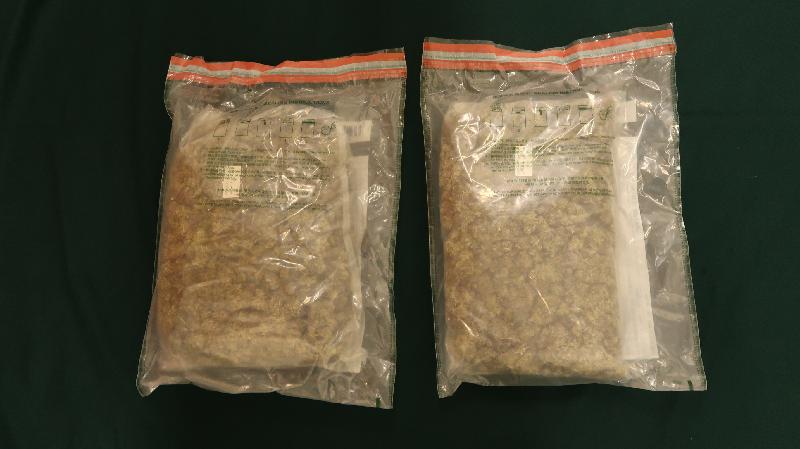
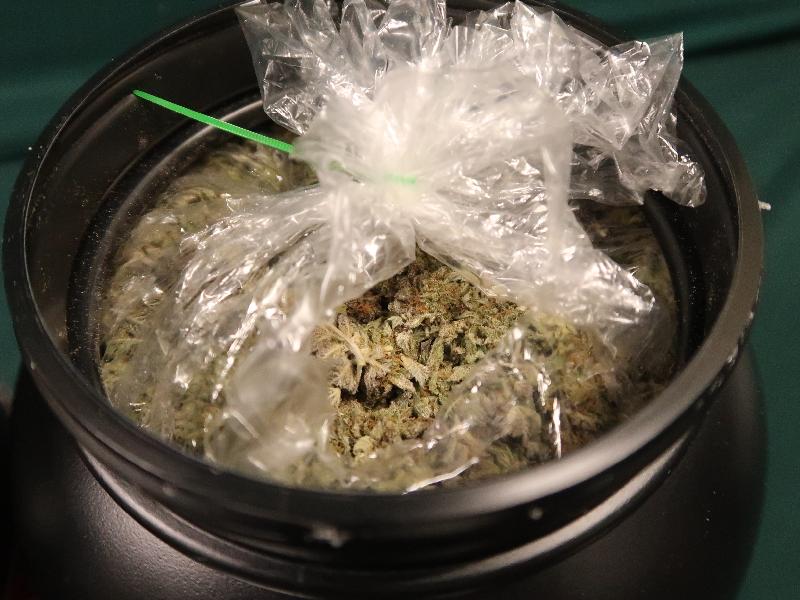
Hong Kong Customs seizes suspected cannabis buds (with photos)

     Hong Kong Customs seized about 1.8 kilograms of suspected cannabis buds with an estimated market value of about $500,000 at Hong Kong International Airport on March 9.

     Customs officers inspected a parcel from the United States on March 9 and found the batch of suspected cannabis buds concealed inside two plastic bottles.

     After a follow-up investigation, Customs officers arrested a 15-year-old man and 16-year-old man suspected to be connected with the case in Kwai Chung and Tsuen Wan on March 12 and today (March 15) respectively.

     The 15-year-old man has been charged with one count of trafficking in a dangerous drug. He will appear at West Kowloon Magistrates' Courts on March 21.

     Investigation is ongoing.

     Under the Dangerous Drugs Ordinance, trafficking in a dangerous drug is a serious offence. The maximum penalty upon conviction is a fine of $5 million and life imprisonment.

     Customs also reiterated that cannabis and tetrahydro-cannabinol (THC) are classified as dangerous drugs under the Ordinance. The importation of products (including food and drinks) containing cannabis or THC into Hong Kong is prohibited unless the relevant provisions in the Ordinance are complied with. In order to avoid breaching the law inadvertently, special attention should be paid to the packaging labels of food and drinks.

     Members of the public may report any suspected drug trafficking activities to Customs' 24-hour hotline 2545 6182 or its dedicated crime-reporting email account (crimereport@customs.gov.hk).

Photo  Photo