LCQ9: National studies and the Basic Law training for Civil Servants

     Following is a question by the Dr Hon Priscilla Leung and a written reply by the Secretary for the Civil Service, Mr Joshua Law, in the Legislative Council today (March 20):

Question:

     According to the existing policy, bureaux and government departments (B&Ds) should make arrangements for the middle-level civil servants (i.e. officers at Master Pay Scale (MPS) Point 34 to 44 or equivalent) under the B/Ds to attend national studies programmes within six years from the time when they reach the relevant MPS Point/pay point threshold. Nevertheless, Report No. 71 of the Director of Audit (the Report), published in October last year, has pointed out that due to insufficient places for such programmes, it is unlikely that such training time schedule can be adhered to. Besides, the Report has recommended that the Government should enhance the tracking of the progress of civil servants' training on the Basic Law. In this connection, will the Government inform this Council:

(1) of (i) the number of training places and (ii) the number of participants for the national studies programmes, in each of the past three years; the projected number of places for such programmes in each of the coming three years;

(2) whether it has, in accordance with the recommendations made in the Report, (i) reviewed the aforesaid training time schedule, (ii) discussed with those Mainland universities currently organising such programmes to increase the number of places for the programmes, (iii) commissioned more Mainland universities to organise such programmes, and (iv) promoted B&Ds to nominate more middle-level civil servants to attend such programmes so as to fully utilise the training places; if so, of the details; if not, the reasons for that;

(3) given that the Government has, since the latter half of last year, extended the national studies programmes to civil servants at MPS Point 28 to 33, of (i) the existing number of civil servants whose salaries are within this salary range, and (ii) the number of places to be made available for them to attend the national studies programmes in each of the coming three years; whether it has conducted a review on such training arrangement having regard to the comments made in the Report; if so, of the outcome; and

(4) as the Government has indicated that it will strengthen the content of Basic Law training for civil servants so as to incorporate the relationship between the Constitution of the People's Republic of China and the Basic Law, of the progress of the relevant work, including (i) the measures put in place for training civil servants to understand the Constitution and (ii) the number of training activities held so far; the new measures in the coming three years to strengthen the training in this respect?

Reply:

President,

     There are practical needs for civil servants to understand the social development and economic situation in the Mainland in performing their duties. To keep abreast with the latest development in the Mainland, they should equip themselves with updated knowledge of the national strategies and plans that could affect Hong Kong.

     The Government of the Hong Kong Special Administrative Region has all along been attaching great importance to national studies and Basic Law training for civil servants. The Civil Service Bureau (CSB) and other bureaux/departments (B/Ds) have been providing diversified training for civil servants, including various seminars, talks and training courses held locally and in the Mainland, as well as visits to and exchange activities in Mainland cities. Currently, about 22 000 civil servants receive different types of national studies and Basic Law training every year.

     Regarding participation of civil servants at Master Pay Scale (MPS) Point 34 to 44 in national studies programmes held in the Mainland as mentioned in the Director of Audit's Report, the Civil Service Training and Development Institute (CSTDI) of the CSB has kept increasing the number of training places for this group of civil servants to attend Mainland programmes in the past few years. It is projected that the number of trainees will rise from about 280 in 2017 to about 420 in 2019. Officers nominated by B/Ds to attend national studies programmes held in the Mainland in the past were all accepted by CSTDI, and CSTDI will continue to adjust the number of training places having regard to the number of nominations received from B/Ds so as to meet their training demands. To enhance national studies training for middle-level civil servants, CSTDI has also extended the national studies programmes held in the Mainland to include civil servants at MPS Point 28 to 33 since the second half of 2018. About 140 of these civil servants attended the Mainland programmes in 2018. It is expected that the number of such trainees will further increase to 240 in 2019.

      To tie in with the increase in the number of training places for national studies programmes held in the Mainland, CSTDI commissioned two additional Mainland universities in 2018 to organise such programmes for Hong Kong civil servants. Currently, there are altogether nine Mainland institutions commissioned by CSTDI to conduct different types of national studies programmes to about 1 000 civil servants every year. In addition, other government departments also organise their own national studies programmes in the Mainland for about 1 000 officers every year having regard to their individual operational needs. Taking into account the above programmes together with others national studies training held in the Mainland and Hong Kong, currently about 10 000 civil servants receive national studies training every year.

     As regards Basic Law training for civil servants, CSTDI has kept enhancing the Basic Law foundation course for civil servants and Basic Law training for middle-level officers in the past few years. These courses and training cover topics such as the relationship between the Constitution of the People's Republic of China and the Basic Law and the principle of "one country, two systems", etc. CSTDI also regularly organises thematic seminars on the Basic Law for civil servants at different levels. The number of civil servants who received Basic Law training were on the rise in the past three years, and it is projected that the number of trainees will increase from about 8 900 in 2017 to about 12 000 in 2019.

      Civil servants may also enhance their understanding of national affairs and development through our e-learning platform. For instance, CSTDI will launch new thematic webpages on the Guangdong-Hong Kong-Macao Greater Bay Area and the 70th anniversary of the founding of the People's Republic of China on the Cyber Learning Centre Plus (CLC Plus) in 2019 so that civil servants could access to the latest information about national development at their convenient time. The Basic Law Portal on the CLC Plus also provides various types of multi-media learning resources, including web courses, video clips, Basic Law Bulletin, audio clips, past seminars and online quizzes, to update civil servants' knowledge of the Basic Law.

     CSTDI will continue to encourage B/Ds to nominate more civil servants at different levels to attend national studies programmes and Basic Law courses, and will correspondingly increase the number of training places to meet their training demands.


LCQ9: National studies and the Basic Law training for Civil Servants

     Following is a question by the Dr Hon Priscilla Leung and a written reply by the Secretary for the Civil Service, Mr Joshua Law, in the Legislative Council today (March 20):

Question:

     According to the existing policy, bureaux and government departments (B&Ds) should make arrangements for the middle-level civil servants (i.e. officers at Master Pay Scale (MPS) Point 34 to 44 or equivalent) under the B/Ds to attend national studies programmes within six years from the time when they reach the relevant MPS Point/pay point threshold. Nevertheless, Report No. 71 of the Director of Audit (the Report), published in October last year, has pointed out that due to insufficient places for such programmes, it is unlikely that such training time schedule can be adhered to. Besides, the Report has recommended that the Government should enhance the tracking of the progress of civil servants' training on the Basic Law. In this connection, will the Government inform this Council:

(1) of (i) the number of training places and (ii) the number of participants for the national studies programmes, in each of the past three years; the projected number of places for such programmes in each of the coming three years;

(2) whether it has, in accordance with the recommendations made in the Report, (i) reviewed the aforesaid training time schedule, (ii) discussed with those Mainland universities currently organising such programmes to increase the number of places for the programmes, (iii) commissioned more Mainland universities to organise such programmes, and (iv) promoted B&Ds to nominate more middle-level civil servants to attend such programmes so as to fully utilise the training places; if so, of the details; if not, the reasons for that;

(3) given that the Government has, since the latter half of last year, extended the national studies programmes to civil servants at MPS Point 28 to 33, of (i) the existing number of civil servants whose salaries are within this salary range, and (ii) the number of places to be made available for them to attend the national studies programmes in each of the coming three years; whether it has conducted a review on such training arrangement having regard to the comments made in the Report; if so, of the outcome; and

(4) as the Government has indicated that it will strengthen the content of Basic Law training for civil servants so as to incorporate the relationship between the Constitution of the People's Republic of China and the Basic Law, of the progress of the relevant work, including (i) the measures put in place for training civil servants to understand the Constitution and (ii) the number of training activities held so far; the new measures in the coming three years to strengthen the training in this respect?

Reply:

President,

     There are practical needs for civil servants to understand the social development and economic situation in the Mainland in performing their duties. To keep abreast with the latest development in the Mainland, they should equip themselves with updated knowledge of the national strategies and plans that could affect Hong Kong.

     The Government of the Hong Kong Special Administrative Region has all along been attaching great importance to national studies and Basic Law training for civil servants. The Civil Service Bureau (CSB) and other bureaux/departments (B/Ds) have been providing diversified training for civil servants, including various seminars, talks and training courses held locally and in the Mainland, as well as visits to and exchange activities in Mainland cities. Currently, about 22 000 civil servants receive different types of national studies and Basic Law training every year.

     Regarding participation of civil servants at Master Pay Scale (MPS) Point 34 to 44 in national studies programmes held in the Mainland as mentioned in the Director of Audit's Report, the Civil Service Training and Development Institute (CSTDI) of the CSB has kept increasing the number of training places for this group of civil servants to attend Mainland programmes in the past few years. It is projected that the number of trainees will rise from about 280 in 2017 to about 420 in 2019. Officers nominated by B/Ds to attend national studies programmes held in the Mainland in the past were all accepted by CSTDI, and CSTDI will continue to adjust the number of training places having regard to the number of nominations received from B/Ds so as to meet their training demands. To enhance national studies training for middle-level civil servants, CSTDI has also extended the national studies programmes held in the Mainland to include civil servants at MPS Point 28 to 33 since the second half of 2018. About 140 of these civil servants attended the Mainland programmes in 2018. It is expected that the number of such trainees will further increase to 240 in 2019.

      To tie in with the increase in the number of training places for national studies programmes held in the Mainland, CSTDI commissioned two additional Mainland universities in 2018 to organise such programmes for Hong Kong civil servants. Currently, there are altogether nine Mainland institutions commissioned by CSTDI to conduct different types of national studies programmes to about 1 000 civil servants every year. In addition, other government departments also organise their own national studies programmes in the Mainland for about 1 000 officers every year having regard to their individual operational needs. Taking into account the above programmes together with others national studies training held in the Mainland and Hong Kong, currently about 10 000 civil servants receive national studies training every year.

     As regards Basic Law training for civil servants, CSTDI has kept enhancing the Basic Law foundation course for civil servants and Basic Law training for middle-level officers in the past few years. These courses and training cover topics such as the relationship between the Constitution of the People's Republic of China and the Basic Law and the principle of "one country, two systems", etc. CSTDI also regularly organises thematic seminars on the Basic Law for civil servants at different levels. The number of civil servants who received Basic Law training were on the rise in the past three years, and it is projected that the number of trainees will increase from about 8 900 in 2017 to about 12 000 in 2019.

      Civil servants may also enhance their understanding of national affairs and development through our e-learning platform. For instance, CSTDI will launch new thematic webpages on the Guangdong-Hong Kong-Macao Greater Bay Area and the 70th anniversary of the founding of the People's Republic of China on the Cyber Learning Centre Plus (CLC Plus) in 2019 so that civil servants could access to the latest information about national development at their convenient time. The Basic Law Portal on the CLC Plus also provides various types of multi-media learning resources, including web courses, video clips, Basic Law Bulletin, audio clips, past seminars and online quizzes, to update civil servants' knowledge of the Basic Law.

     CSTDI will continue to encourage B/Ds to nominate more civil servants at different levels to attend national studies programmes and Basic Law courses, and will correspondingly increase the number of training places to meet their training demands.


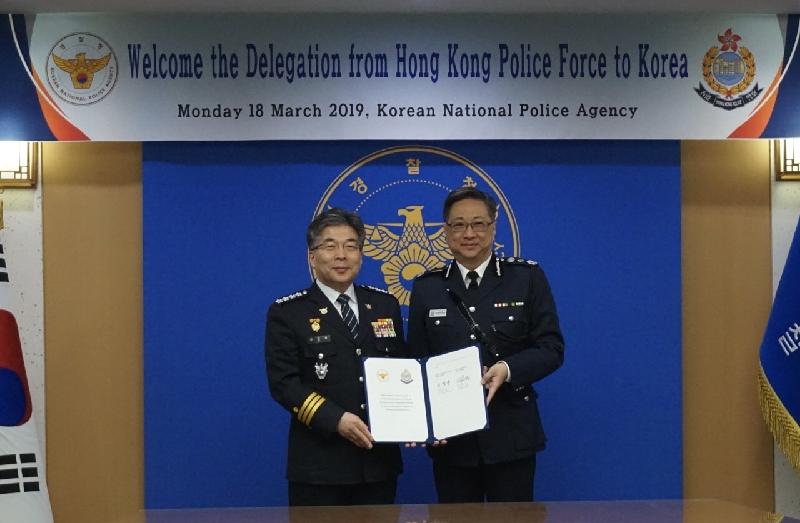
CP visits Korean National Police Agency (with photo)

     The Commissioner of Police, Mr Lo Wai-chung, led a five-member delegation to visit the Korean National Police Agency (KNPA) on March 17.  

     As a highlight of the visit, Mr Lo, on behalf of the Hong Kong Police, signed a renewed Memorandum of Understanding (MOU) on combating international crime with the Commissioner General of KNPA, Mr Min Gab-ryong. The renewed memorandum is a testament to the continuation of strengthening collaboration and partnership between the two organisations.

     The delegation also visited the Seoul Metropolitan Police Agency, Korean National Police University and the Korea Internet & Security Agency, where the delegates discussed strategies on enhancing policing using digital technologies and combating cybercrimes.

     The delegation returned to Hong Kong today (March 20).

Photo  


LCQ15: Grade structure review for disciplined services grades

     Following is a question by the Hon Mrs Regina Ip and a written reply by the Secretary for the Civil Service, Mr Joshua Law, in the Legislative Council today (March 20):

Question:

     Some trade unions of the disciplined services have relayed to me that as compared with civilian staff, disciplined services staff are required to have better physical fitness, have a higher sense of discipline and work shifts more frequently, while the work of disciplined services is more dangerous than that of civilian staff. However, the current remuneration packages for disciplined services staff have not sufficiently reflected such factors. For instance, the maximum pay point for Customs Officers is lower than that for Assistant Clerical Officers, whose entry requirement on academic qualifications is similar. Moreover, the pay difference between successive pay points in the pay scale for the former is smaller than that for the latter. Given that the Government is conducting a grade structure review for the disciplined services grades, will the Government inform this Council whether the review includes examining the raising of the pay levels for disciplined services staff (particularly for the rank and file), and widening the pay difference between successive pay points in their pay scales; if so, of the details; if not, the reasons for that?

Reply:

President,

     The civil service pay policy is to offer sufficient remuneration to attract, retain and motivate staff of a suitable calibre to provide the public with an effective and efficient service; and to maintain broad comparability between civil service pay and private sector pay. To implement this policy, the Government devised the "Improved Civil Service Pay Adjustment Mechanism" in 2007, under which civil service pay is compared with private sector pay through regularly conducted pay surveys. Nevertheless, as it is not possible to find comparable posts and jobs in the private sector for the disciplined services, and individual disciplined services grades are also facing recruitment or retention difficulties, the Chief Executive-in-Council therefore decided in October last year to conduct a grade structure review (GSR) for the disciplined services, and once every 10 years in future, to ensure that the grade structure and remuneration of the disciplined services are effective in attracting and retaining talents.

     The Standing Committee on Disciplined Services Salaries and Conditions of Service (SCDS) has accepted the Government's invitation to conduct a GSR for the disciplined services grades. At the same time, the Standing Committee on Directorate Salaries and Conditions of Service (SDCS) has also agreed to advise on the salaries and conditions of service of the heads of the disciplined services. The two advisory bodies will conduct the review independently to consider the appropriate pay scales for each of the grades and ranks and the grade structure of each disciplined services, etc. The two advisory bodies will also consider the work nature, job duties and workload of the disciplined services; changes in public expectation towards the disciplined services; the recruitment and retention situation of the disciplined services; and other factors involving wider community interests (e.g. financial consideration). The SCDS and SDCS have commenced work, including meeting the management and the staff side representatives of the disciplined services and inviting them to submit proposals. If the staff side have any suggestions or views on, among other things, the pay of individual grades or the differences between pay points of the pay scales, they may raise them with the SCDS and the SDCS. In the course of the review, the two advisory bodies will maintain communication with the management and the staff side of the disciplined services. They will thoroughly consider proposals submitted by the management and the staff side and listen to stakeholders' views. It is expected that the review will take around 18 months for completion by around mid-2020.


LCQ19: Wastage of the Administrative Officer and Executive Officer grades staff

     Following is a question by the Hon Lam Cheuk-ting and a written reply by the Secretary for the Civil Service, Mr Joshua Law, in the Legislative Council today (March 20):

Question:

     Regarding the wastage of the Administrative Officer (AO) and Executive Officer (EO) grades staff, will the Government inform this Council:

(1) of the wastage of (a) directorate and (b) non-directorate officers in the two grades in the past three financial years, with a breakdown by reason for departure (i.e. retirement and other reasons) (set out in the table below); and
 

  AO grade EO grade
Financial Year Retirement Other reasons Total Retirement Other reasons Total
(a) (b) (a) (b) (a) (b) (a) (b) (a) (b) (a) (b)
2015-2016                        
2016-2017                        
2017-2018                        

(2) of the measures in place to reduce the wastage of staff in the two grades?

Reply:

President,

     My consolidated reply to the two parts of the question is as follows:

     The number of (a) directorate and (b) non-directorate officers in the Administrative Officer (AO) grade and Executive Officer (EO) grade who left the service from 2015/16 to 2017/18 financial year is tabulated below:
 

  AO grade EO grade
Financial Year Retirement Other reasons Total Retirement Other reasons Total
(a) (b) (a) (b) (a) (b) (a) (b) (a) (b) (a) (b)
2015-2016 8 1 2 7 10 8 9 24 1 39 10 63
2016-2017 14 1 3 6 17 7 7 36 0 55 7 91
2017-2018 6 0 4 5 10 5 11 26 1 73 12 99

     The wastage rate of the AO grade in the three aforementioned financial years was 2.9%, 3.8% and 2.3% respectively, and that of the EO grade was 2.4%, 3.0% and 3.4% respectively. The wastage rate of both grades during the same period was lower than that of the civil service as a whole, which was 4.7%, 4.7% and 5.1% respectively. Besides reaching retirement age, other reasons for leaving the service included resignation, completion of agreement and death. The major reasons for resignation included marriage or family reasons, taking up jobs in outside bodies and pursuing further studies etc.
 
     The Civil Service Bureau will continue to pay attention to the vacancy situation of the AO and EO grades across all ranks, and will carry out recruitment and promotion exercises timely. We will also continue to maintain close communication with officers of the two grades, and will understand their work through different channels and provide suitable assistance.