Hong Kong Customs seizes suspected cannabis buds (with photo)

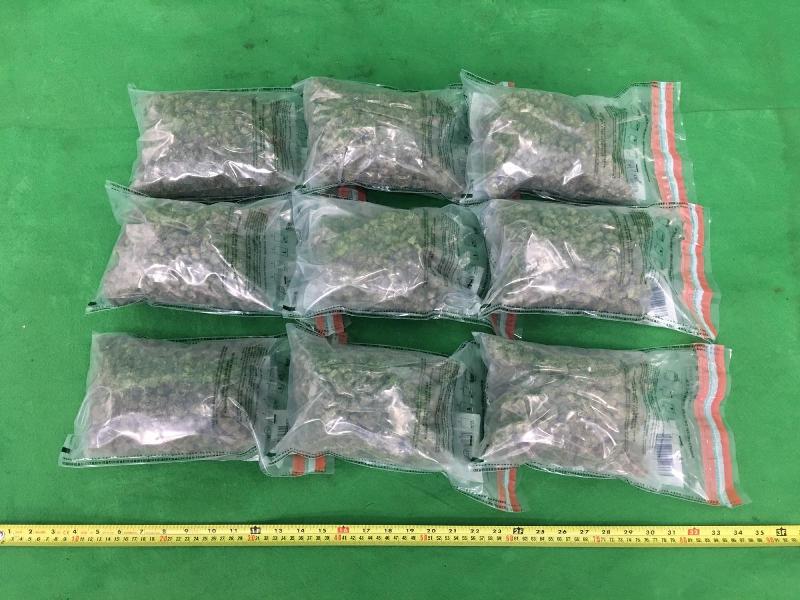
     â€‹Hong Kong Customs seized about 2 kilograms of suspected cannabis buds with an estimated market value of about $510,000 at Hong Kong International Airport on March 18. 

     Customs officers inspected a parcel arriving in Hong Kong from Canada on March 18 and seized the batch of suspected cannabis buds inside the parcel. 

     After follow-up investigation, Customs officers yesterday (March 26) arrested a 28-year-old man suspected to be connected to the case in Sheung Shui. 

     Investigation is ongoing and the arrested man has been released on bail pending further investigation.

     Customs will maintain close contact with Hong Kong Post and the logistics industries to step up action against drug trafficking through postal parcel or express courier channels.

     Under the Dangerous Drugs Ordinance, trafficking in a dangerous drug is a serious offence. The maximum penalty upon conviction is a fine of $5 million and life imprisonment.

     Customs also issued a reminder that cannabis and tetrahydro-cannabinol (THC) are classified as dangerous drugs under the Ordinance. Importation of products (including food and drinks) containing cannabis or THC into Hong Kong is prohibited unless the relevant provisions in the Ordinance are complied with. In order to avoid breaching the law inadvertently, special attention should be paid to the packaging labels of food and drinks.

     Members of the public may report any suspected drug trafficking activities to Customs' 24-hour hotline 2545 6182 or its dedicated crime-reporting email account (crimereport@customs.gov.hk).

Photo  


LCQ8: New delivery arrangement for mail items

     Following is a question by the Hon Lau Kwok-fan and a written reply by the Secretary for Commerce and Economic Development, Mr Edward Yau, in the Legislative Council today (March 27):
 
Question:
 
     It has been reported that the Hongkong Post (HKP) has recently implemented a new measure: when postmen make door delivery of mail items requiring signature by recipients (such as registered, Speedpost and Local CourierPost letters/packets), or when post office counter staff deliver mail items requiring signature to persons holding mail delivery notification cards, they are no longer required to request the recipients of these mail items to produce identity documents for identity verification.  In this connection, will the Government inform this Council:
 
(1)  whether HKP had consulted the public before implementing the new measure; if so, of the outcome; if not, the reasons for that;
 
(2)  whether HKP has so far received any complaint lodged by members of the public concerning the new measure; if so, of the details;
 
(3)  as some members of the public have pointed out that mail items requiring signature, the charges for which are higher than those for surface mail items, originally have an important advantage of ensuring that the recipients are either the designated recipients of mail items or persons whose identities are traceable, whether HKP has assessed if the new measure has rendered mail items requiring signature losing this advantage and thus made such items no different from surface mail items; if HKP has assessed and the outcome is in the affirmative, of the remedial measures; if the assessment outcome is in the negative, the justifications for that; and
 
(4)  as some members of the public have pointed out that people post mail items requiring signature for the purpose of preventing recipients, after receiving such mail items, from denying receipt of them, but under the new measure, when the designated recipients of mail items requiring signature claim that they have never received the items, HKP can hardly verify such claims as there is no way to confirm the identities of the recipients of the items, thus defeating the purpose of posting such items, whether HKP has any solution?

Reply:
 
President,
 
     With regard to the question raised by the Hon Lau Kwok-fan, our reply is as follows:
 
     It is the established principle of various postal administrations and courier sector that mail items are delivered according to the address (i.e. delivery to the address) but not to the designated addressee as given on the mail item (i.e. delivery to the addressee).  This is also the practice adopted by Hongkong Post.  Under this principle, mail delivery is mainly classified into two categories, namely, "signature for the receipt not required" and "signature for the receipt required".
 
     For a mail item where signature for the receipt is not required, delivery is deemed successful when such an item is delivered to the address (such as in the case of putting the mail item into the letter box of its corresponding address).  For a mail item where signature for the receipt is required (including registered mail, Speedpost item, parcel and Local CourierPost item, etc.), delivery is deemed successful only when such an item is delivered to the address and signature for the receipt is obtained from the recipient who does not necessarily have to be the addressee.
 
     In the past, for a mail item where signature for the receipt was required, Hongkong Post would require the person who received the item at the address at the time of delivery to produce his/her identification document if it could not be ascertained whether such person was entitled to receiving it.  The name of the recipient and the first four alphanumeric characters of his/her identification document would be recorded.  In case of unsuccessful door delivery (such as no one was present to receive the item), a notification card would be left at the address concerned or in its letter box, notifying the addressee to collect the item from a designated post office.  At the time of collection, the card holder would be required to produce his/her identification document, so as to prove that he/she is the addressee of the mail item.  If the card holder was not the addressee of the item, he/she would be required to produce a copy of the identification document of the addressee and the original identification document of his/her own.  If the identification document of the addressee or the card holder did not show the name as given on the mail item, he/she would be required to provide supporting documents to show that the addressee was living with the card holder or to prove their relationship (such as certificate of marriage, residential proof showing that the card holder lived at the delivery address, etc).  Staff at the post office would examine the above documents and record the name of the card holder and the first four alphanumeric characters of his/her identification document when the mail item was delivered.
 
     With the rapid development of e-commerce, the number of online purchases delivered through the postal system has been increasing.  Some of the online shopping platforms allow online shoppers to post their orders without using their real names.  Hongkong Post received quite a number of complaints directly from members of the public or referred by the Office of the Ombudsman, questioning the reason for requiring the person receiving or collecting the mail item to produce his/her identification document or other information, adding that it would be difficult for some of them to produce proof of address (such as housewives and minors who would not be holders of household accounts).  It was considered that the above measures had caused great nuisances to the public and failed to keep up with social development.
 
     Hongkong Post conducted a review in this connection, and considered that its past practice had deviated from the principle of "delivery to the address" and would be easily mistaken that mail delivery service was based on a principle of "delivery to the addressee".  The past experience also showed that information about the names and the first four alphanumeric characters of the identification documents of the recipients collected at time of delivering the mail item did not help much in tracking down the missing mail items.  As such, Hongkong Post has since March 4 made the following adjustments to the delivery arrangement for mail items where signature for the receipt is required:
 
(a) if someone is present at the delivery address, he/she is allowed to receive the mail item and sign to acknowledge its receipt, without the need to produce his/her identification document or his/her information be recorded; and
 
(b) if no one is present at the delivery address to receive the mail item, the postman will leave a notification card at the address or in its letter box.  At the time of collecting the item and signing to acknowledge its receipt, the card holder will not be required to produce his/her identification document, or proof showing that he/she is living with the addressee or his/her relationship with the addressee.  The post office will file the notification card and the process will be taped by the closed-circuit television at the counter as in the normal circumstances.
 
     The new delivery arrangement above has been operating smoothly since its implementation.
 
     According to Hongkong Post, there are enquiries and complaints concerning the new delivery arrangements (a total of 15 as at March 13).  The main concern is whether it is safe to deliver mail items which require signature for the receipt without checking the identification documents (e.g., a person would be able to collect another's mail item if the notification card is stolen), and that it would be difficult to track an item in the event of a dispute over its delivery.
 
     Hongkong Post understands the worries of individual members of the public and notes that letter boxes of tenement buildings in some old districts and the rural areas are less secure.  Starting from March 20, Hongkong Post has fine-tuned the new arrangements.  When door delivery of a mail item which requires signature for the receipt is unsuccessful and a notification card is to be issued, the card holder when making collection from the designated post office will be required to produce his/her identification document and his/her name will be recorded before signing to acknowledge its receipt.
 
     Hongkong Post will continue to monitor the operation of the new arrangements, and from time to time assess the impact of the arrangements and adjust the operational details taking into account the factors of social changes, public needs and mail security.  Hongkong Post will also continue to promote the correct way of writing addresses; remind senders to provide return addresses and affix sufficient postage, and the need for households or commercial tenants to install secure and proper letterboxes etc., in order to facilitate safe and smooth delivery of mails.


LCQ13: Trading of animal fur products

     Following is a question by the Hon Claudia Mo and a written reply by the Secretary for Commerce and Economic Development, Mr Edward Yau, in the Legislative Council today (March 27):
  
Question:
 
     At present, Hong Kong is the world's third largest fur clothing exporter, and one of the world's major sources of fur garments and accessories. Some animal welfare concern groups are concerned that Hong Kong's fur industry is contributing to the inhumane killing of some one billion rabbits and 50 million other animals in fur farms and in the wild each year for the worldwide fur trade. In this connection, will the Government inform this Council:
 
(1) given that the Mainland is Hong Kong's largest export market of furskins (of which a large proportion are re-exports from overseas countries for fur clothing production on the Mainland) and some concern groups are worried about Mainland’s ineffective regulation of her fur industry, whether the Government will consider discussing with the Mainland authorities the removal of leather and furskin articles from the list of tariff-free types of products under phase three of the Mainland and Hong Kong Closer Economic Partnership Arrangement, as Hong Kong's first step towards a ban on fur trade; if so, of the details; if not, the reasons for that; 

(2) as it is learnt that there is currently little or no regulation of fur trade on the Mainland, which is the world's largest fur importer, whether the Government will consider banning fur trade with the Mainland until her fur trade regulations have been tightened to a level on a par with those of the European Union; if so, of the details; if not, the reasons for that; and 

(3) as there is now an international trend of tightened regulation of or imposition of a ban on fur trade and fur farming (e.g. San Francisco has banned fur trade and Japan has phased out fur farming), and many international fashion brands have implemented fur-free policies for fashion design, whether the Government will consider introducing a ban on the import, export and re-export of fur products; if so, of the details; if not, the reasons for that? 

Reply
 
President,
 
     Hong Kong is a free port. We pursue a free trade policy and do not maintain barriers on trade. No tariff is charged on import or export of goods. Nonetheless, certain goods are subject to import/export control in Hong Kong under certain specified circumstances, for example, to fulfill obligations undertaken by Hong Kong to trading partners or international conventions, or out of public health, safety or internal security considerations, etc. Examples of goods that are subject to import/export control are live food poultry, game and prohibited meat, endangered animals and plants species, Chinese herbal medicines and proprietary Chinese medicines, plants, plant pests and soil, as well as controlled chemicals, etc. Also, the United Nations from time to time passes resolutions to impose sanctions on certain countries, and Hong Kong will impose restrictions on concerned trade and other activities according to the sanctions.
 
     In consultation with the Food and Health Bureau (FHB), the Environment Bureau (ENB) and the Trade and Industry Department, our reply to the various parts of the question is as follows:
 
     According to ENB, to ensure that international trade in specimens of wild animals and plants does not threaten their survival, the Convention on International Trade in Endangered Species of Wild Fauna and Flora (CITES) was signed by governments of a number of countries in 1973 to regulate the import and export of endangered animals and plants through a licensing system, so as to protect wild animals and plants from being affected by international trade, and to ensure their sustainable use. At present, there are 183 Parties to the Convention, and Hong Kong has implemented the requirements of CITES since 1976. CITES requires that the import, introduction from the sea, export or re-export of the species listed in its three Appendices be subject to licensing control. In accordance with the criteria and requirements of CITES, Hong Kong enacted the Protection of Endangered Species of Animals and Plants Ordinance (Cap. 586) (the Ordinance) to regulate the import, export and possession of endangered species. For animal species listed under CITES, their international trade including skin and fur trade is regulated under the Ordinance. The import, export, re-export and possession of the concerned endangered species, including their skin and fur, are regulated under a licensing system and the specimens must be inspected by an authorised officer at the time of entering or leaving Hong Kong.
 
     According to FHB's understanding, there is no animal fur farming in Hong Kong and there is also no internationally harmonised control on the import and export of fur products of non-endangered animals. Currently, the Government has no plan to ban the import and export of the trading of animal fur products by legislative means. Nevertheless, FHB will closely monitor the international trend and the related developments.
 
     As regards the Mainland and Hong Kong Closer Economic Partnership Arrangement (CEPA), it is a free trade agreement consistent with the provisions of the World Trade Organization. In 2018, exports of furskin products of Hong Kong origin under zero tariff preference of CEPA to the Mainland accounted for only less than 0.01 per cent of the total exports of those products from Hong Kong to the Mainland.


LCQ20: Measures to cope with the demand for public hospital services

     Following is a question by the Hon Holden Chow and a written reply by the Secretary for Food and Health, Professor Sophia Chan, in the Legislative Council today (March 27):
 
Question:
 
     It has been reported that the various public hospitals have experienced an overflow of patients in recent years (particularly during the winter surge of influenza), resulting in deterioration in the quality of healthcare services and healthcare workers being overstretched. In this connection, will the Government inform this Council:
 
(1) as the Government announced in January of last year and this year respectively that an additional allocation of $500 million would be made to the Hospital Authority (HA) for coping with the winter surge of influenza, whether it knows the respective uses of those two allocations, including the numbers of doctors, nurses, clerical and supporting staff members employed, with a breakdown by whether they are/were full-time, part-time or temporary employees;
 
(2) whether it knows the number of additional doctors, nurses, clerical and supporting staff members that HA plans to recruit in the next financial year (with a breakdown by name of the public hospital to which they will be posted); and
 
(3) whether it knows if HA has put in place new measures to (i) alleviate the work pressure on healthcare workers (such as streamlining administrative procedure) and (ii) improve their working environment; if HA has, the details; if not, the reasons for that?
 
Reply:
 
President,
 
     My reply to the various parts of the question raised by the Hon Holden Chow is as follows:
 
(1) To meet the service demand during the winter surge in 2017-18, the Hospital Authority (HA) put in place a response plan which included the following measures:
 
1. opening time-limited beds;
 
2. enhancing virology services to facilitate and expedite patient management decision;
 
3. enhancing ward rounds of senior clinicians and related supporting services in the evenings, at weekends and on public holidays so as to facilitate early discharge of patients;
 
4. enhancing discharge support (e.g. non-emergency ambulance transfer service, pharmacy and portering service);
 
5. increasing the service quotas of general out-patient clinics; and
 
6. enhancing geriatrics support to Accident and Emergency departments.
 
     In response to the upsurge in service demand, the Government announced in January 2018 an additional one-off allocation of $500 million for the HA to implement the response plan for winter surge and various additional measures to alleviate manpower shortage. The measures are as follows:
 
1. extending the use of the Special Honorarium Scheme (SHS) to provide extra manpower of clerical and supporting staff so that the healthcare staff could focus more on clinical work;
 
2. further relaxing and streamlining the approval for the SHS arrangement to a minimum operation need of one hour and to cover all grades of staff to meet the increasing need for greater flexibility in the use of SHS under exceptional circumstances;
 
3. providing SHS at Advanced Practice Nurse level to work on night-shift duties at both acute general, and convalescent and rehabilitation wards/services to enhance senior coverage and supervision to ward staff;
 
4. relaxing the criteria for the implementation of the Continuous Night Shift Scheme (CNSS) by suspending the required night shift frequency for triggering the CNSS so as to increase flexibility in manpower deployment; and
 
5. increasing the rate of the SHS allowance by 10 per cent under a special one-off arrangement to encourage more staff to work during the surge period with anticipated significant increase in workload.
 
     The overall expenditure for implementing the response plan and additional measures was $649 million, including fully utilising the additional $500 million allocated by the Government and a sum of $149 million coming from the HA's revenue reserve. The expenditures involved in meeting service demand during the winter surge in 2017‑18 by HA clusters are set out in the Annex.
 
     Besides, in 2017-18, the numbers of doctors, nurses and allied health professionals of the HA increased by 75 (1.3 per cent), 1 131 (4.5per cent) and 243 (3.2 per cent) respectively over 2016-17 (calculated on full-time equivalent basis including permanent, contract and temporary staff).
 
     To meet the service demand during the winter surge in 2018-19, the HA is implementing the same measures as taken under the response plan for the 2017-18 winter surge. The HA has also set up the Locum Office, so as to further increase its manpower through adopting a more flexible and efficient approach in recruitment. The SHS has been relaxed to a minimum operation need of one hour in order to encourage more staff to participate. Several additional measures implemented in 2017-18 have also been regularised to alleviate manpower shortage. The measures include:
 
1. extending the use of SHS to provide extra manpower of clerical and supporting staff so that the healthcare staff could focus more on clinical work;
 
2. providing SHS at Advanced Practice Nurse level to work on night-shift duties at both acute general, and convalescent and rehabilitation wards/services to enhance senior coverage and supervision to ward staff; and
 
3. relaxing the criteria for implementing the CNSS by suspending the required night shift frequency for triggering the CNSS so as to increase the flexibility in manpower deployment.
 
     In response to the upsurge in service demand in January 2019, the Government announced in the same month that it had set aside $500 million for the HA to meet the additional expenditure in coping with the service demand during winter surge. The HA has implemented the following enhancement measures, which are in place from January 28 until April 30, 2019:
 
Enhancing Senior Coverage
——————————–
 
     The rates of the SHS allowance are offered based on the clinical ranks of staff, so as to encourage participation of senior doctors, nurses and allied health professionals in the SHS, in order to provide more senior healthcare manpower to cope with the increase in service demand.
 
Nursing Night Shift Support
———————————
 
1. further promoting and arranging more night shift SHS for Advanced Practice Nurses;
 
2. introducing night shift for temporary undergraduate nursing students;
 
3. arranging agency nurses runner support for night shift, e.g. escorting patients; and
 
4. promoting the relaxed CNSS to nurses and supporting staff.
 
Enhancement of SHS
————————–
 
1. increasing the rate of allowance by 10 per cent to encourage staff participation;
 
2. streamlining the approval process; and
 
3. increasing flexibility when approving for the use of SHS without setting rigid threshold for triggering SHS.
 
     The expenditure involved in implementing the above measures for the winter surge in 2018-19 will be available only after the completion of all the winter surge response measures.
 
     Besides, it is projected that the numbers of doctors, nurses and allied health professionals (calculated on full-time equivalent basis, including permanent, contract and temporary staff), in the HA for 2018-19 will be increased by 142 (2.4 per cent), 614 (2.4 per cent) and 255 (3.3 per cent) respectively as compared to 2017-18.
 
(2) In 2019-20, the HA plans to recruit about 520 doctors, 2 270 nurses and 700 allied health professionals. Besides, each cluster will continue to actively recruit clerical and supporting staff to meet the service demand in response to its operational needs and manpower situation.
 
(3) The HA Head Office has recently directed cluster and hospital management to reduce the number of meetings and postpone non-urgent meetings during winter surge period so that frontline staff could focus more on clinical work. At the same time, the HA will regularly review the number and efficiency of meetings, so as to ensure the smooth conduct of meetings and streamline meetings. The HA will continue to recruit additional ward Executive Assistants and supporting staff to assist frontline healthcare staff.
 
     The HA has been proactively implementing various human resources measures to retain professionals and alleviate the shortage of frontline healthcare staff. Key measures include:
 
Manpower of Doctors
————————-
 
1. Recruiting local medical graduates: The number of Resident Trainee posts has been increased to recruit and provide specialist training for all qualified local medical graduates;
 
2. Recruiting non-locally trained doctors under limited registration: The HA has resorted to recruitment of non-locally trained doctors under limited registration since 2011-12. Upon commencement of the Medical Registration (Amendment) Ordinance 2018, the validity period of limited registration has been extended to up to three years. Coupled with the extension of contract period to a maximum of three years since 2017, it is expected that more non-locally trained doctors will be recruited through limited registration;
 
3. Special Retired and Rehire Scheme (SRRS): Since 2015-16, the HA rehires suitable serving doctors upon their retirement at normal retirement age or completion of contract, so that they can continue to perform full-time clinical duties in public hospitals, thereby alleviating manpower situation and facilitating staff training and knowledge transfer;
 
4. Continuous recruitment of part-time doctors: The HA continues to recruit part-time doctors and introduce further flexibility in recruitment strategies, including the setting up of the Locum Office;
 
5. SHS: HA continues to implement the SHS as appropriate in order to address the issue of short-term manpower constraint and meet service demand;
 
6. Creating more promotion opportunities: A centrally co-ordinated additional Associate Consultant Promotion Mechanism has been launched since 2011-12 to recognise meritorious doctors who have served in the HA for five years or more after obtaining fellowship;
 
7. Enhancing training: more training courses and oversees training opportunities has been provided for doctors, and simulation training has also been enhanced to support professional development;
 
8. Flexible work arrangements: The HA is actively considering the introduction of more flexible options in work arrangements to retain experienced hands, such as providing special arrangement for existing full-time frontline professional staff who have temporary special needs and compassionate reasons, such as health or family reasons, to work fractionally for a fixed period of time and thereafter resume their full-time duties; and
 
9. Fixed Rate Honorarium (FRH) for Doctors: To give recognition to the contribution of doctors who are required to work consistently long hours by nature of their duties and to compensate for the overtime work they performed in order to maintain adequate medical service for patients, the HA grants a FRH to eligible doctors on a monthly basis. To boost staff morale, the HA has planned to further increase the rate of the FRH starting from April 2019 at the earliest.
 
Frontline Nursing Staff
—————————-
 
1. Reinstating the annual increment mechanism: To further boost staff morale and retain staff, the HA has reinstated the annual increment mechanism for all serving staff who joined the HA on or after June 15, 2002, as well as new recruits, with effect from April 1, 2018. The arrangement is expected to be applicable to about 17 000 eligible staff;
 
2. Continuous recruitment of full-time, part-time and agency nurses: Hospitals will continue to recruit full-time, part-time and agency nurses to enhance the flexibility in staff deployment, thereby easing the workload of frontline staff;
 
3. SRRS: The HA has implemented the SRRS since 2015-16 to rehire suitable healthcare professionals after their retirement, so as to retain professionals to provide training, impart knowledge and alleviate the manpower situation in the HA;
 
4. Enhancing promotion opportunities: In 2008-09, the HA created the post of Nurse Consultant to enhance the development prospects of the nursing profession, thereby improving the healthcare services of the HA. There are currently 113 Nurse Consultant posts. A total of 1 476 nurses were promoted in the past three years;
 
5. Providing more training opportunities: The Institute of Advanced Nursing Studies of the HA offers 26 nursing specialist training courses each year for nurses to continuously pursue further studies after graduation. The HA also provides subsidies for over 100 senior nurses to pursue further studies and training overseas each year;
 
6. Enhancing preceptorship support: Under the HA's preceptorship programme, experienced nurses are recruited through granting special allowance, offering part-time employment, etc. to serve as preceptors to provide guidance for newly recruited nurses in an actual clinical setting, thereby familiarising them with ward procedures and environment as well as alleviating the work pressure of other experienced nursing staff in coaching new nurses. The HA also provides simulation training for newly recruited nurses to enhance their first aid and emergency handling skills. In 2018-19, the HA recruited 70 additional Advanced Practice Nurses (on full-time equivalent basis) as part-time clinical preceptors to coach about 3 570 nurses in service for two years or less. It also plans to increase the number of preceptors in 2020-21;
 
7. Improving work environment: Since 2013-14, the HA has installed some 6 000 additional electrically-operated beds and some 523 ceiling hoist systems to facilitate the lifting and transfer of patients; in 2018-19, the HA will procure some 2 000 electrically-operated beds to help simplify the work procedures required of ward staff, and improve the work environment and facilities, thereby relieving the work pressure on frontline nurses; and
       
8. Recruiting additional ward clerks and ward assistants: The HA recruits additional ward clerks and ward assistants to assist nurses in carrying out clerical work and providing patient care, thereby easing the workload of nurses.
 
Allied Health Professionals
——————————–
 
1. Reinstating the annual increment mechanism: To further boost staff morale and retain staff, the HA has reinstated the annual increment mechanism for all serving staff who joined the HA on or after June 15, 2002, as well as new recruits, with effect from April 1, 2018. The arrangement is expected to be applicable for about 17 000 eligible staff;
 
2. SRRS: The HA has implemented the SRRS since 2015-16 to rehire suitable healthcare staff after their retirement, so as to retain professionals to provide training, impart knowledge and alleviate the manpower situation in the HA;
 
3. Enhancing training and development of allied health professionals: The Institute of Advanced Allied Health Studies of the HA offers 65 specialist training/enhancement courses each year to strengthen services and professional development. It also provides over 50 scholarship places for advanced allied health professionals to pursue further study and training overseas; and
 
4. Re-engineering work processes and recruiting more Patient Care Assistants.

     The HA will continue to monitor the manpower situation of healthcare staff and make appropriate arrangements as to manpower planning and deployment to meet service demand.


LCQ18: Regulation of the use of animals to solicit business

     Following is a question by the Hon Chan Hak-kan and a written reply by the Secretary for Food and Health, Professor Sophia Chan, in the Legislative Council today (March 27):
 
Question:
 
     Currently, quite a number of shops without a restaurant licence, restaurants and cafés keep animals on their premises for entertainment of customers with a view to soliciting business. Quite a number of members of the public have relayed to me that these animals are often kept under extremely unsatisfactory conditions, including not having enough rest time, being confined in a narrow activity space, and not being given inadequate food. In this connection, will the Government inform this Council:
 
(1) whether the Government received complaints in the past three years about animals being abused on the aforesaid premises; if so, of the details;
 
(2) whether the Government compiled statistics in the past three years on the number of such kind of premises; if so, of the details; if not, the reasons for that;
 
(3) whether (i) the use of animals by operators of restaurants to solicit business and (ii) the provision of food, which was prepared off-site (e.g. cup noodles, biscuits and packaged drinks), by operators of premises without a restaurant licence for customers' consumption on the premises are subject to regulation under the existing legislation; if so, of the details;
 
(4) whether the Government instituted prosecutions in the past three years against the operators of premises mentioned in (3) (ii) above for operating a restaurant without a licence; if so, of the details; if not, the reasons for that;
 
(5) whether the Government instituted, by invoking the Food Business Regulation (Cap 132X), prosecutions in the past three years against the relevant operators for the presence of animals in food premises; if so, of the details;
 
(6) whether the Government deployed officers to pose as patrons in the past three years to investigate if the operators or the customers of those premises had committed offences under the Prevention of Cruelty to Animals Ordinance (Cap 169); if so, of the details; if not, the reasons for that; and
 
(7) whether it will amend the legislation to strengthen the regulation of commercial acts of using animals to solicit business, so as to protect animal rights?
 
Reply:
 
President,
 
(1) In the past three years, the Agriculture, Fisheries and Conservation Department (AFCD) received one complaint concerning suspected acts of cruelty to rabbits kept by a café. The investigation did not find any acts of cruelty to animals involved.  However, the café concerned was prosecuted by the Food and Environmental Hygiene Department (FEHD) for operating food business without a licence.
 
(2) and (3) All licensed food premises have to meet the requirements of the Food Business Regulation (Cap 132X) (the Regulation) to prevent food contamination.  Animals can be a source of contamination of food and equipment as their bodies, hair and excreta may carry pathogens and parasites. To ensure food safety and environmental hygiene, section 5(3)(b) of the Regulation requires that no person shall suffer or permit the presence of live birds or animals in any food room (including a kitchen) of food premises.
 
     In addition, section 10B of the Regulation stipulates that no person shall bring any dog onto any food premises, and that no person engaged in any food business shall knowingly suffer or permit the presence of any dog on any food premises.  The only exception is where the dogs are serving as guide dogs for visually impaired persons (other than entering a food room, including a kitchen) or performing statutory duties (e.g. police dogs).
 
     Other than the requirements of section 10B of the Regulation, the existence of other animals in food premises is not a major licensing control, but a licensee must keep the food premises clean and in good repair and condition. Also, the Public Health and Municipal Services Ordinance (Cap 132) provides that any food intended to be sold for human consumption in Hong Kong must be fit for human consumption.  Hence, it is the responsibility of the licensee to ensure food safety and environmental hygiene of the food premises.
 
(4) According to section 31(1) (b) of the Regulation, a restaurant licence issued by FEHD is required for conducting any food business which involves the sale of meals or unbottled non-alcoholic drinks (other than Chinese herb tea) for consumption on the premises.
 
     FEHD instituted 1 711, 1 604 and 1 710 prosecutions against unlicensed food premises respectively in each of the past three years. It does not keep separate breakdown on the use of animals by these food premises for soliciting business.
 
(5) In the past three years, FEHD instituted one prosecution against the licensee of food premises for suffering or permitting animal(s) to enter the food room of the premises.
 
(6) Upon receiving complaints from members of the public against acts of animal cruelty, AFCD's officers will take appropriate follow-up and investigation after inspecting the premises suspected to have contravened the law.
 
(7) Having reviewed overseas legislation on animal welfare, and considered views of animal welfare organisations and other stakeholders, we plan to consult the public in mid-2019 on proposals to strengthen the protection of animal welfare. Our proposals would include exploring the introduction of a concept of positive duty of care on animal keepers, i.e. requiring animal keepers to take all necessary measures to protect the welfare of their animals, such as providing proper care and sufficient space for their animals, etc. Under these proposals, the "animal keepers" mentioned above include the persons in charge of the animal keeping premises. We will draw up legislative proposals after taking into account the views gathered from the public consultation. Yet, the Government has no plan to regulate the use of animal in soliciting business, unless it involves acts of cruelty to animals or failure to provide duty of care.