Hong Kong Customs seizes suspected heroin (with photo)

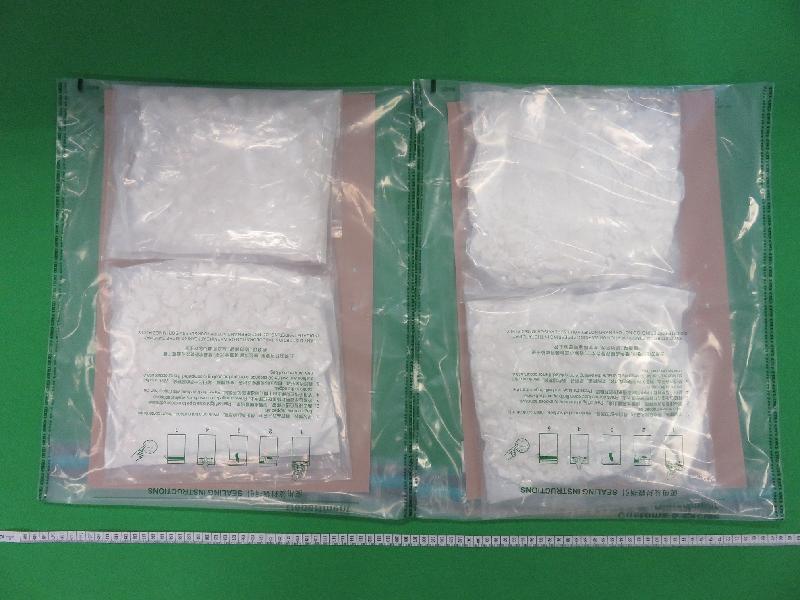
     â€‹Hong Kong Customs yesterday (April 28) seized about 1.3 kilograms of suspected heroin with an estimated market value of about $1,180,000 at Hong Kong-Macau Ferry Terminal.

     Customs officers conducted Customs clearance on an incoming male passenger at Hong Kong Macau-Ferry Terminal yesterday afternoon and found the suspected heroin inside a backpack carried by him. The suspected heroin was believed to be delivered to Hong Kong via Macau from Malaysia. The 25-year-old man was then arrested.

     Investigation is ongoing. 

     Under the Dangerous Drugs Ordinance, trafficking in a dangerous drug is a serious offence. The maximum penalty upon conviction is a fine of $5 million and life imprisonment.

     Members of the public may report any suspected drug trafficking activities to the Customs' 24-hour hotline 2545 6182 or its dedicated crime-reporting email account (crimereport@customs.gov.hk).

Photo  


Appeal for information on missing man in Sha Tin (with photo)

     Police today (April 29) appealed to the public for information on a man who went missing in Sha Tin.

     Kwan Chak-hung, aged 27, went missing after he left his residence on Chui Yan Street on April 27 afternoon. His family made a report to Police on the same day.

     He is about 1.7 metres tall, 50 kilograms in weight and of thin build. He has a pointed face with yellow complexion and short black hair. He was last seen wearing a pair of black-rimmed glasses, a grey long-sleeved jacket, black trousers, black sports shoes and carrying a black shoulder bag.

     Anyone who knows the whereabouts of the missing man or may have seen him is urged to contact the Regional Missing Person Unit of New Territories South on 3661 1176, 5613 6963 or email to rmpu-nts-2@police.gov.hk, or contact any police station.

Photo  


Employer fined for terminating employment of pregnant employee, non-payment of wages and defaulted payment of Labour Tribunal Award

     ASN Limited was prosecuted by the Labour Department (LD) for terminating the continuous contract of employment of a pregnant employee and failing to pay wages and other termination payments to two employees within seven days after the termination of their contracts of employment, as well as defaulting on the sums awarded by the Labour Tribunal (LT), as required by the Employment Ordinance (EO). The employer was fined $62,000 after pleading guilty at Eastern Magistrates' Courts today (April 29) and was ordered to pay outstanding sums of about $69,000 via the court to the two employees.

     "The ruling helps disseminate a strong message to all employers that they have to pay wages and other termination payments to employees within the time limit stipulated in the EO and the awarded sums according to the LT or Minor Employment Claims Adjudication Board and should not illegally terminate the contracts of employment of pregnant employees," an LD spokesman said.

     "The LD will not tolerate these offences and will continue to make dedicated efforts in enforcing the law and safeguarding employees' statutory rights," the spokesman added.


CHP investigates case of invasive meningococcal infection

     The Centre for Health Protection (CHP) of the Department of Health is today (April 29) investigating a case of invasive meningococcal infection, a communicable disease transmitted by direct contact with droplets from carriers or infected persons.
 
     The case involves an eight-year-old girl, with good past health, who had presented with fever since April 25. She was admitted to Pamela Youde Nethersole Eastern Hospital for treatment on the same day. Her blood specimen tested positive for Neisseria meningitidis upon laboratory testing. The clinical diagnosis was meningococcaemia. The patient is now in a stable condition.    
 
     Initial enquiries revealed that the patient had travelled to Guangxi during the incubation period. Her home contacts have remained asymptomatic so far. The CHP's investigation is continuing.
 
     "Meningococcal infection is caused by a bacterium known as meningococcus. It is mainly transmitted by direct contact through respiratory secretions, including droplets from the nose and throat, from infected persons. The incubation period varies from two to 10 days, and is commonly three or four days," a spokesman for the CHP said.
 
     The clinical picture may vary. Severe illness may result when the bacteria invade the bloodstream (meningococcaemia) or the membranes that envelop the brain and spinal cord (meningococcal meningitis).
 
     Meningococcaemia is characterised by sudden onset of fever, intense headache, purpura, shock and even death in severe cases. Meningococcal meningitis is characterised by high fever, severe headache and stiff neck followed by drowsiness, vomiting, fear of bright light, or a rash. It can cause brain damage or even death. The brain damage may lead to intellectual impairment, mental retardation, hearing loss and electrolyte imbalance. Invasive meningococcal infections can be complicated by arthritis, inflammation of the heart muscle, inflammation of the posterior chamber of the eye or chest infection.
 
     Meningococcal infection is a serious illness. Patients should be treated promptly with antibiotics.
 
     To prevent meningococcal infection, members of the public are advised to take heed of the following measures:
 

  • Wash hands with liquid soap and water properly, especially when they are dirtied by respiratory secretions, e.g. after sneezing, and clean hands with alcohol-based handrub when they are not visibly soiled;
  • Cover the nose and mouth while sneezing or coughing, hold the spit with a tissue, dispose of nasal and mouth discharges in a lidded rubbish bin, and wash hands immediately;
  • Avoid crowded places;
  • Avoid close contact with patients who have fever or severe headache;
  • Travellers to high-risk areas may consult doctors for meningococcal vaccination; and
  • Travellers returning from high-risk areas should seek medical advice if they become ill and should discuss their recent travel history with their doctor.

 
     The public may visit the CHP's website for more information on meningococcal infection.


Update on measles cases

     The Centre for Health Protection of the Department of Health (DH) said today (April 29) that no additional case of measles infection had been recorded as at 4pm today.
 
     Regarding measles control measures implemented at Hong Kong International Airport (HKIA), a total of 16 persons had received measles vaccination at the airport vaccination station as at 6pm today, bringing the cumulative number of vaccinations given to 8 320.
 
     From tomorrow (April 30) to May 17 (excluding Sundays and public holidays), measles vaccination will be provided to airport staff who:
 
(1) Were born in or after 1967, and have not received two doses of measles vaccination, and have not been infected with measles before; or
 
(2) Have laboratory evidence of testing not positive against measles antibody (IgG).
 
     The vaccination quota for the measles vaccination station at the airport remains at 600 doses daily. The venue and operation hours of the airport vaccination station are as follows:
 

Venue: Multi-function Room, HKIA Tower (Level 5, Terminal 2)
Hours: April 30 to May 17 (excluding Sundays and public holidays)
10am to 1pm
2pm to 6pm

 
     As for the blood test service, the DH will continue to provide the measles serology test service to about 200 airport staff who were born on or after 1967 on April 30 and May 2 and 7.
 
     The venue and operation hours of the airport blood test station are as follows:
 

Venue: South side before the Immigration Hall at Level 3 of Terminal 2 (non-restricted area)
Hours: April 30 and May 2 and 7
9am to 1pm

 
     A pilot service at the blood test station on the same designated dates and times to provide measles serology testing for a total of about 200 Filipino foreign domestic helpers who are coming to or returning to work in Hong Kong will also be carried out.
 
     A hotline (2125 1122) has been set up for public enquiries and operates during office hours from Mondays to Fridays. A total of 3 295 enquiries have been received so far.