CGO will be temporarily closed tomorrow

      Due to security considerations, the Central Government Offices (CGO), Tamar will be temporarily closed tomorrow (June 21) .

       Staff working in the CGO should not go to the workplace and should work in accordance with the contingency plans of their respective bureaux or departments. All visits to the CGO will be postponed or cancelled.


Coastal clean-up activities jointly performed by EPD and relevant authorities of Guangdong Province (with photos)

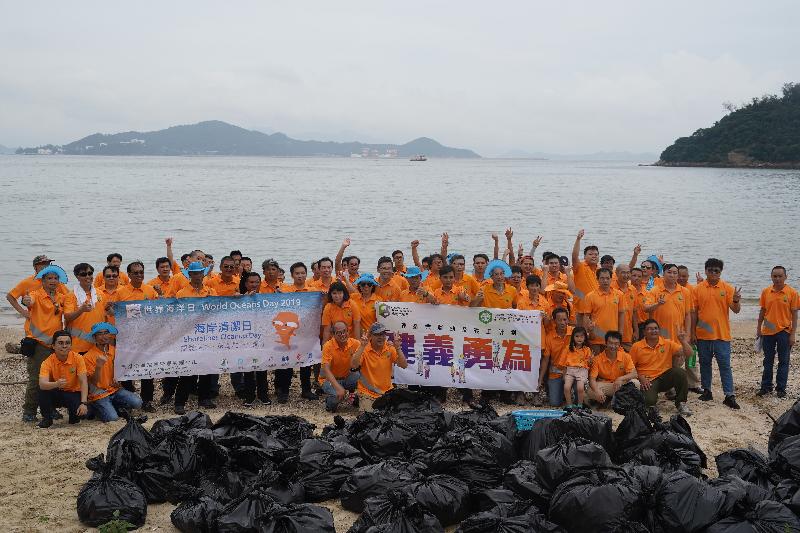
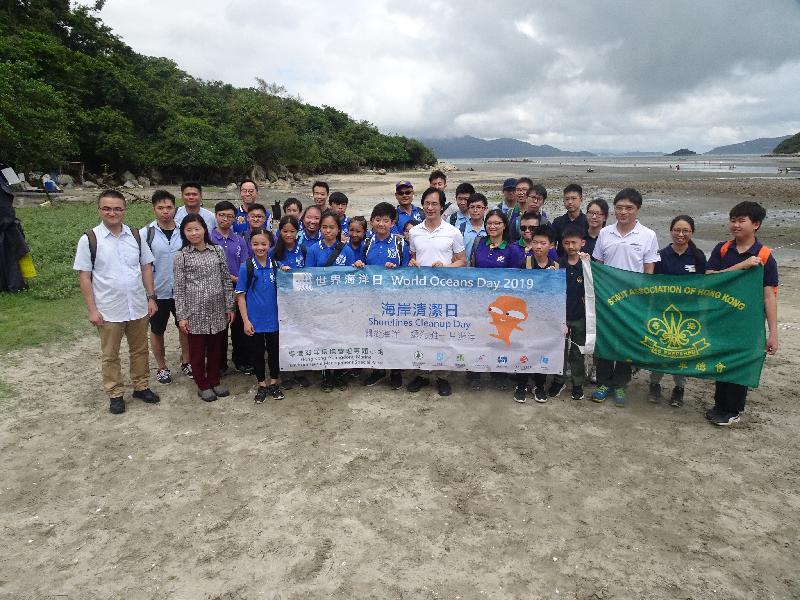
     A spokesman for the Environmental Protection Department (EPD) said today (June 20) that to celebrate World Oceans Day, the EPD had collaborated with the Department of Ecology and Environment of Guangdong Province (GDDEE) through the Hong Kong-Guangdong Marine Environmental Management Special Panel to organise coastal clean-up activities for the first time to jointly promote the messages of keeping our shorelines clean and protecting our ocean together.
 
     Representatives from government departments and volunteers of the two places organised a number of coastal clean-up activities during the period from May 25 to June 8 under the theme of "Care Our Ocean, Keep Our Beaches Clean". About 2 400 participants took part in the activities, which cleaned up over 20 kilometres of coast and collected 22 tonnes of refuse.
 
     The EPD together with volunteers from the Construction Industry Council and members of the Estate Agents Authority and the Scout Association of Hong Kong participated in beach clean-up activities at Shap Long, Chi Ma Wan and Shui Hau as well as Tai Long Wan, Lantau Island, in May and June. The GDDEE carried out various beach clean-up activities in 14 coastal cities at prefecture-level or above in June.
 
     This series of joint coastal clean-up activities was a major milestone marking a closer collaboration between government departments in the Guangdong-Hong Kong-Macao Greater Bay Area and a big step towards greater co-operation in marine environmental education. Through these activities, members of the public can understand more about the marine refuse problem, thereby instilling behavioural changes to reduce waste at source, protect the ocean and keep the beaches clean.

Photo  Photo  


Hong Kong Customs combats illicit cigarette activities (with photo)

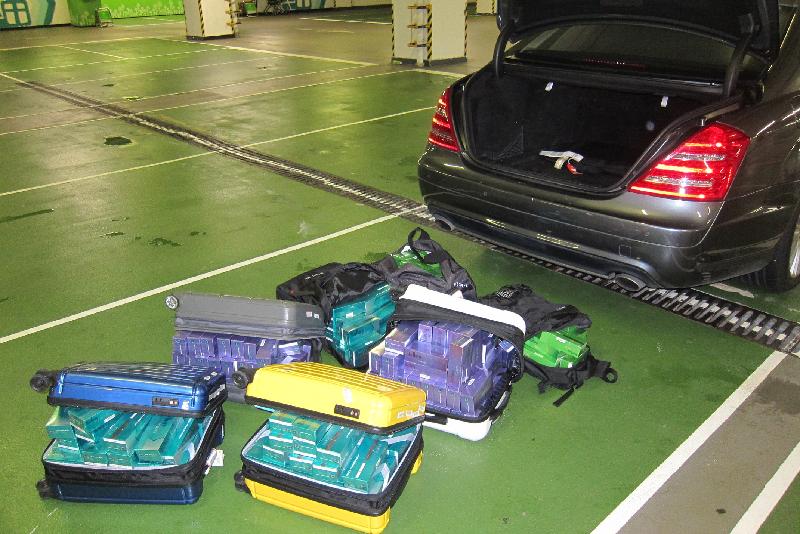
     Hong Kong Customs on June 18 and yesterday (June 19) seized about 250 000 suspected illicit heat-not-burn (HNB) products with an estimated market value of about $700,000 and a duty potential of about $500,000 at Hong Kong International Airport and in Sham Shui Po and Tai Kok Tsui.

     Customs officers detected three cases of suspected illicit cigarette storage and distribution and seized the batch of suspected illicit HNB products inside a hand-carry bag of an arriving male passenger at Hong Kong International Airport, a shop in Sham Shui Po and a private car in Tai Kok Tsui.

     During the operation, Customs officers arrested three men, aged between 31 and 57, and detained a cross-boundary private car suspected to be in connection with the case. Customs believes an HNB product smuggling syndicate was smashed.

     Investigation is ongoing.

     Customs is mounting a territory-wide anti-illicit cigarette operation codenamed "Net II" from June this year with a view to combating illicit cigarette activities on all fronts through a multi-pronged approach. The operation is ongoing.

     Customs reminds members of the public that smuggling is a serious offence. Under the Import and Export Ordinance, any person found guilty of importing or exporting unmanifested cargo is liable to a maximum fine of $2 million and imprisonment for seven years.

     Under the Dutiable Commodities Ordinance (DCO), tobacco is among the dutiable goods to which the DCO applies. Any HNB product containing tobacco in content is also a dutiable item subject to the control of the DCO. Any person who possesses, sells or buys dutiable commodities without a valid license commits an offence. The maximum penalty upon conviction is a fine of $1 million and imprisonment for two years.

     Members of the public may call Customs' hotline 2815 7711 regarding whether a specific tobacco or smoking product is under the regulation of the DCO. They may also report any suspected violation of the DCO to Customs' 24-hour hotline 2545 6182 or its dedicated crime-reporting email account (crimereport@customs.gov.hk).
Photo  


Missing man in Kwai Chung located

     A man who went missing in Kwai Chung has been located.

     Ma Ka-chi, aged 71, went missing after he left a hostel on Lai Chi Ling Road on June 18 noon. The staff of the hostel made a report to Police on the same day.

     The man was located in the Central District this afternoon (June 20). He sustained no injuries and no suspicious circumstances were detected.     


CHP investigates case of invasive meningococcal infection

     The Centre for Health Protection (CHP) of the Department of Health is today (June 20) investigating a case of invasive meningococcal infection, a communicable disease transmitted by direct contact with droplets from carriers or infected persons.
 
     The case involves a 41-year-old man, with good past health, who presented with fever, vomiting and headache since June 10. He attended the Accident and Emergency Department at Tuen Mun Hospital on June 16 and 17 and was subsequently admitted for further management on June 17. His blood sample tested positive for Neisseria meningitidis upon laboratory testing. The clinical diagnosis was meningococcal meningitis with bacteremia. The patient is now in a stable condition.    
 
     Initial enquiries revealed that the patient had visited Shenzhen during the incubation period. His three sons have developed fever recently and will be referred to hospital for further assessment. His other home contacts have remained asymptomatic so far. The CHP's investigation is continuing.
 
     "Meningococcal infection is caused by a bacterium known as meningococcus. It is mainly transmitted by direct contact through respiratory secretions, including droplets from the nose and throat, from infected persons. The incubation period varies from two to 10 days, and is commonly three or four days," a spokesman for the CHP said.
 
     The clinical picture may vary. Severe illness may result when the bacteria invade the bloodstream (meningococcaemia) or the membranes that envelop the brain and spinal cord (meningococcal meningitis).
 
     Meningococcaemia is characterised by sudden onset of fever, intense headache, purpura, shock and even death in severe cases. Meningococcal meningitis is characterised by high fever, severe headache and stiff neck followed by drowsiness, vomiting, fear of bright light, or a rash. It can cause brain damage or even death. The brain damage may lead to intellectual impairment, mental retardation, hearing loss and electrolyte imbalance. Invasive meningococcal infections can be complicated by arthritis, inflammation of the heart muscle, inflammation of the posterior chamber of the eye or chest infection.
 
     Meningococcal infection is a serious illness. Patients should be treated promptly with antibiotics.
 
     To prevent meningococcal infection, members of the public are advised to take heed of the following measures:
 

  • Wash hands with liquid soap and water properly, especially when they are dirtied by respiratory secretions, e.g. after sneezing, and clean hands with alcohol-based handrub when they are not visibly soiled;
  • Cover the nose and mouth while sneezing or coughing, hold the spit with a tissue, dispose of nasal and mouth discharges in a lidded rubbish bin, and wash hands immediately;
  • Avoid crowded places;
  • Avoid close contact with patients who have fever or severe headache;
  • Travellers to high-risk areas may consult doctors for meningococcal vaccination; and
  • Travellers returning from high-risk areas should seek medical advice if they become ill and should discuss their recent travel history with their doctor.

 
     The public may visit the CHP's website for more information on meningococcal infection.