A spokesman for the Drainage Services Department (DSD) said today (March 29) that the number of flooding blackspots in Hong Kong has reached the lowest on record. In order to further reduce flood risks during rainstorms, the DSD will introduce the "just-in-time clearance" arrangement during the coming rainy season and will proactively incorporate new technologies to enhance the effectiveness and efficiencies of construction and maintenance works.
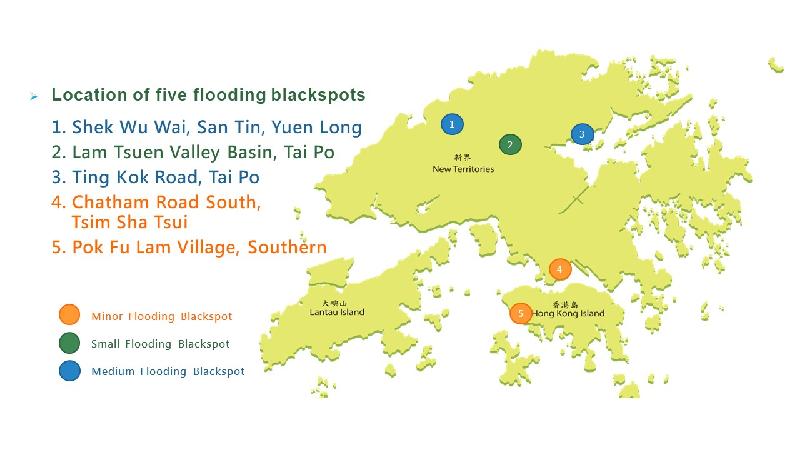
The spokesman said that the DSD has removed a total of 126 flooding blackspots over the past 26 years, including the one at the junction of Morrison Hill Road and Lap Tak Lane in Wan Chai this year. There are only five remaining flooding blackspots in Hong Kong, including Shek Wu Wai in San Tin, Yuen Long; Lam Tsuen Valley Basin and Ting Kok Road in Tai Po; Chatham Road South in Tsim Sha Tsui and Pok Fu Lam Village in Southern District. Among them, the drainage improvement works at Ting Kok Road have been completed, with its effectiveness having been monitored for several years. This flooding blackspot is expected to be removed after the coming rainy season.
"In order to further reduce the flood risks during rainstorms, we will introduce the 'just-in-time clearance' arrangement during daylight hours on week days in the upcoming rainy season. Before the onset of a rainstorm, staff will be deployed to inspect about 200 locations which are susceptible to blockage by litter, fallen leaves or the like, and will immediately arrange for clearance works if necessary. Furthermore, DSD staff will inspect and clear all main drains and rivers immediately after a rainstorm or when a typhoon signal is about to be lowered to prepare for the challenges of further rainstorms," the spokesman said.
Hong Kong faces an average rainfall of about 2 400 millimetres a year, one of the highest among cities in the Pacific Rim. Flooding is inevitable under extreme rainstorms. Notwithstanding this, the DSD has analysed over 200 flooding cases between 2017 and 2019, finding that over 60 per cent of them were due to blocked drains by litter, fallen leaves or other washouts carried by surface runoff. The "just-in-time clearance" arrangement is definitely an appropriate solution.
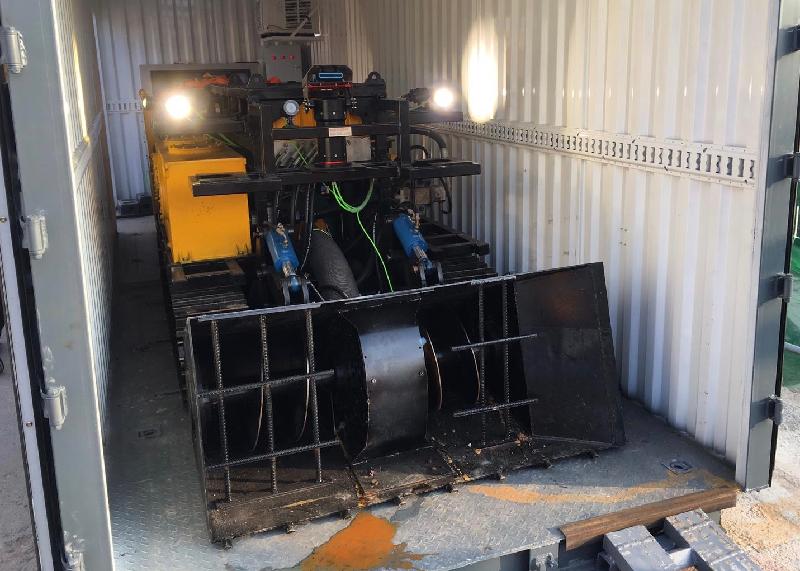
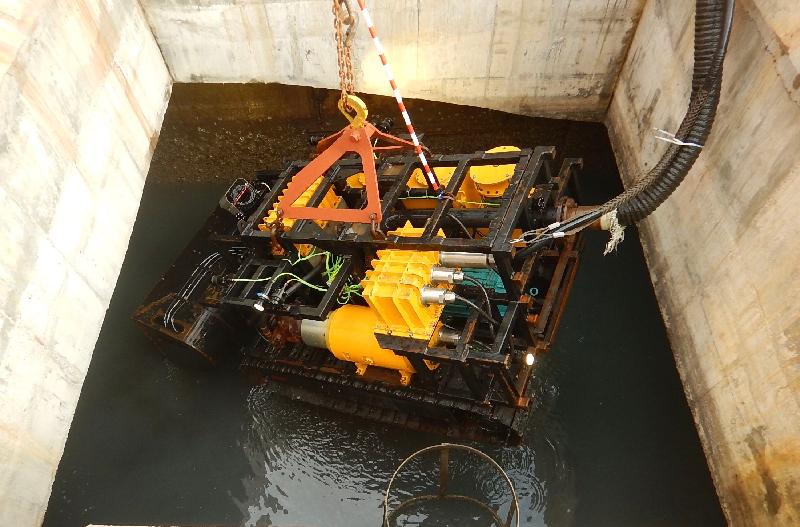
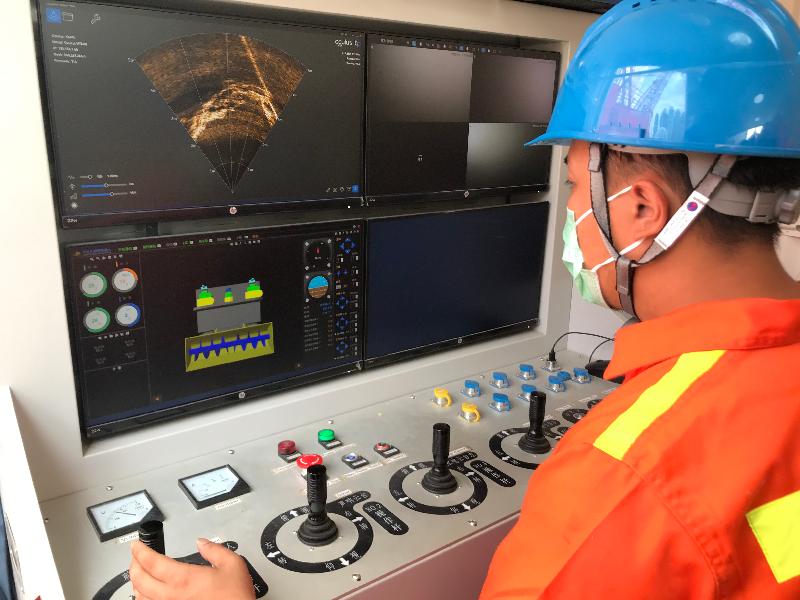
As high rainfall severely restricts the construction and maintenance of drainage facilities, thus affecting their capacities to cope with rainstorms, the DSD has been proactively incorporating new technologies. A new remote-controlled desilting robot has been procured for silt clearing works at submerged box culverts. The robot is able to go further inside submerged box culverts, and silt can also be transported to the ground surface through a tube connected to the robot, which largely improves the efficiency of the desilting works. Workers can be spared from entering the confined and submerged space of the culverts, and desilting works will no longer be limited mostly to dry seasons.
In order to increase construction efficiencies of new works projects, the DSD also incorporated the Design for Manufacture and Assembly (DfMA) concept, together with the Building Information Modelling technique, to design structural modules which could more easily be built and assembled amid the risks of inclement weather.
"The construction of a dry weather flow interceptor at the Cherry Street box culvert has adopted both DfMA and traditional cast in-situ methods. While structural modules are constructed off-site, part of the structures are cast in-situ. The construction period is therefore expected to be shortened by about six months," the spokesman added.
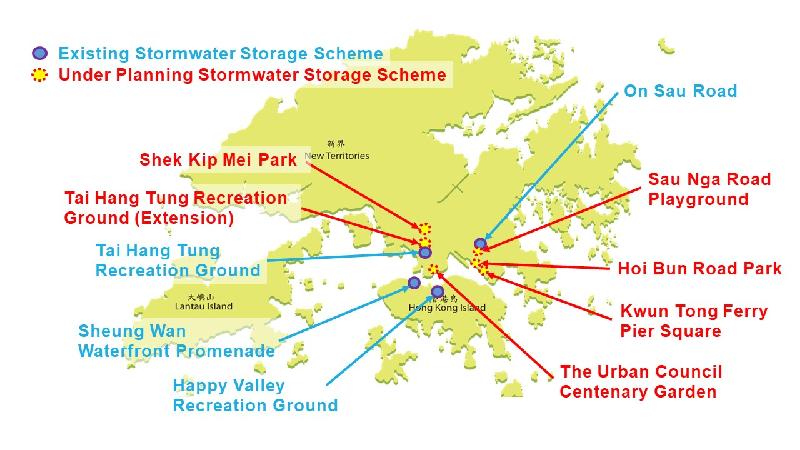
Apart from strengthening the responsive management measures before and after rainstorms, the DSD will continue to press ahead with its flood prevention strategy, which includes implementing underground stormwater storage schemes. Stormwater storage schemes aim to collect and temporarily store excessive rainwater during rainstorms, thus reducing the loading at downstream drains and the consequential flood risks. The four completed underground stormwater storage schemes in Tai Hang Tung, Sheung Wan, Happy Valley and On Sau Road have achieved remarkable results to prevent flooding in these areas. The DSD is collaborating with other departments to identify suitable public open spaces for construction of more underground stormwater storage schemes. So far, six locations are under planning, which include Shek Kip Mei Park, Tai Hang Tung Recreation Ground (extension), the Urban Council Centenary Garden in Tsim Sha Tsui, as well as Sau Nga Road Playground, Kwun Tong Ferry Pier Square and Hoi Bun Road Park in Kwun Tong District.